
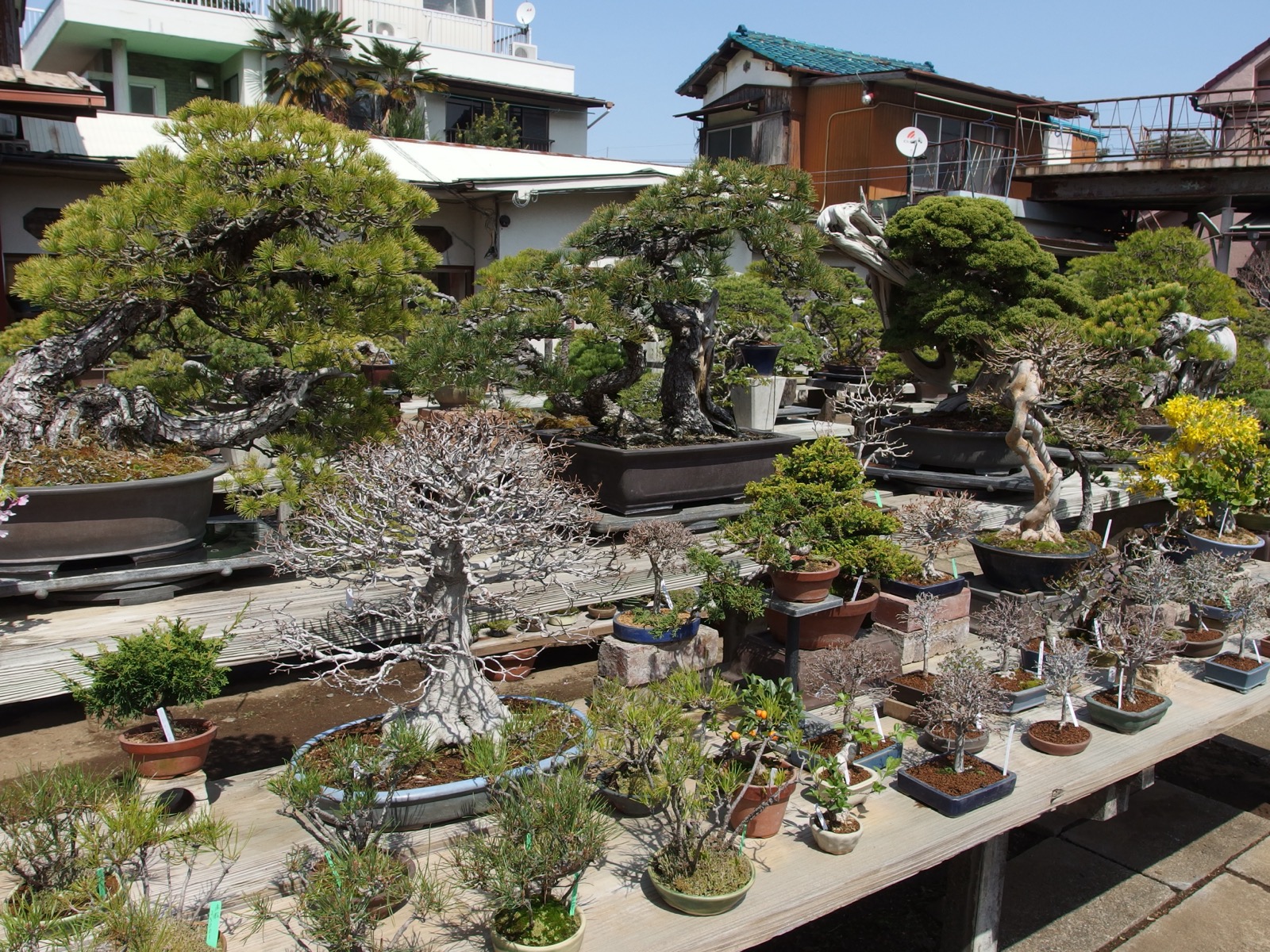
A working nursery bench in Omiya Bonsai Village, Saitama — the kind of ground some owners choose over a moving truck when a tree has to leave their care for a while. Photo by Guilhem Vellut, CC BY 2.0, via Wikimedia Commons — Source

Wire or zip-tie the pot to the bottom of its box so it cannot shift, pack soft material under every branch so nothing bends downward, and — if the calendar gives you any choice at all — make the move while the tree is dormant. Distance is what turns a house move from an afternoon's inconvenience into real risk for the tree, and past a certain distance, a fair number of owners choose not to move the tree at all.
Secure the pot first, then the branches
A bonsai's whole world sits in a pot a few centimeters deep, and that is exactly what makes it vulnerable in a moving truck: a box that shifts an inch can tip the tree, spill the soil, and tear roots that took years to train into their current shape. The standard fix is to anchor the root ball itself — soft wire threaded through the pot's drainage holes, crossed over the surface of the soil, and tightened just enough to hold it in place — and then anchor the pot to the floor of its box the same way, so a jolt in transit is absorbed by the box rather than the tree.
Branches need a different kind of protection. Wired branches, deadwood jin (神, "a stripped, weathered branch left bare as a design feature") and shari (舎利, "a stripped section of trunk"), and anything recently pruned are the most breakable points on the tree, and they break from below, not above — a branch resting on nothing but empty space in a box will sag and snap the moment something else in the truck presses against it. Padding needs to go in underneath each branch before anything is packed on top, filling the box until nothing can move when it is gently shaken. Soft packing material works better here than bubble wrap, which tends to catch and tear at foliage rather than cushion it.
Choose the dormant season if you have any say in it
If the move can be scheduled, late winter into early spring — before buds swell and new growth begins — is the gentlest window for handling a bonsai's roots and branches, for the same reason it is the standard season for repotting: a dormant tree is not sustaining a full canopy, so the physical stress of being lifted, boxed, and jostled has far less to work against, and any damage that does occur gets repaired quickly once the tree moves into active growth. A move made at the height of summer heat asks a tree to recover from handling stress and extreme temperature at the same time, which is a heavier combination than most trees need to carry in a single week.
Temperature is worth watching regardless of season. A closed vehicle can heat well past what open air suggests, and soil in a small pot can climb far above the surrounding air temperature in direct sun — a risk worth taking seriously above roughly 30°C (86°F), and again once conditions drop toward freezing. A tree that would be perfectly safe standing in a garden for an afternoon is not equally safe sealed inside a hot box for the same few hours.
Distance is the real variable
A move across town is inconvenience with very little biological cost. A move across a country, or across a continent, is a different proposition. A healthy bonsai in good packaging can generally tolerate several days in transit, but every extra day compounds the same stresses — reduced light, temperature swings, no fresh air, no one checking the soil — and a tree that would shrug off a short drive can arrive from a week-long haul visibly weakened, sometimes for a full growing season afterward. How often a bonsai needs water is a useful reminder of just how little reserve a small pot holds even sitting still; in transit, with no one able to check it, that margin only gets thinner. A move that also crosses a national border adds an entirely separate layer of plant-quarantine restrictions that has nothing to do with packing technique.
When the distance is too far, there's an older answer
For a short move, none of this amounts to more than careful packing and good timing — the same care that goes into a routine repotting is enough. But for a move that would put real days on the road, or for an owner relocating to a country where the tree could not be grown well at all, Japanese bonsai practice already has an answer that predates moving trucks entirely: leave the tree in someone else's care rather than move it. This is the same azukari (預かり, "to receive and hold something in trust") arrangement that lets an owner travel for a season without worrying who waters their tree — stretched, in this case, to cover a permanent change of address rather than a few weeks away.
The culture behind that word treats a tree's ownership and its daily care as two separate things that were never required to travel together. A long-term nursery arrangement simply makes that separation permanent: the tree stays where a trained artist can keep working it through every season, and the owner's connection to it continues without ever putting the tree itself inside a box. Azukari is built on exactly that idea — a tree keeps growing in Japan under a working artist's hand, its seasonal care recorded as it happens, so that a change of address never has to become a question about how the tree will survive the trip.
References
- Bonsai Trader — "How to Safely Ship a Bonsai Tree: Complete Guide" — on securing the root ball and pot with soft wire, padding branches from underneath, and safe seasonal temperature windows for transit.
- Bonsai4Me — "Heat and High Temperature Damage to Bonsai" — on optimum growing temperatures of roughly 20–30°C (70–85°F), the risks above 30°C/90°F, and soil surface temperatures in direct sun.
- Bonsai Empire — "Repotting Bonsai" — on why early spring dormancy, before full foliage returns, minimizes the stress of root and branch handling.
- Bonsai Tree Help — "What Time of Year Do You Repot Bonsai?" — on late winter to early spring dormancy reducing handling stress and allowing faster recovery before summer heat.