
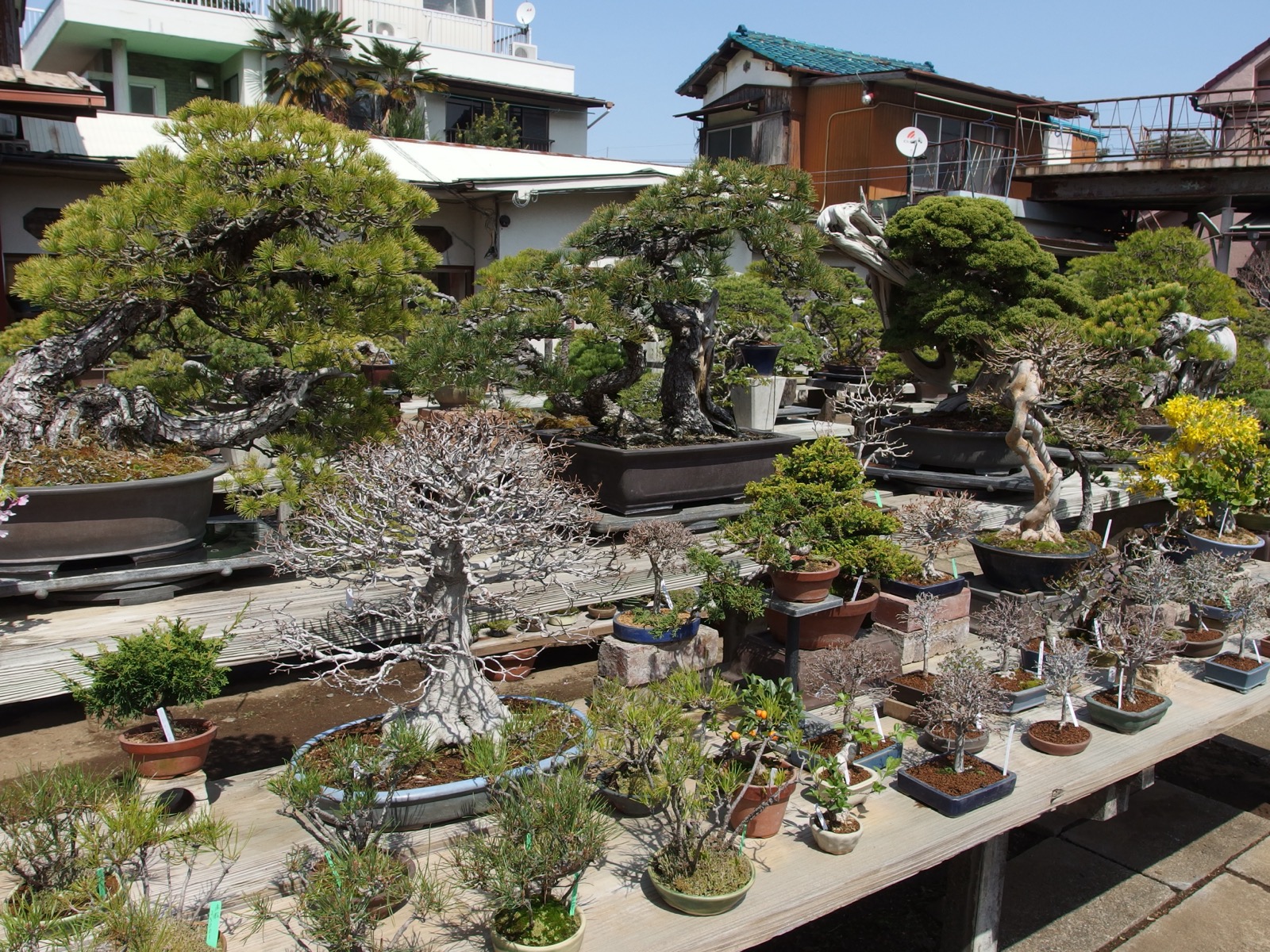
A working nursery bench in Omiya Bonsai Village, Saitama — the kind of ground where trees that belong to someone traveling are routinely kept and watered by someone else. Photo by Guilhem Vellut, CC BY 2.0, via Wikimedia Commons — Source

A timer-driven drip system can cover a long weekend, a well-briefed friend or family member can usually cover a week or two, and for anything longer — a month, a season, a year abroad — Japan's bonsai world has an older answer: leave the tree in someone else's care entirely. Which option fits depends less on how far you're going than on how long the tree will be left, since a bonsai's small pot holds only a few days of water reserve no matter the season.
A long weekend: let a timer do it
For an absence of a few days, the simplest fix is mechanical. A garden sprinkler or drip line run off a household tap, controlled by an inexpensive programmable timer, is the standard fix recommended across bonsai forums and reference sites — one grower reports keeping over 200 trees alive through a European heatwave on little more than a £30 timer, a hose, and a single sprinkler, by grouping every pot together out of direct sun and wind first. Simpler still, self-watering wicks or capillary trays can carry a small collection for a week or two without any moving parts at all. The one rule that matters more than the equipment: test the system for a few days before leaving, because a timer that runs dry or a sprinkler that misses half the benches only reveals the problem once no one is there to see it.
A week or two: someone you trust
Handing a watering can to a neighbor, a friend, or a family member is the oldest fix there is, and it works — with real limits. Bonsai reference sites are consistent on this point: relying on someone without bonsai experience is genuinely risky, and plenty of trees have been lost not to malice but to a forgotten Tuesday. The fix is to make the job as hard to get wrong as possible: write down which pots need water and how often — see how often a bonsai actually needs watering for the "check the soil, not the calendar" logic worth passing on — and be honest about what a missed day or two actually risks, which is covered in more detail here. A friend who understands they are checking soil moisture, not following a fixed schedule, is far less likely to either drown a tree out of caution or leave it dry out of uncertainty.
When the trip is longer: an old nursery answer
Past a couple of weeks, both a timer and a favor start to strain, and this is where Japanese bonsai practice branches away from an improvised fix toward something closer to a service. At Daijuen, a nursery in Aichi Prefecture with roughly ninety years in business, an owner's tree can be entrusted to the nursery outright, with staff taking on the full year's calendar of bud-pinching, pruning, fertilizing, and pest watch for as long as it stays in their keeping. The Japan National Tourism Organization has documented the same pattern from the customer's side, quoting one professional grower plainly: some people bring him their bonsai only while they are traveling, he says, and others simply leave their trees at his nursery for good. Watering, in this arrangement, is a minor part of a much larger job — the tree keeps being trained, not just kept alive, whether or not its owner is in the country at all.
A practice older than the question
None of this is a modern workaround invented for the age of long-haul travel. Japan built the idea of splitting a tree's ownership from its daily care into a single word, azukari (預かり, "to receive and hold something in trust"), long before anyone needed a term for a nursery watching a tree during a two-week trip abroad — the same word, and the same habit of mind, that covers a coat check or a neighbor asked to look after a garden. The culture behind that word is older and runs deeper than any single travel arrangement, but a traveler asking who will water their bonsai this month is, without necessarily realizing it, asking the same question Japanese bonsai owners have been answering for generations.
For an owner whose travel is less a trip than a permanent condition — living in a different country from where a fine bonsai can actually be grown well — a long-term nursery arrangement is simply that same answer, stretched to cover every season rather than a single absence. Azukari is built on exactly that stretch: a tree stays in Japan under a working artist's care year-round, its seasonal work recorded as it happens, so the question of who waters it while its owner is elsewhere never has to be asked again.
References
- Bonsai4Me — "Watering Bonsai While on Holiday or Vacation" — on grouping trees for timer-based sprinkler systems, the £30 setup that watered over 200 bonsai through a heatwave, and the risk of relying on an inexperienced neighbor.
- Bonsai Empire — "Automated Bonsai Watering" — on drip and sprinkler timer systems, Blumat sensors, and testing a system before a long absence.
- Daijuen — "A 90-Year Professional Explains the Care and Custody of Premium Black Pine Bonsai" — on the nursery's custodial (azukari) cultivation service, covering a full year's calendar of care.
- Japan Travel (JNTO) — "Bonsai Is Big in Japan" — on daily watering demands and owners who bring trees to a grower while traveling or leave them permanently.