
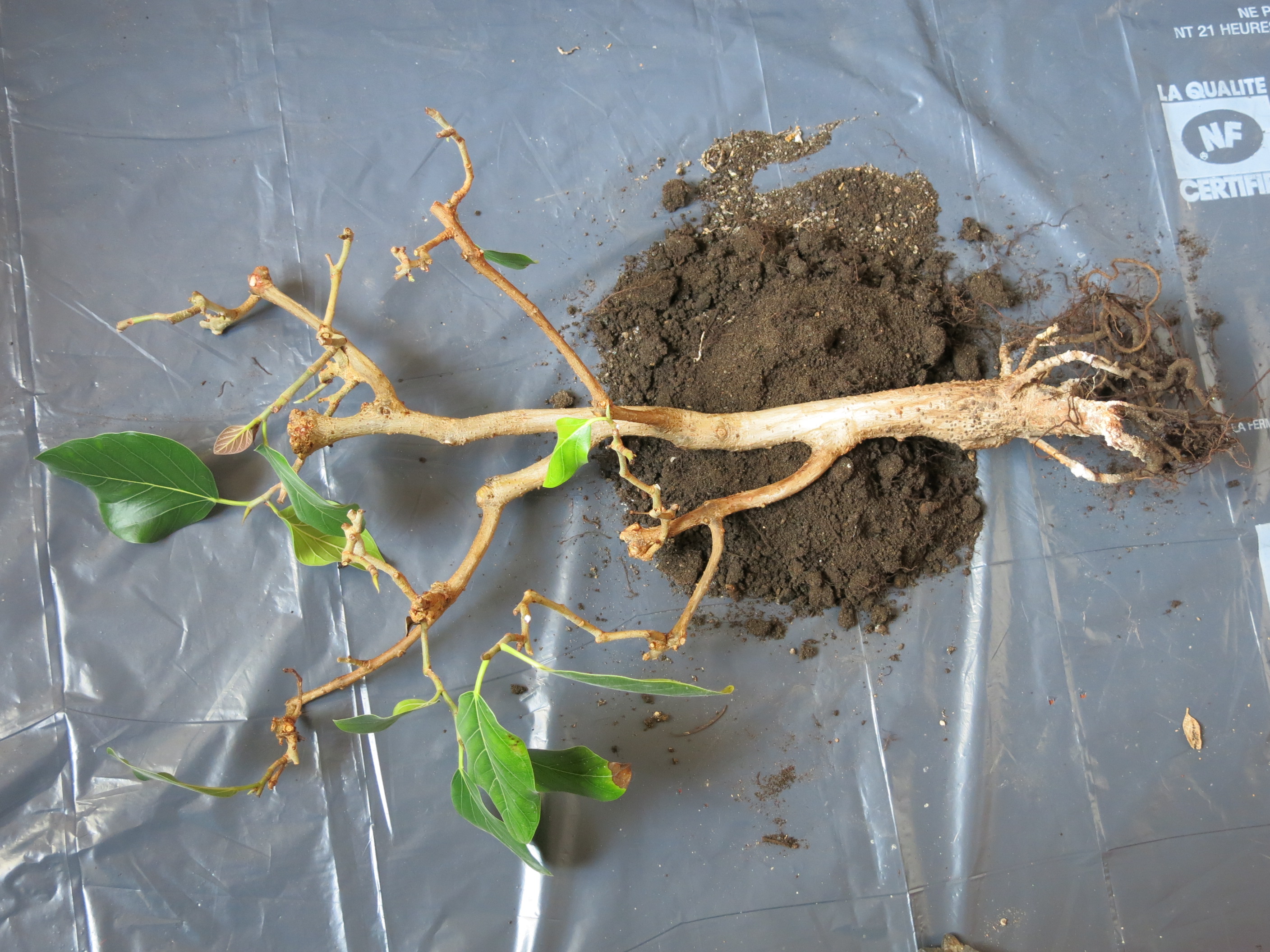
A banyan fig bonsai (Ficus benghalensis), about 70 cm tall and grown from seed since 1979, lifted from its container with the old rootball still attached. / Photo by Tangopaso, public domain, via Wikimedia Commons — Source

A young, actively growing bonsai generally needs repotting every two to three years; a mature, well-established tree can often go five years or longer between repottings, and some conifers even longer still. The right season, in either case, is early spring, just before the buds begin to swell — not a date fixed on a calendar, and not a fixed interval that applies to every tree the same way.
The number of years depends on the tree, not the calendar
There is no single repotting schedule that fits every bonsai. The Royal Horticultural Society puts the general guideline at two to three years for most trees, stretching toward five years for slower-growing conifers, and dropping to every year for the most vigorous growers. Species matter as much as age: a young elm in training, with roots that colonize a pot quickly, is commonly repotted every one to two years, while an old pine that has already settled into its shape is left undisturbed for much longer, since conifers generally tolerate root disturbance less often than broadleaf trees. Two bonsai of the same age can sit on entirely different schedules if one is a fast-rooting deciduous species and the other a slow, established conifer.
Watch the buds, not the date
Growers do not mark a repotting date on the calendar a year in advance. Instead, they watch the tree itself. As a bonsai comes out of winter dormancy, its buds begin to extend and swell, preparing to open into new leaves or new needle growth — and that swelling, just before it happens, is the signal that root activity is starting up again for the season. Repotting at this exact point lets the tree recover fastest: cut roots have the whole growing season ahead of them to put out new fine roots and settle into fresh soil, rather than sitting disturbed while the tree is still fully dormant or already pushing hard new growth. Tropical species kept indoors over winter, such as ficus, follow a looser version of the same rule — repotted during their own slower, semi-dormant stretch rather than a true spring flush.
The clock is only ever a rough guide. The real evidence sits inside the pot. Lift a tree at the start of its expected window and check the rootball: if roots have filled all the available space and begun circling around the edges — a state growers call "pot-bound" or "root-bound" — it is time, regardless of exactly how many years have passed since the last repotting.
The one moment anyone sees the roots
Nearly all of a bonsai's life is spent with its roots completely out of sight, working in soil no one examines. Repotting is the single point in that cycle when a grower can actually lift the tree free and look — at how the roots have filled the pot, whether the granular soil packed around them has begun to break down and compact, whether growth below ground matches what the trunk and branches suggest above it. We go into the actual technique performed at that moment — how much of the root mass can safely be cut back, and why the old soil is discarded rather than reused — in more depth elsewhere; this is the short answer to when that moment arrives.
Why the timing matters as much as the technique
A bonsai left in the same pot indefinitely does not simply stay as it is. Its roots exhaust the space and nutrients available to them, growth stalls, and decline follows — slowly at first, then all at once. Repotted on schedule, that same tree keeps generating the fine new roots that do most of the real work of drawing in water and nutrients, season after season, for as long as a grower keeps the rhythm going. Getting the timing right — the correct year for that particular tree, and the right week within the season — is what turns repotting from a disruptive shock into the routine renewal behind the very long stretches of years some bonsai spend in a single pot, decades and sometimes centuries at a time.
Azukari keeps exactly this kind of seasonal judgment running in the background. An artist in Japan decides, tree by tree, when a particular specimen is actually ready — not on a fixed date, but by reading its buds and its roots — and records the work once it is done, so an owner anywhere can see when their tree was last repotted and why.
References
- Royal Horticultural Society — Bonsai: Growing Miniature Trees — official RHS guidance on repotting frequency (two to three years generally, three to five for slow-growing conifers, annually for fast growers) and timing.
- Bonsai Empire — Repotting Bonsai — on judging when a tree is ready to repot, the root-pruning process, and why potted trees become root-bound without it.
- Bonsai4Me — "Repotting and Root-Pruning Bonsai, Part 1" — on timing repotting by observing swelling buds at the end of dormancy rather than a fixed calendar date, including the looser rule for indoor tropical species.
- Bonsai4Me — "Repotting and Root-Pruning Bonsai, Part II" — on identifying a "pot-bound" or "root-bound" rootball, and on vigorous-rooting species such as elm needing repotting every one to two years.