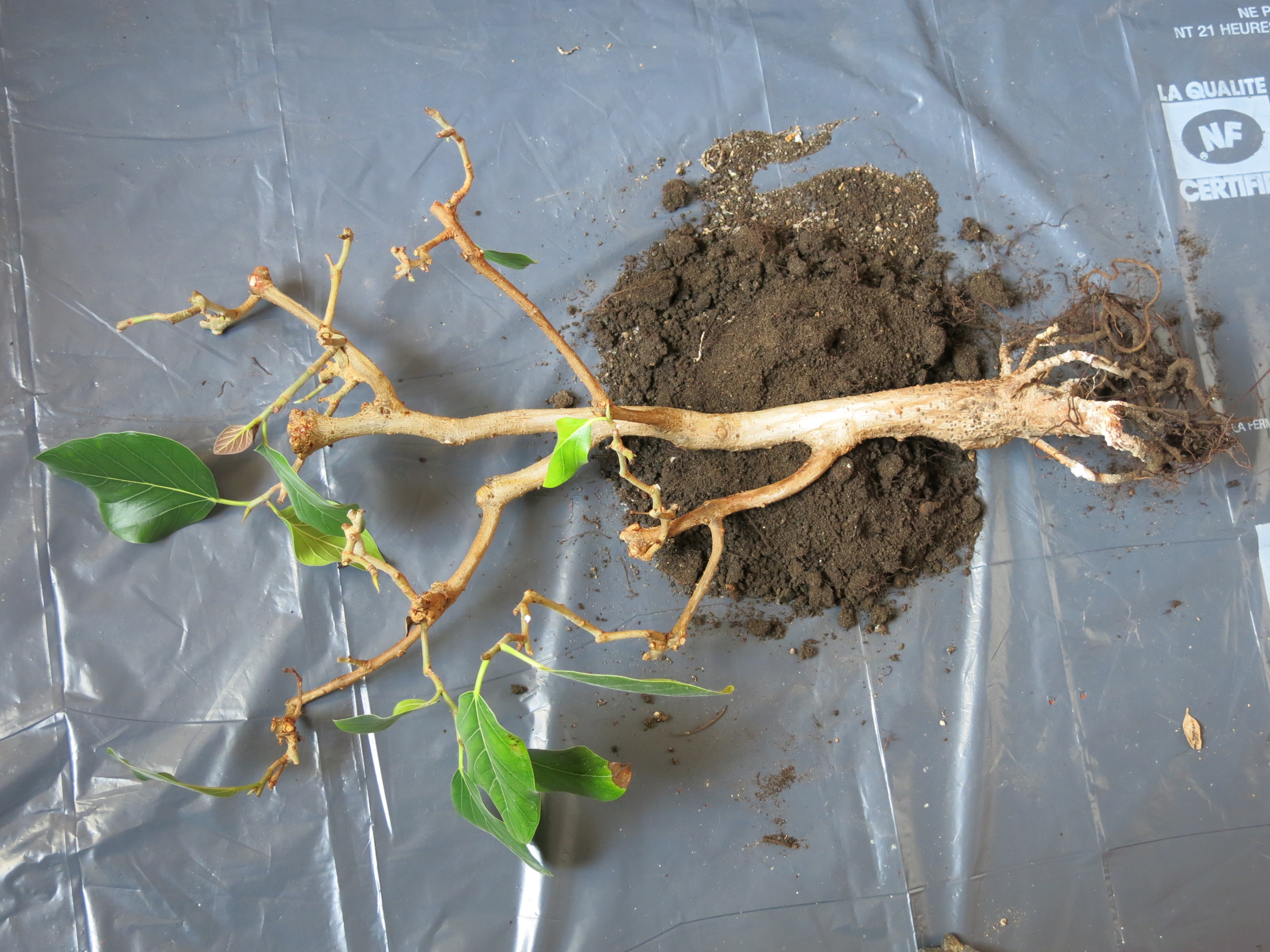
A banyan fig bonsai (Ficus benghalensis), about 70 cm tall and grown from seed since 1979, lifted from its container with the old rootball still attached. / Photo by Tangopaso, public domain, via Wikimedia Commons — Source

The banyan fig above has been growing since 1979. It stands about 70 cm tall — a fraction of what the species reaches with room to spread, where a banyan's aerial roots can widen into a canopy big enough to shade a city block. Four decades in the same small pot come down to one repeated act, performed every few years without exception: lift the tree out, cut back its roots, and throw away the soil.
Repotting is not a chore that keeps a bonsai inside its container. It is the technique that lets a tree confined to a container go on living at all.
The tree sets the calendar, not the grower
Uekae (植え替え, "repotting," literally "replanting") follows no fixed yearly rhythm. A young, fast-growing tree in training may need it every year or two, because vigorous new roots fill whatever space they are given almost as fast as it is offered. A mature, already-shaped specimen — a pine that has found its silhouette — is left alone longer, often three to five years at a stretch; conifers generally tolerate root disturbance less well than broadleaf trees do. The Royal Horticultural Society puts the general rule at two to three years, stretching to five for slow conifers and tightening to annual for fast growers. None of that is a substitute for looking. A grower lifts the tree from its pot in early spring, before the buds swell, and checks whether the roots have circled into a dense mat with nowhere left to go. If they have, that is the only calendar that matters.
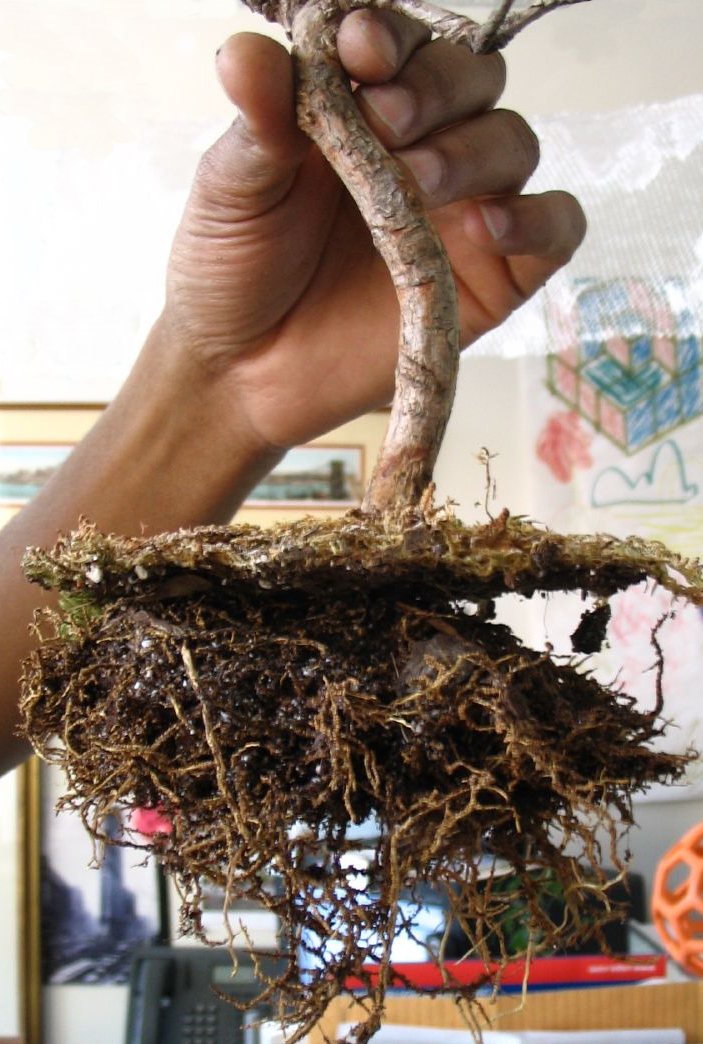
A bonsai lifted out for exactly that check: the rootball has become a solid mat holding the shape of the pot, with no open soil left for a new root to enter. / Photo by ericskiff (Glitch010101), CC BY-SA 2.0, via Wikimedia Commons — Source

Cut too much, or too little, and the tree loses either way
The work itself is plain to describe and easy to ruin. Old soil is worked loose from the rootball with a chopstick or similar tool, careful not to tear the fine roots underneath. The long roots that have reached the pot's edge are cut back with sharp scissors — but only some of them. Growers generally avoid removing more than about a third of a root system in one season, and a pine needs at least half its roots left untouched to protect the mycorrhizal fungi living among them, the microscopic partners its roots depend on for water and nutrients. Cut too much, and the tree cannot recover before summer heat arrives. Cut too little, and the roots stay crowded, air stops moving through the soil, and growth above the pot quietly stalls.
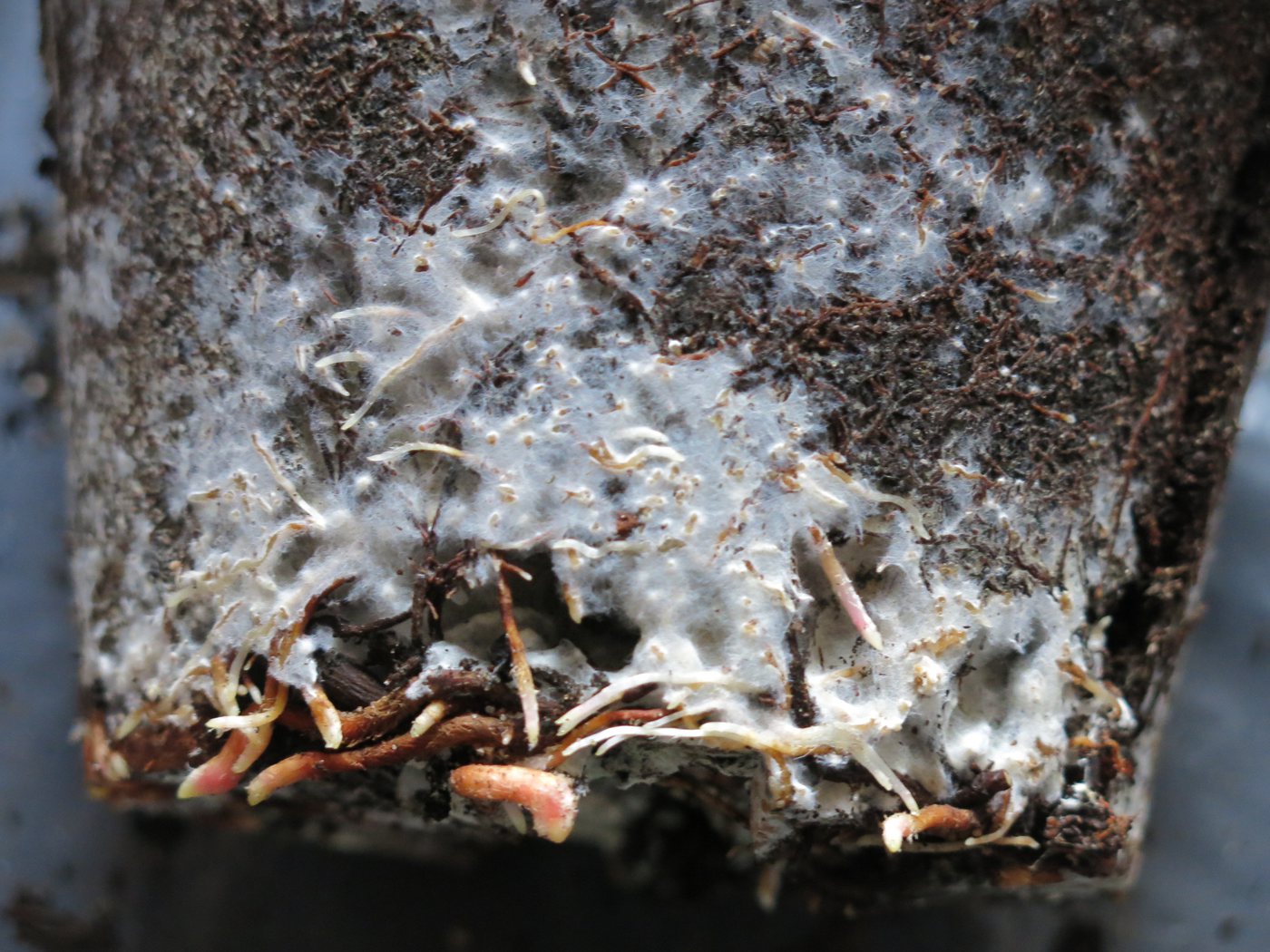
The underside of a maritime pine's rootball, its fine roots threaded through with white fungal growth of the kind growers are careful not to strip away when they work on a pine. / Photo by Tangopaso, public domain, via Wikimedia Commons — Source

The soil wears out long before the tree does
A tree rooted in open ground draws on soil that keeps renewing itself: worms turn it, rain carries fresh minerals through it, roots travel outward into ground no root has touched before. A bonsai has none of that. Whatever sits in its pot is the only soil it will ever have, and that soil does not stay the same for long. Much of what is used in Japan is akadama (赤玉土, "red ball earth"), a granular, baked volcanic clay from the Kanto region, mined chiefly in Ibaraki Prefecture. Fresh akadama does real work — its granules hold water in their pores while leaving air space between them, exactly the balance a confined root system needs — but it is not permanent. Watering breaks the granules down over time, especially in cold, wet conditions, until they collapse into finer particles that pack together, choke drainage, and eventually suffocate the roots they were meant to feed. Replacing that spent soil is as much a part of repotting as trimming the roots sitting in it.
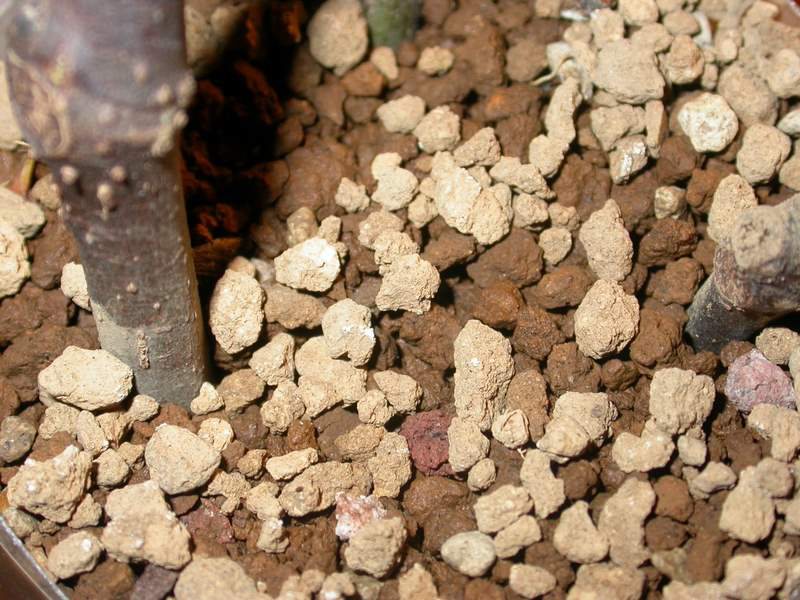
Akadama at the soil surface of a bonsai pot, pale dry granules sitting among darker damp ones. The visible gaps between granules are the other half of the job: water goes into the granules, air stays in the spaces between them. / Photo by Abrahami, CC BY-SA 3.0, via Wikimedia Commons — Source

Root pruning does, by hand, what open ground would do for free
Left alone indefinitely, a potted tree becomes root-bound: it exhausts the space and the nutrients within it, growth halts, and decline follows — slowly at first, then all at once. A tree's roots have to keep finding new ground or new nutrients somewhere, and a fixed pot cannot offer either on its own, indefinitely. Repotting supplies, by hand, what open ground would otherwise supply for free. Cutting back the roots does not weaken a healthy tree; it prompts fresh, fine roots to emerge from each cut, and it is those fine tips — not the older, woody roots — that do most of the actual work of drawing in water and nutrients. New soil restores what old, compacted soil no longer offers. Together, the two are what let a tree stay in the same small pot not for one season but for a lifetime measured in decades, or, for the oldest bonsai in Japan, in centuries. We wrote elsewhere about why some bonsai live so long — repotting, repeated without fail, is one of the ordinary techniques quietly underneath that answer.
What can't be seen decides what the tree becomes
A visitor standing in front of a bonsai sees the trunk, the branches, the nebari spreading across the soil surface — never the roots working underneath, and never the seasons of repotting that shaped them. A trunk can be wired into an elegant line and a canopy pruned into a convincing silhouette while the roots below are quietly starving in exhausted soil; by the time that decline shows above ground, it is already well advanced. The reverse holds too: a plain-looking young tree with roots renewed carefully, season after season, is a tree with real years still ahead of it. This is why growers treat root work as foundational rather than cosmetic — the spring repotting season is, by most accounts, the single most consequential few weeks on a bonsai's yearly calendar. If you ever find yourself judging a bonsai's soundness, or the skill of whoever tends it, the trunk and the branches are the wrong place to look first. Ask instead when it was last repotted, and what came out of the pot.
The pot stays the same size; nothing else does
A bonsai's roots are cut back before anyone admires them. Its soil is discarded before it wears out completely. Neither shows up in a photograph, and neither is what a first-time visitor to a bonsai garden notices. It is, nonetheless, why the tree in that photograph is still alive to be photographed at all.
Azukari records this part on purpose, because nothing else will. When an artist repots a tree in our care — on the tree's schedule, not the owner's — what was cut, what soil went in, and why becomes part of the record the owner receives that season. It is the one line in that record a photograph could never have supplied.
References
- Royal Horticultural Society — Bonsai: Growing Miniature Trees — official RHS guidance on repotting and root-pruning frequency (two to three years generally, three to five for slow-growing conifers, annually for fast growers), timing, and technique.
- Bonsai Empire — Repotting Bonsai — repotting technique, the 30% root-pruning guideline, mycorrhizal fungi considerations for pines, and why potted trees become root-bound without it.
- Wikipedia — Akadama — composition, origin in Japan's Kanto region, and drainage/water-retention properties of the volcanic clay soil used in repotting, including its gradual breakdown over time.