
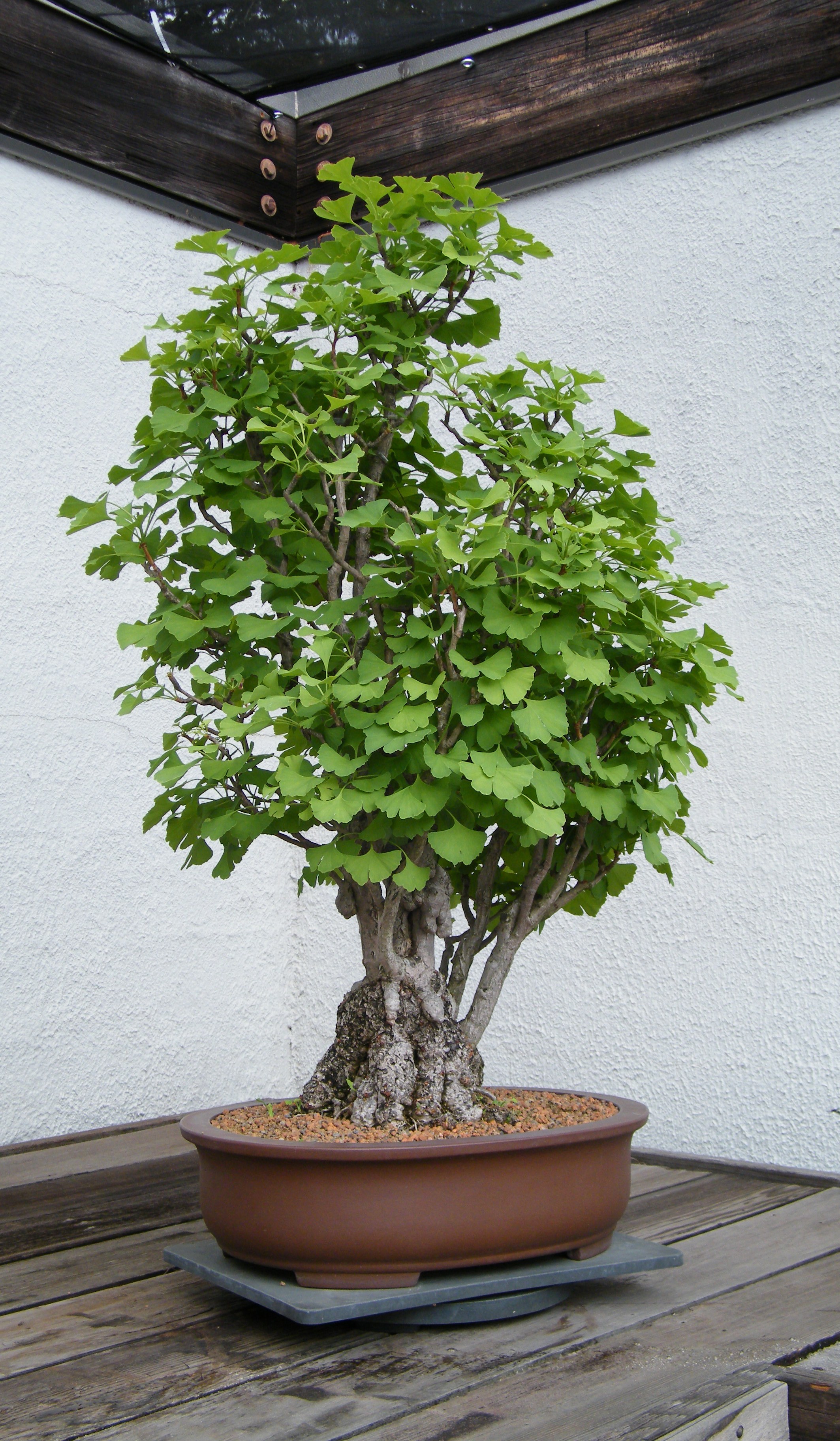
A ginkgo bonsai said to have been in training since 1926, photographed in late spring at the National Bonsai & Penjing Museum, U.S. National Arboretum. / Photo by Sarah Stierch, CC BY 4.0, via Wikimedia Commons — Source

A bonsai's year does not divide evenly into four seasons. Three of them are spent living off what happens in the fourth.
Spring compresses a bonsai nursery's hardest and least forgiving work into a matter of weeks: repotting has to land inside a window measured in days, and the strength of the growth that follows tells more about a tree's condition than anything visible for the rest of the year.
The bench fills up all at once
Late winter into spring, a bonsai nursery's calendar goes from quiet to crowded within days. Repotting is the largest single task, but it never arrives alone. Structural pruning is timed to finish before the buds swell, so the cuts heal into a season of active growth rather than sitting on a dormant tree. Wire applied the previous autumn is checked and adjusted before the new shoots thicken enough to bite into it. On maples in particular, once budding starts, the first leaves have to be pinched back by hand almost every day — a single skipped day can let a shoot run further than a grower wants. None of this can be pushed into summer without cost; each task depends on catching a tree at a stage that lasts only a few weeks. A nursery managing dozens or hundreds of trees does not spread the work evenly across the calendar. It compresses nearly all of it into spring, tree by tree, in the order each one wakes.
The tree announces its own window
Uekae (植え替え, "repotting") is the task spring exists to make possible. A fully dormant tree can technically be repotted through winter with little risk, but the root work does it no immediate good while the tree is still resting. The moment a grower actually waits for is narrower than that: roots awake, buds visibly swelling or just beginning to extend, but before new leaves have opened and started drawing water back through those same roots. Repot too early, while the tree is still dormant, and the disturbed roots gain little from the season ahead. Repot once the foliage has already unfurled and depends on an intact root system, and the tree can lose leaves it cannot spare. Because the stage is set by the tree's own biology rather than a date on a calendar, growers watch buds rather than a forecast. A tree lifted from its pot even a week past that point spends the rest of the year recovering rather than growing. Repotting itself is a technique repeated every few years for as long as a tree lives; spring is simply when that technique has to be carried out.
New growth is the season's report card
Once repotting is behind it, a tree's medashi (芽出し, "budding," literally "the buds coming out") becomes the clearest account available of how the previous year — and the repotting itself — actually went. On pines, the new shoots that emerge each spring are commonly called candles, for the shape they take before their needles separate, and growers watching a tree's recovery track how many candles appear and how far they run: both needle and shoot length track fairly directly with a tree's underlying vigor. A weak tree pushes short, sparse growth, or none at all. A tree that wintered well and settled cleanly into new soil answers with shoots that lengthen visibly week to week. Deciduous species tell the same story through leaf size and density rather than candles, but the principle holds across species. For anyone sizing up a tree from outside, that spring push doubles as the year's most honest report — more telling than the same tree's appearance months later, once growth has slowed and decline becomes easier to disguise.
The rest of the year runs on what spring gets right
A tree that comes through repotting cleanly and pushes strong growth in the following weeks carries that vigor into summer largely on its own; the routine watering and feeding that follow have healthy roots and foliage to build on. A tree repotted a little too late, or one whose new growth comes weak, spends much of the summer simply making up ground, and a setback taken in spring is difficult to fully undo before the heat of the months that follow arrives. This is part of why growers who care about how long a tree lives treat spring with more caution than any other season: longevity is built less by any single dramatic intervention than by getting these few ordinary weeks right, without fail, year after year.
Azukari keeps that timing on the artist's calendar rather than the owner's. Each tree is repotted, pruned, and wired at the moment it is actually ready, not on a fixed date chosen for convenience from abroad, and the work is logged as it happens — what was cut, what was repotted, how the new growth answered. The weeks that matter most pass largely unseen by an owner on the other side of the world. What they leave behind, written into a tree's growth through the rest of the year, does not.
References
- Bonsai4Me — "When to Repot Your Deciduous (and Broadleaf) Bonsai" — on the narrow "extending buds" window for repotting and the risks of repotting too early or too late.
- Bonsai Empire — Bonsai Maintenance Calendar — on the concentration of repotting, pruning, and wiring tasks in late winter and spring.
- Bonsai Tonight — "Distinguishing Vigorous Growth from Healthy Growth in Bonsai" — on shoot and needle length as indicators of a tree's vigor.
- Royal Horticultural Society — Bonsai: Growing Miniature Trees — on repotting frequency by species and repotting in spring, before growth resumes.