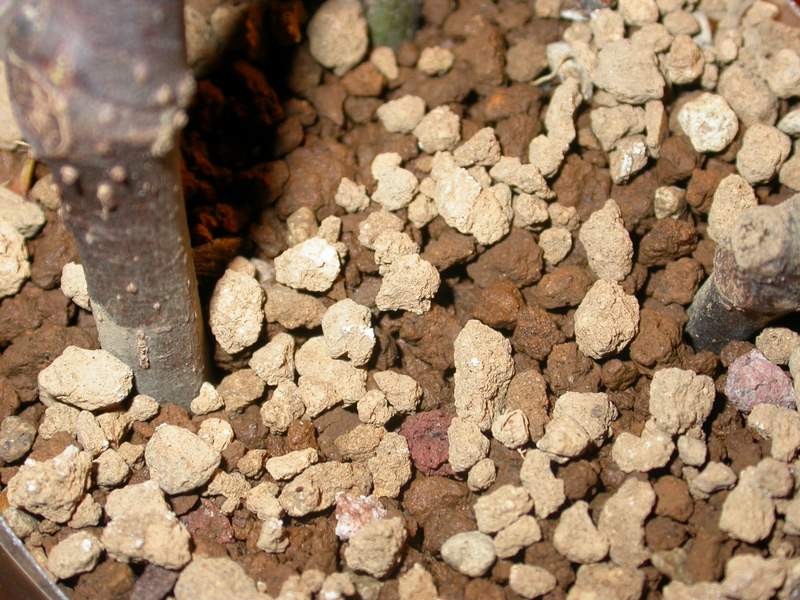
Akadama granules at the base of a bonsai trunk — the paler grains are dry, the darker ones freshly watered. / Photo by Abrahami, CC BY-SA 3.0, via Wikimedia Commons — Source

Scrape back the moss on almost any well-kept bonsai pot in Japan and the same material turns up underneath: small, round, reddish-brown granules, packed loosely enough that daylight shows between them. This is akadama (赤玉土, literally "red ball soil"), a naturally granular clay dug from the volcanic ash that blankets the Kanto region around Tokyo, and it is about as close as bonsai cultivation comes to a shared foundation.
A bonsai's health starts below the moss, in a soil built to hold water and let it go at the same time.
A soil unique to Japan
Akadama forms in the Kanto loam — layers of volcanic ash that fell across the plain around Tokyo and, over a very long span of time, weathered into a stable, mineral-rich clay. Growers surface-mine it at several sites on that plateau, most prized today from Ibaraki Prefecture, with further supply historically drawn from Gunma and Tochigi. After drying, it is sifted into graded sizes, from a fine grain suited to a mame (see our piece on mini bonsai) up through coarse grades for large stock in deep containers. Ibaraki's version has a particular reputation among Japanese growers: its grains are said to be hard enough to survive years of watering without turning to mud, which is one reason trade writers describe it as close to indispensable for serious bonsai work. No other country's horticultural tradition has built quite so much everyday practice around one local material — bonsai literature worldwide still names akadama as the default soil, even in places where growers eventually substitute something suited to their own climate instead.
Two kinds of space at once
A bonsai's roots cannot range downward the way a tree's roots can in open ground; the pot is shallow, and the soil has to do more of the work a whole hillside would otherwise do. Ordinary garden soil, packed with fine particles, is a poor match for that — water pools at the bottom of a shallow pot while the packed soil above it pushes out the air roots need. Akadama's rounded, porous granules solve both problems in the same handful of soil: larger gaps between granules let water pass through and air reach the roots, while countless smaller pores inside each granule hold moisture and nutrients that roots can draw on between waterings. That aerated layer close under the surface is also where a tree's surface roots spread outward instead of down, one more reason the soil nearest the moss matters as much as what lies deeper in the pot. The color helps a grower judge things too — the granules darken visibly when wet and pale again as they dry, so an experienced eye can often read a pot's condition at a glance. Given how little day-to-day margin a bonsai actually allows, as we've written elsewhere about watering, that quick visual read matters more than it might sound like it should.
A different mix for every tree
The ratio changes by species. Pines and other conifers are commonly potted in a mix weighted toward faster drainage — something in the neighborhood of seven parts hard akadama to three parts kiryuzuna (桐生砂, a coarse mineral aggregate mined near the city of Kiryu in Gunma) or pumice, suited to a conifer's preference for roots that dry out somewhat between waterings. Deciduous trees, with finer and more active root systems, are usually given more akadama and less coarse aggregate — often closer to eight parts to two — to keep moisture steadier. Satsuki (皐月) azalea is a case apart, generally grown in kanuma (鹿沼土, "Kanuma soil," named for the Tochigi town where it is mined), a paler, more acidic material that akadama alone cannot provide. None of these ratios is fixed law; growers adjust them for a tree's own vigor, the local climate, and the season, treating a published ratio as a starting point rather than a rule.
Akadama also has a lifespan of its own. With repeated watering the granules soften and gradually collapse into fine material that clogs the same air pockets that made the mix work in the first place — typically within a year or two for standard grades, longer for hard Ibaraki stock or for granules a producer has fired in a kiln to raise their durability. This slow collapse is one of the practical reasons bonsai are repotted on a cycle rather than left in the same pot indefinitely: eventually it is the soil, as much as the roots, that needs renewing.
What the soil says about the grower
None of this shows in a photograph of a finished tree. But a nursery bench tells on itself to anyone who looks closely at what is under the moss rather than above it: whether the akadama grade matches the tree's size and pot depth, whether the mix was properly screened before potting so fine dust doesn't choke the drainage layer, whether the surface is kept clean rather than crusted over. A wide-based tree still in training and a refined shohin in a shallow, decorative pot rarely sit in the same bag of soil, and a grower who treats them as if they should has not thought as carefully as one who hasn't. It is a quiet kind of judgment — nothing about it announces itself — but it is one of the more reliable places to look if you want to know how carefully a tree is actually being kept.
Closing
A bonsai's visible age lives in its bark, its branches, the roots at its base. Its health lives lower than any of that, in a soil most visitors to a garden never think to ask about.
Azukari sits at that same level. An artist in Japan continues this unglamorous, largely unphotographed work — screening out old akadama at each repotting, choosing a mix suited to that particular tree and season — and records what was done, regardless of whether an owner ever sees the soil itself. A tree cared for this way carries part of its history in roots that a well-built soil made possible, long before anything above the rim of the pot shows it.
References
- Wikipedia — Akadama — overview of akadama's volcanic origin in the Kanto loam, mining and grading, and its drainage/water-retention properties.
- Bonsai Tonight — All About Akadama — grower-level detail on how akadama breaks down over time, hard-fired versus softer grades, and mixing practice.
- 感動の園芸・儲かる農業 — 栃木産 赤玉土と茨城産 赤玉土 — comparison of Tochigi- and Ibaraki-sourced akadama, including the Ibaraki grade's hardness and its standing among bonsai growers.
- 原田園芸(たけのはな商事)— 盆栽用土の配合比 — reference mixing ratios of hard akadama to pumice/kiryuzuna for conifer versus deciduous bonsai.
- Wikimedia Commons — File: Akadama dry and wet.JPG — source and license (CC BY-SA 3.0, photo by Abrahami) for the header image.