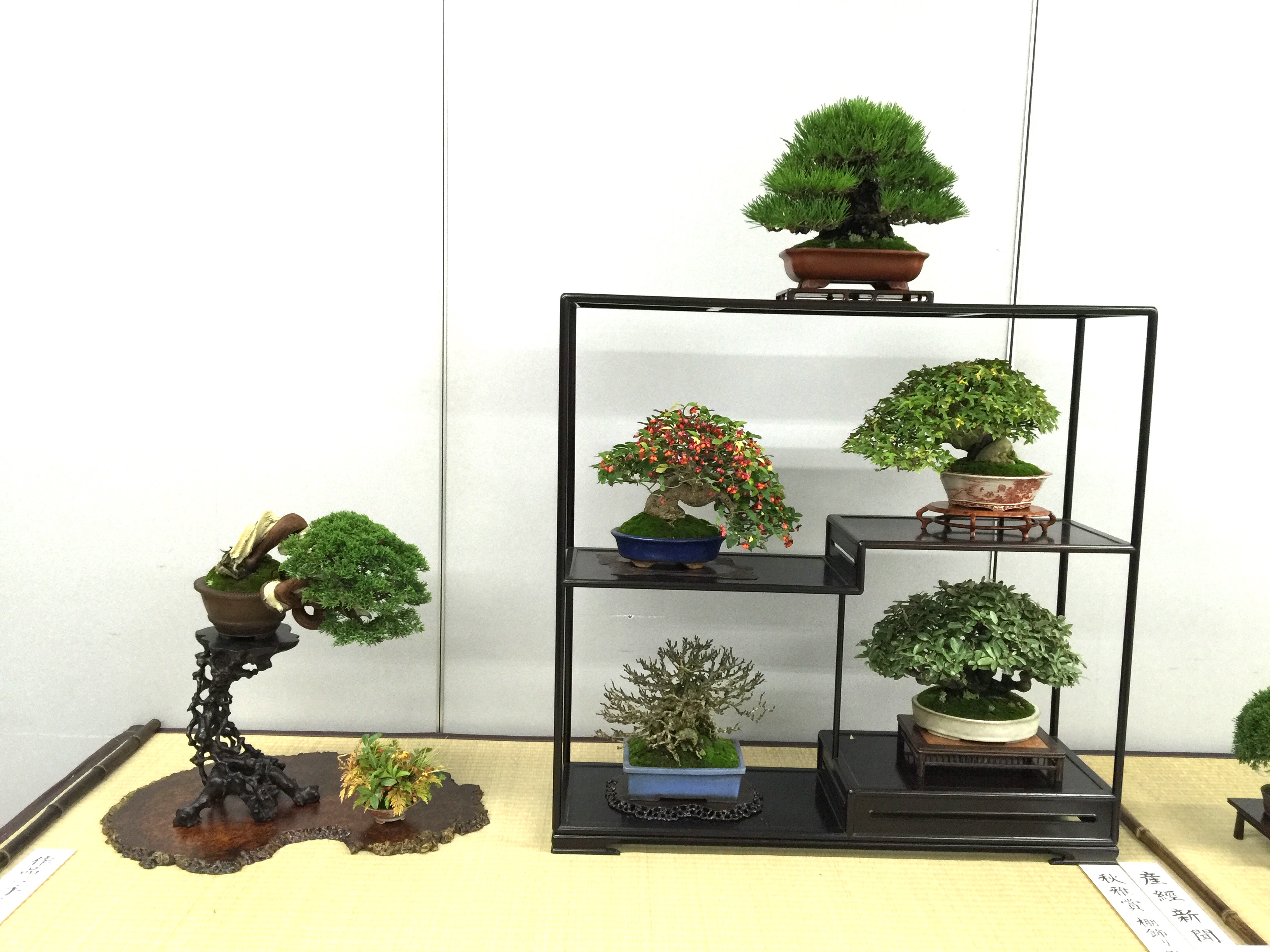
Photo by All Japan Shohin-Bonsai Association, CC BY-SA 4.0, via Wikimedia Commons — Source

Somewhere past the black pines and the centuries-old white pines standing on their own display stands, a large bonsai exhibition usually keeps a much smaller table. On it sit trees no taller than a teacup. Visitors lean in rather than step back.
A mame bonsai is a complete bonsai, small enough to rest in the palm of one hand.
A World in the Palm
The word is mame (豆, "bean") — borrowed from the vegetable to describe anything unusually small. In bonsai it names a size class, not a species: a tree generally under about 10 centimeters (4 inches) tall, grown and trained by the same methods as a bonsai many times its size.
Just above mame sits shohin (小品, "a small work"), the category for bonsai that can still be lifted and shown in one hand — commonly placed at up to roughly 20 to 25 centimeters. No single rule fixes the boundary between the two; associations and individual growers describe it a little differently, and the same tree is sometimes shown under either name depending on how it is potted. Mame sits at the smallest end of a much broader range of bonsai sizes, a range we walk through in From Grand to Palm-Sized.
Almost any species can be trained as mame — pines and junipers, maples, flowering quinces, azaleas, even moss grown as its own small landscape. What decides the category is not the tree's kind, but how far its scale has been compressed.
Where the Door Opens
For a first bonsai, size is often the real obstacle. A large bonsai asks for a bench, space outdoors, protection from wind and frost, and years before its structure even begins to show. A mame bonsai asks for a saucer of space — a windowsill, a shelf, a corner of a balcony — and a single pot to learn from.
That does not make a mame bonsai easier to keep. Its pot holds only a few centimeters of soil, which dries faster and stores less reserve than the wide pot of a large tree; in summer, a mame may need watering more than once a day rather than less. What shrinks is not the attention a tree needs, but the space and the scale of commitment required to begin one. A single chojubai (長寿梅, a dwarf flowering quince long favored for its size and its readiness to flower even while young) is, for many, where a relationship with bonsai starts — long before a garden of larger trees follows, if it ever does.
The Same Thought, Compressed Further
As we wrote in "Bonsai Is Not a Small Tree," the art was never about shrinking a tree — it is about holding the form of a great tree, or an entire landscape, inside a pot. A mame bonsai does not set that idea aside. It compresses it further.
Proportion still has to read correctly at a glance: trunk taper, branch placement, the sense of nebari (根張り, the visible spread of surface roots gripping the soil) — all of it has to suggest age and scale within a few centimeters of trunk. There is less material to work with, and less room for error. A millimeter of wire left too long, a single shoot allowed to run, changes a mame's whole proportion in a way that would barely register on a larger tree. The thinking is identical to any other bonsai. Only the margin for error has shrunk along with the tree.
A Modern Entry Point
Mame and shohin bonsai carry their own dedicated culture in Japan. The All Japan Shohin-Bonsai Association, formed in the mid-1980s, holds Gafu-ten (雅風展, "an exhibition of elegant style") in Kyoto every January — now in its fifth decade and among the largest small-bonsai fairs in the country, with roughly 120 display settings and around 600 trees shown over three days.
Outside Japan, mame bonsai has become one of the more visible doors into bonsai culture generally: small enough to photograph well, to travel with, to give as a gift, to keep in an apartment with no garden at all. For many people outside Japan, a mame bonsai is the first bonsai they ever hold in their own hands, long before they ever stand in front of a tree that has been under cultivation for a hundred years.
Closing
A mame bonsai and a meiboku — a famed, historic bonsai — sit at opposite ends of the same practice. One asks for a windowsill and a season; the other has already asked several generations for their attention. What connects them is not size but the same repeated, unhurried judgment: water today, watch tomorrow, prune when it is time and not before.
Azukari's own trees are grown in Japan, under an artist's continued hand, at a scale a mame bonsai has not yet reached. But the discipline behind them is the same one a beginner practices over a palm-sized pot on a windowsill — attention, given without hurry, across however many seasons a tree is granted. A mame bonsai is simply where that discipline is easiest to begin.
References
- Bonsai Empire — Shohin Bonsai — size definitions for shohin (under roughly 25cm) and mame (under roughly 10cm) bonsai.
- All Japan Shohin-Bonsai Association — About Us — history and founding of the association and its definition of shohin bonsai as roughly under 20cm.
- All Japan Shohin-Bonsai Association — Bonsai Faire — description of the Gafu-ten exhibition in Kyoto, its scale (roughly 120 settings, 600 trees), and its January schedule.
- Bonsai Navi — 豆盆栽 (Mame Bonsai) growing guide — Japanese-language guide to mame bonsai size, suitable species, and the closer watering attention smaller pots require.