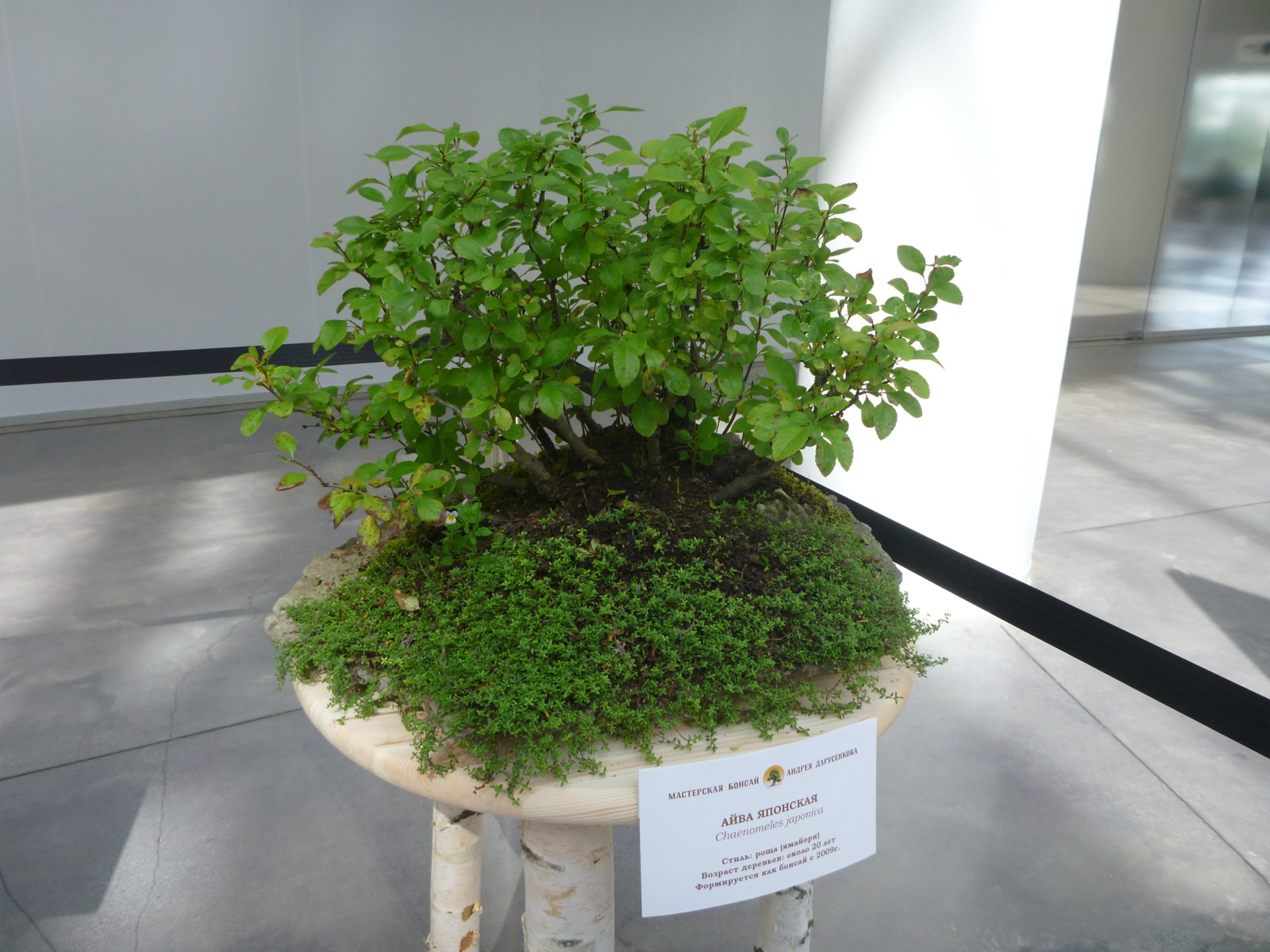
Photo by IvanA, CC BY-SA 4.0, via Wikimedia Commons — Source

Among flowering bonsai, one small deciduous shrub blooms not once a year but in repeated flushes, carries a name that promises long life, and is where a striking number of people first put their hands on a bonsai at all.
Chojubai is a dwarf flowering quince, grown for small vermilion flowers that open across more than one season on a plant compact enough to fit in one hand.
Not a Plum, Despite the Name
Chojubai (長寿梅) reads, character by character, as "long-life plum" — yet the plant is not a plum at all. It belongs to boke (木瓜, Chaenomeles, the flowering quince genus), a group of roses-family shrubs native to East Asia and unrelated to ume (梅, Japanese apricot/plum). According to several Japanese nursery accounts, the "long-life" half of the name was given precisely because the plant keeps flowering in bursts through much of the year rather than for one brief spring window — an auspicious trait that earned it a name usually reserved for a very different tree. In some regions the same plant is also known by older, more local names: koboke (小木瓜, "small quince"), shidomi, or jinashi.
Botanically, sources do not fully agree on where chojubai sits. Several long-established Japanese nurseries classify it under Chaenomeles speciosa, the Chinese quince, while a number of English-language bonsai sources — including growers who trained in Japan — list it as a cultivar of Chaenomeles japonica, the lower-growing native Japanese quince. What both agree on is the plant itself: a hardy, deciduous shrub, rarely more than knee-high even ungrafted, with small glossy leaves and a naturally twiggy, dense habit that needed almost no encouragement to become a bonsai.
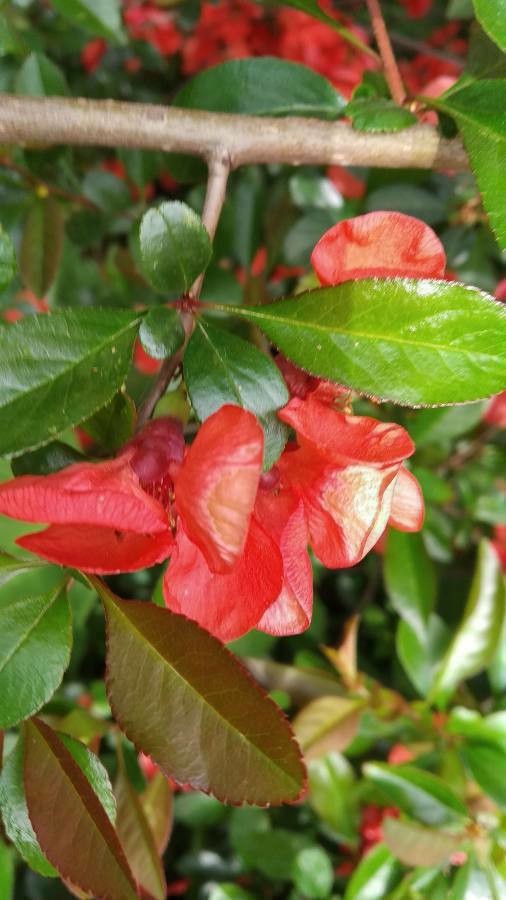
Photo by Carodejnictvionline, CC BY-SA 4.0, via Wikimedia Commons — Source

Flowers That Do Not Wait for One Season
Most flowering bonsai save everything for a single window — a week or two of plum blossoms, a few days of cherry. Chojubai is unusual for spreading its bloom out. Japanese growers commonly describe it as shikizaki (四季咲き, "flowering through the seasons"): a main flush in spring, typically cited as running from around February through May, and a second flush again in autumn, with individual sprays sometimes continuing to open for weeks at a stretch when the weather cooperates. Under attentive care, some accounts report flowers appearing in almost any month.
The flowers themselves are small — well under 3cm across, by most descriptions closer to the size of a fingernail — and while the species can produce white blossoms, bonsai growers overwhelmingly favor the red-flowering form, prized for both its color and, according to one long-running American bonsai nursery's account, for producing the finest, most densely twigged growth of the color variants. Because the plant flowers even while young and while leafless, a chojubai in late winter can look, at a glance, like bare wood suddenly dotted with small red jewels.
That readiness to bloom without waiting for age is also, by most Japanese growers' accounts, why chojubai is treated as a strong, forgiving species: it buds back reliably after pruning, roots easily from cuttings or air-layers, and tolerates the kind of hard cutting-back that would set a slower species back for years.
A Staple of Small Bonsai
Chojubai rarely thickens its trunk quickly, and its leaves and flowers stay small no matter how mature the plant becomes — two traits that, for most bonsai species, would be limitations. For a mame (豆, palm-sized) or shohin (小品, "small work") bonsai, they are exactly what is needed. A tree that resists getting larger, and whose proportions stay convincing at a small scale, is well suited to a size class where every centimeter of trunk and every millimeter of leaf has to read correctly.
Its branching adds to the case. Chojubai throws fine, densely divided twigs with little training, and on well-developed specimens even the bare winter silhouette — leafless, flowerless, all structure — is considered worth looking at in its own right. With age, some specimens develop a rough, corky texture to the bark that is not seen on other Chaenomeles, according to one detailed English-language grower's account; that same source describes chojubai bonsai moving, by the 1990s, from a supporting accent plant into specimens shown and awarded in their own right at Japan's Kokufu bonsai exhibitions, though the precise dates and award history are not independently confirmed here and should be read as one nursery's account rather than a settled record.
Between its size, its flowering habit, and its structure, chojubai has become one of the standard species of Japan's flowering mini-bonsai world — reached for by name almost as often as pine or juniper are reached for among larger trees. It sits alongside plum, satsuki azalea, and wisteria among the species we walk through in What Is Flower Bonsai, but chojubai's particular gift is fitting that same seasonal drama into a size a windowsill can hold.
Where Many Bonsai Journeys Begin
A chojubai asks little to start: a small pot, an outdoor spot with some sun, and a stable amount of water, since its shallow pot's limited soil dries faster than a large tree's. In return it forgives more than most beginners expect — pruned too hard, it grows back; watered inconsistently for a stretch, it usually recovers; left with a branch running too long, it can be cut back and will bud again from bare wood, a trick that many pines and junipers cannot offer.
That combination of small ambition and real forgiveness is why chojubai so often turns up as someone's very first bonsai, in Japan and increasingly outside it. It is small enough to keep in an apartment, quick enough to reward attention within a season rather than a decade, and, once it has bloomed twice, hard to think of as merely decorative. It is one of the species that made a case for a much smaller category of bonsai altogether, the kind we describe in Mame: Bonsai in the Palm.
A Small Tree, Practiced On
None of what makes chojubai easy makes it less serious a bonsai. The same watching for new growth, the same judgment about which shoot to shorten and which to leave, the same patience through a leafless season that will flower again — all of it is present here, just compressed onto a plant a person can hold in one palm. Its old, auspicious name is fitting for reasons beyond marketing: a plant that keeps blooming in one flush after another, season after season, is not a bad daily reminder of the kind of unhurried, repeated attention that bonsai asks for at any size — the same attention that, on a larger and older tree, is what an Azukari record exists to carry forward.
References
- Crataegus Bonsai — "'Chojubai' Quince — Diminutive Jewels" — classification as Chaenomeles japonica 'Chojubai', flower and leaf size, corky bark with age, blooming pattern, and an account of its rise at Kokufu exhibitions.
- Bonsai Empire — Flowering Quince Bonsai Care Guide — classification as Chaenomeles speciosa, general care and description of chojubai as a dwarf cultivar valued for miniature size and prolific flowering.
- ki-do-ri — 長寿梅(チョウジュバイ) — botanical family, red-flower preference in bonsai, shikizaki (four-season flowering) habit, and beginner-friendly vigor.
- Bonsaimyo — 長寿梅の育て方 — popularity among flowering bonsai, hardiness for beginners, and the plant's auspicious name driving its popularity as a gift.
- 和のこころ.com — 長寿梅盆栽の育て方 — name origin tied to its multi-season flowering, alternate regional names (koboke, shidomi, jinashi), and ease of propagation by cutting and air-layering.