
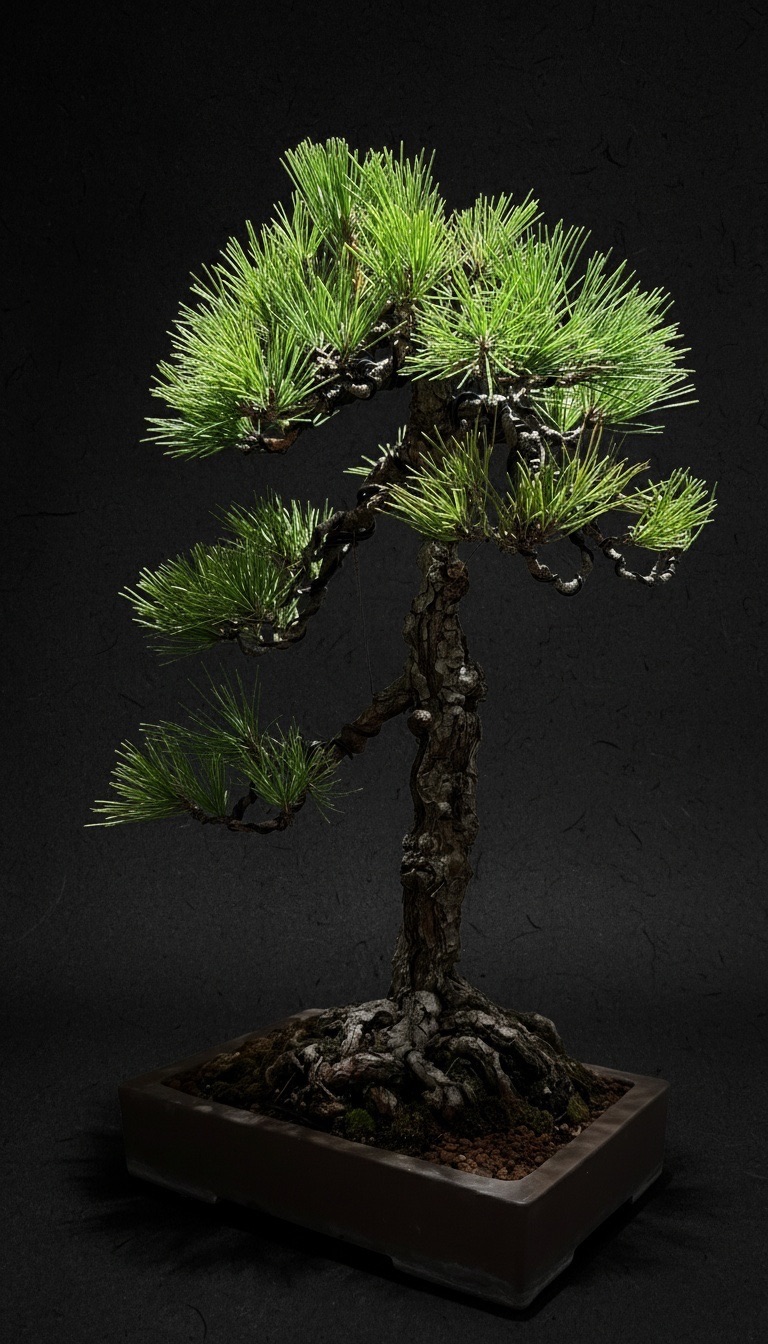
A Japanese black pine trained toward bonsai's larger size classes. / Photo: Azukari
Line up ten bonsai at a large exhibition and the range is immediate: a black pine tall enough to reach a visitor's shoulder stands a few meters from a maple that would fit inside a teacup. Both are judged by the same eye, held to the same discipline of pruning, watering, and years of patient shaping. Only their scale differs.
Bonsai are grouped into named size classes running from mame, small enough to rest on one palm, to daihin specimens that take several people to move — and the class a tree belongs to says nothing about how well it has been grown.
A Ladder of Named Sizes
Japanese practice does not use a single, universally fixed scale, but growers and associations generally group bonsai into a handful of bands running from the smallest to the largest. At the small end sits mame (豆, "bean"), a tree light enough for one palm, commonly placed under about ten centimeters — a class we look at more closely in Mame: Bonsai in the Palm. Just above it is shohin (小品, "a small work"), trees still liftable and showable in one hand; the All Japan Shohin-Bonsai Association itself describes shohin as running "from mini to about 20cm tall," while other sources place the upper edge closer to 25 centimeters.
Above shohin, the bands widen and the names shift toward describing how many hands a tree needs rather than how it looks on a shelf. Chuhin (中品, "medium-class") trees are generally placed at roughly 20 to 40 centimeters, manageable by one person but no longer a one-hand tree. Beyond that comes daihin (大品, "large-class"), starting around 40 centimeters and running well past a meter for the grandest classical specimens — English-language bonsai circles sometimes use the informal label "imperial size" for the largest of these, trees that can require two, three, or more people working together to lift safely. None of these boundaries are enforced by a single governing body; a tree potted one way is called shohin, potted slightly differently it might be called chuhin — the names are a rough map, not a ruler.
Viewing Distance Changes with Scale
A tree's size class quietly shapes how it is meant to be looked at. A daihin pine is usually given its own space — a wide bench, a corner of a garden, a dedicated spot at a hall — and viewed from a few steps back, the distance needed to read the whole trunk line and canopy at once, much as how a bonsai's front is chosen depends on the whole silhouette reading correctly from a set viewing point.
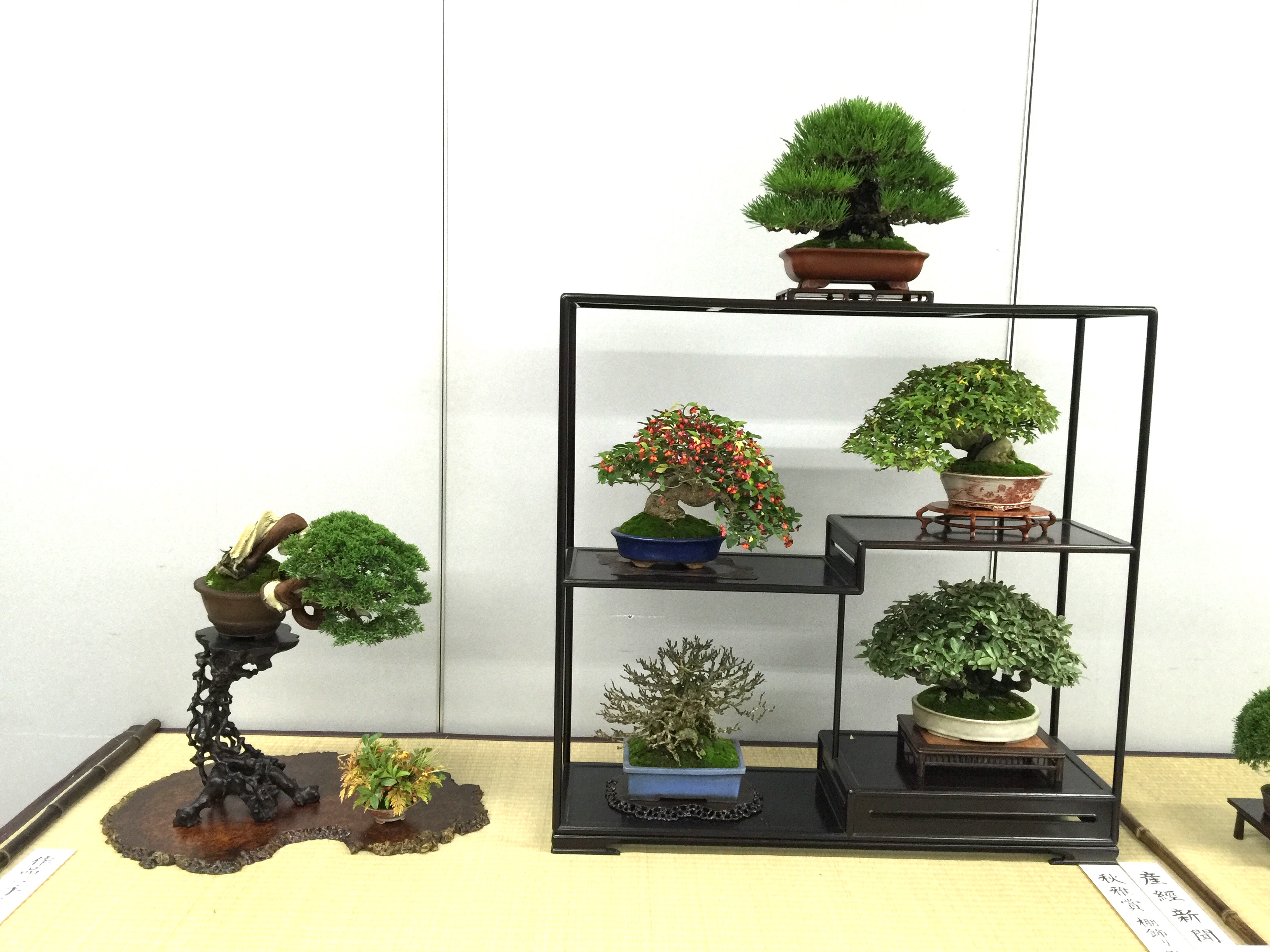
Photo by All Japan Shohin-Bonsai Association, CC BY-SA 4.0, via Wikimedia Commons — Source

Shohin and mame are rarely given that same solitary space. A single small pot would look lost on a large exhibition floor, so they are shown close together instead — several trees, an accent plant, sometimes a scroll, arranged as one coordinated setting to be read up close rather than from across a room. Grand exhibitions built primarily around large, classical specimens sit at one end of the yearly calendar; dedicated small-bonsai exhibitions such as Gafu-ten (雅風展, "an exhibition of elegant style"), organized since the 1980s specifically to give shohin and mame their own stage, sit at the other. Neither format is a smaller version of the other. Each size asks to be looked at on its own terms.
What Shrinks Is the Margin for Error
A large bonsai carries some of its presence in sheer mass — a trunk a person cannot get both hands around reads as old and weathered almost before a viewer studies its detail. A mame or shohin tree has no such advantage. Every element that gives a bonsai its sense of age and proportion — the spread of nebari (根張り, the visible surface roots gripping the soil), the taper of the trunk, the fineness of the branching — has to be compressed correctly into a few centimeters, with nothing left to hide behind. Leaf quality, or hasei (葉性), matters at every size, but at the smallest scales even the leaf itself has to shrink believably or the whole illusion of a mature tree collapses. Nothing about the underlying judgment changes as a tree gets smaller. What disappears is the room for a mistake to go unnoticed.
Size Is a Scale, Not a Rank
It is tempting to read this ladder of sizes as a ladder of quality, with the grandest, oldest-looking daihin naturally standing above a shohin or mame. That mirrors a similar and equally mistaken habit around species, where a young, unrefined tree from a favored lineage does not actually outrank an old, well-trained one from a less favored line. The same logic holds for size. A shohin that has been trained with unbroken care for decades, its proportions settled and its record intact, stands ahead of a large tree still early in its shaping — regardless of which one is taller. Size describes scale. Age, training, and record describe standing. They are different measurements entirely, and a bonsai enthusiast learns early not to mistake one for the other.
Closing
The range from daihin to mame also happens to trace the range of Japanese living space itself — a garden bench for the largest trees, a shelf or a windowsill for the smallest, with nothing about the underlying discipline changing in between. A tree kept at any size is still watered by season, still pruned by judgment, still shaped by a hand that has spent years learning where to cut and where to wait.
Azukari entrusts trees across this same range, each still growing in Japan under an artist's continued care. What is recorded for a tree — who tends it, what work is done each season, how its form is progressing — does not depend on how large its pot happens to be. A small tree's record is kept with the same attention as a large one's, because the standard a bonsai is held to was never about its size to begin with.
References
- All Japan Shohin-Bonsai Association — About Us — the association's founding in 1985, its public-interest status, and its definition of shohin bonsai as "from mini to about 20cm tall."
- Bonsai Empire — Shohin Bonsai — size definitions for shohin (under roughly 25cm) and mame (under roughly 10cm) bonsai.
- Bonsai Navi — 大品盆栽、中品盆栽、小品盆栽、それぞれの違いについて — Japanese-language breakdown of daihin (roughly 40cm and above, requiring two or more people to move), chuhin (roughly 20–40cm), and shohin (roughly 15–20cm) size classes.
- Miyagi Bonsai — Bonsai Size Classifications: From Keshitsubo to Imperial Explained — a fuller spectrum of named size classes from keshitsubo up to imperial size, and the informal hand-lifting system sometimes used alongside them.