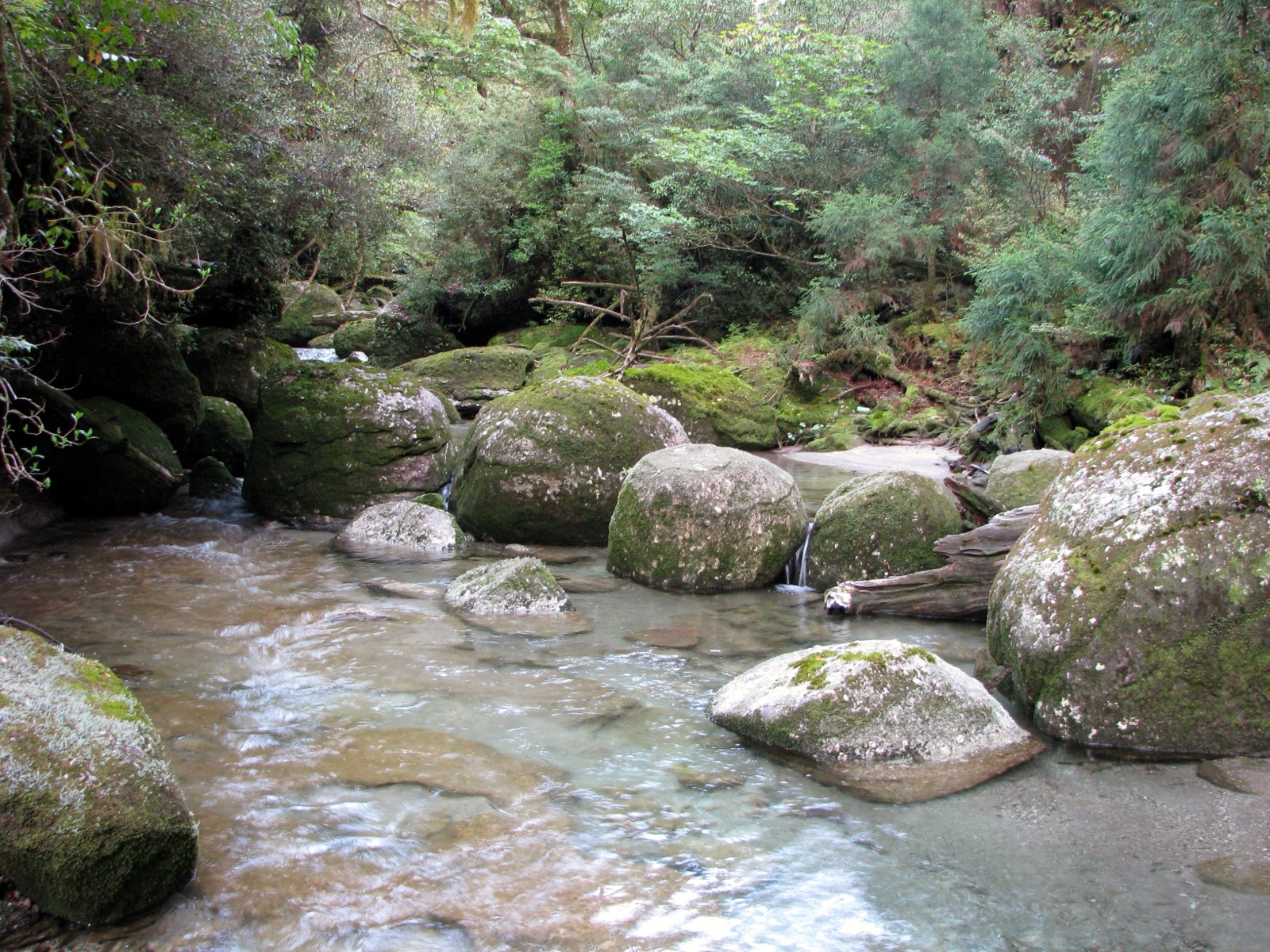
A streambed in Yakushima's Shiratani Unsuikyo ravine, its boulders wrapped in moss down to the waterline. / Photo by Chris 73, CC BY-SA 3.0, via Wikimedia Commons — Source

Follow a mountain stream in Japan far enough uphill and the trees stop growing simply in soil. A root meets a boulder too large to split or grow through, and rather than stopping there, it turns, spreads across the stone's surface, and follows every crack and ledge downward until it finds a pocket of earth to enter. Give that root a few decades in a valley's shade and dampness, and the rock and the root are no longer easily told apart.
A valley does not teach a tree to avoid rock. It teaches a tree to grow over it — and that single habit, copied faithfully, is where bonsai's root-over-rock style comes from.
A valley gives a root no say in where it goes
A mountain valley is a different environment from an open cliff or a windswept coast. Its floor is shaded most of the day, its air stays damp near running water, and its soil collects only in thin pockets among boulders and bedrock rather than spreading evenly across open ground. A tree that germinates there has no choice about where its roots go. Stone, for a root, is workable material: over decades or centuries, roots that meet a rock this way reach into its cracks and crevices for whatever water and nutrients collect there — trees growing in or on rock, as one bonsai reference puts it, "have to struggle to find nutrients in a harsh environment" — and they grip the surface as they thicken with age, until root and stone read as a single form. That terrain, damp and shaded and choked with rock, is what bonsai copied when it built one of its most literal styles.
Ishitsuki copies one habit of a valley tree, and little else
That style is called ishitsuki (石付き, "attached to stone," covered in more depth in a dedicated piece on the technique), and it is one of the more direct translations in bonsai's vocabulary of forms: a tree is trained so its roots visibly wrap a stone on their way to soil, exactly as a valley tree's roots do. There are two variations. In one, which the guides distinguish as sekijoju, the roots grow down inside the rock's own crevices, taking the natural cracks as their route. In the other, the roots run across the outside surface of the stone and extend into the pot below. A rock can even be grown on without any pot at all, though watering then becomes the whole job. What no version allows is haste: a root typically needs something like six to twelve months bound against a rock's surface before it grips firmly on its own, and the guides suggest leaving a planting at least twelve months before judging the result at all. Trident maple and Japanese maple are common choices, since their surface roots drape over a stone with real drama, though both develop more slowly than ficus, the species usually recommended for a first attempt. Juniper and pine make convincingly aged compositions as well, and suit growers with some years behind them.
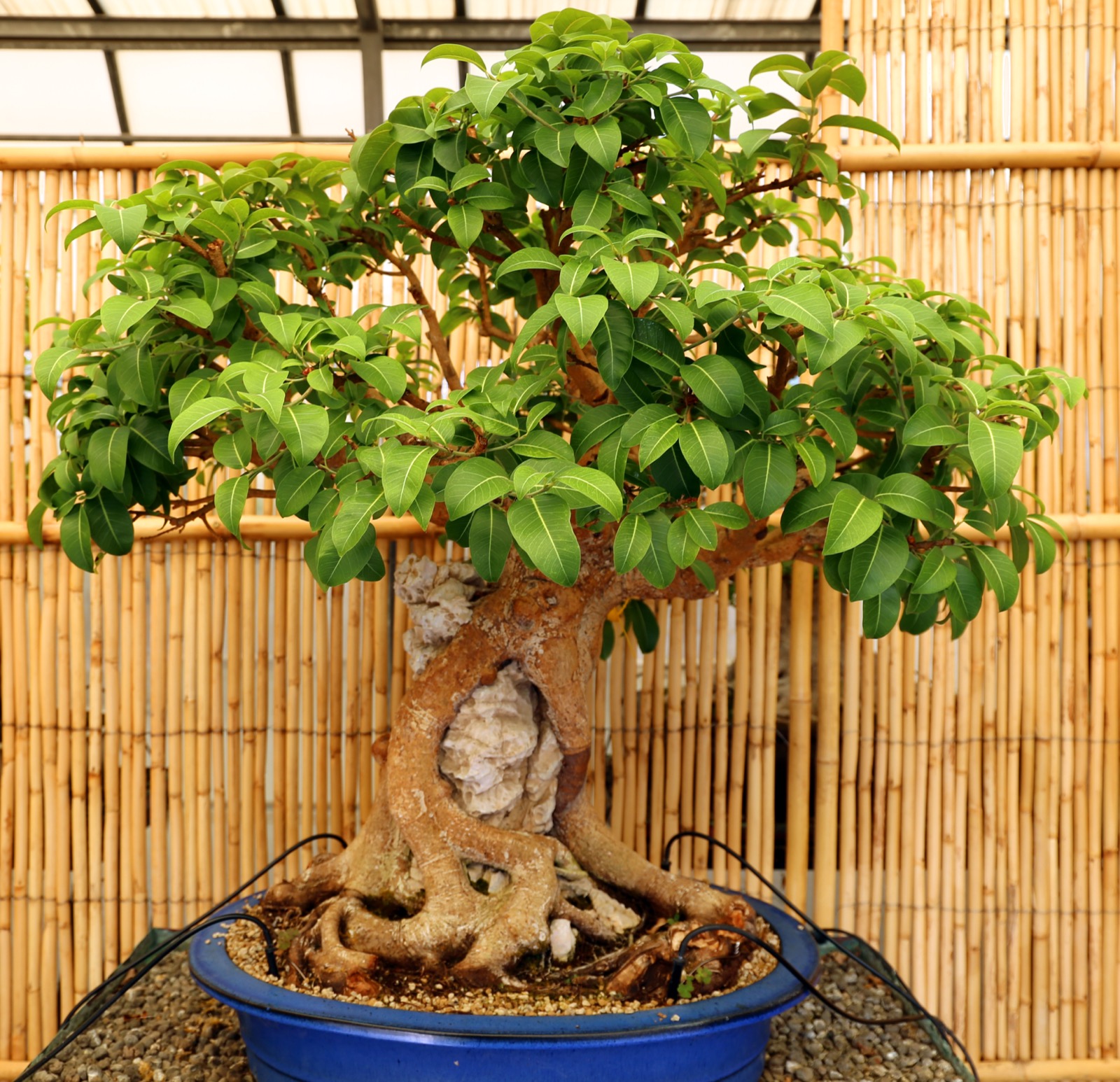
Ficus natalensis in ishitsuki style, roughly 40 years old, Museo del Bonsai, Pescia, Italy — its roots wrap a stone set into the trunk's base before reaching the soil. / Photo by Sailko, CC BY-SA 4.0, via Wikimedia Commons — Source

The second lesson is color, and it takes even longer
A valley's other lesson is color rather than form. Shaded most of the day and never far from running water, a ravine floor stays damp enough that moss and fern cover almost anything that holds still long enough — stone, fallen branch, exposed root. Yakushima's Shiratani Unsuikyo ravine, in the mountains of Kagoshima Prefecture, is an unusually well-documented example: a roughly 424-hectare nature park sitting between about 600 and 1,300 meters in elevation, its forest floor covered in ferns and mosses beneath Yakusugi (屋久杉, the local name reserved for Japanese cedars on the island once they pass a thousand years old) and laurel trees. Its moss-covered section is known as Koke-musu-mori ("moss-grown forest"), and the Kagoshima tourism authority credits it with inspiring Hayao Miyazaki's Princess Mononoke — where, it is said, staff had to work in at least 200 shades of green to carry the forest's own color onto the screen. A bonsai grower encouraging moss to spread over an ishitsuki planting's exposed roots and soil is after the same effect at pot scale. The moss is evidence rather than ornament: the visible sign that a composition has been left undisturbed long enough for something to settle onto it.
Every element in the pot stands in for a piece of terrain
Put the two lessons together and an ishitsuki composition is doing more than showing off a root's grip. Set it in a shallow water tray, a suiban (水盤), and the stream a valley tree would actually stand beside enters the picture too — the whole ravine wall of stone, root, water and moss folded into something a person can lift with two hands. Each element is standing in for a piece of terrain a valley tree spent a lifetime negotiating.
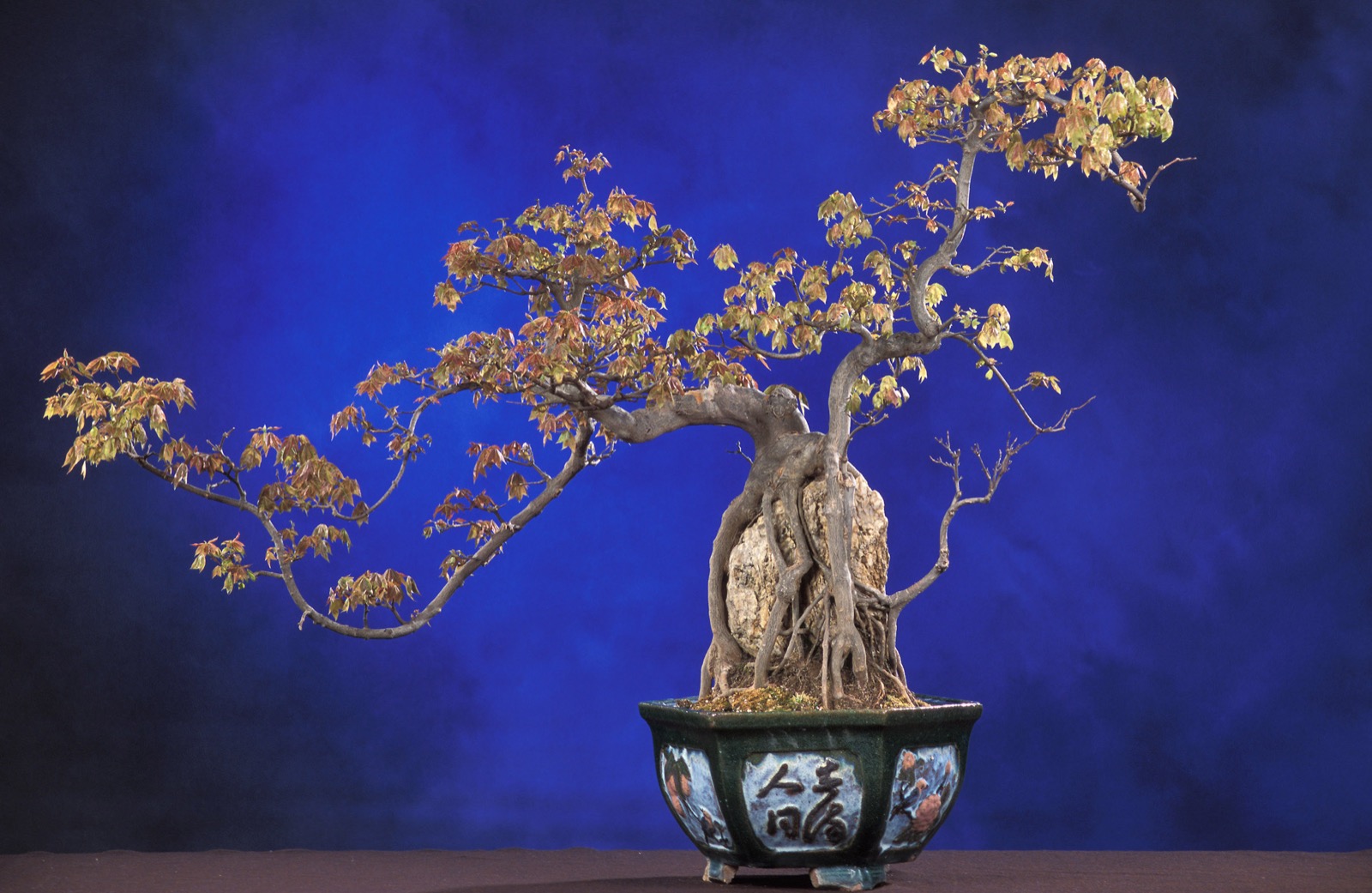
A trident maple (Acer buergerianum) at the National Bonsai and Penjing Museum, its roots grown over a rock and its foliage trimmed into the shape of a dragon. / Photo by Peggy Greb, USDA Agricultural Research Service, public domain, via Wikimedia Commons — Source

The waiting is the technique
None of this can be shortened past its own pace. A root bound to a rock this spring will not grip on its own for the better part of a year, and the moss that finally makes the composition look like it belongs in a ravine takes longer still. That patience is the actual subject of an ishitsuki planting, more than the finished shape is — a record of a grower agreeing to work at the valley's speed rather than the workshop's. It is also the one thing worth asking about if such a tree is ever put in front of you: how long the roots have already been on that stone. The grip is what took the years. Nothing else in the composition did.
Azukari is built around that same arithmetic. A tree trained in this style stays in Japan and keeps doing its slow work in an artist's garden, the roots tightening on the stone season by season whether or not its owner is standing anywhere near it. What an owner receives is not a shortcut through those years but a share in them.
For more on how bonsai's forms come from nature, see "Nature Is the Textbook," "What Coastal Pines Teach," and "Nebari: What the Roots Say."
References
- Bonsai Empire — Rock Planting — gives the Japanese names for the style as "Seki-joju / Ishisuki," notes that trees growing in or on rock "have to struggle to find nutrients in a harsh environment," and adds that a bonsai can be grown on a rock without a pot, in which case "regular watering will be very important."
- InBonsai — Bonsai Root Over Rock: Complete Ishitsuki Guide — the two variations (sekijoju, "roots growing directly inside the rock, utilizing natural crevices," versus roots that "flow across the outside surface of the rock and extend into the pot below"); "after 6-12 months, roots will have gripped the rock independently" and the advice to "allow at minimum 12 months before assessing the result"; and trident and Japanese maple as species with "dramatic surface roots that look spectacular draped over rocks," though "slower growing than Ficus." The page ranks ficus first for beginners and groups pine with juniper as best for experienced growers.
- DISCOVER KAGOSHIMA — Shiratani Unsuikyo Ravine — official Kagoshima tourism page: "a nature park spanning 424 hectares," "around 600-1,300m above sea level," a forest floor "covered in verdant green plants like ferns and mosses," made up of "Yakusugi cedar and laurel trees," and the moss-covered forest (Koke-musu-mori) "which inspired director Hayao Miyazaki's Studio Ghibli film, Princess Mononoke," where "staff had to incorporate at least 200 shades of green."
- Ministry of the Environment — Yakushima World Natural Heritage, "Yakusugi" trees — the official definition: "among the trees found on Yakushima, those older than one thousand years are called Yakusugi."
- Wikimedia Commons — File: Mononoke mori Yakushima 02.jpg — source and license (CC BY-SA 3.0, photo by Chris 73, 2008) for the header image; the file describes it as "landscape in and around Shiratani Unsuikyo forest... on Yakushima."
- Wikimedia Commons — File: Pescia, museo del bonsai, ficus natalensis, stile ishitsuki... — source and license (CC BY-SA 4.0, photo by Sailko) for the ishitsuki ficus image, whose description gives the species, the ishitsuki style and "circa 40 anni."
- Wikimedia Commons — File: BonsaiTridentMaple.jpg — source and license (public domain, photo by Peggy Greb, USDA Agricultural Research Service) for the trident maple image; the description states the tree "has its roots growing over a rock and its foliage and stems trimmed in the shape of a dragon."