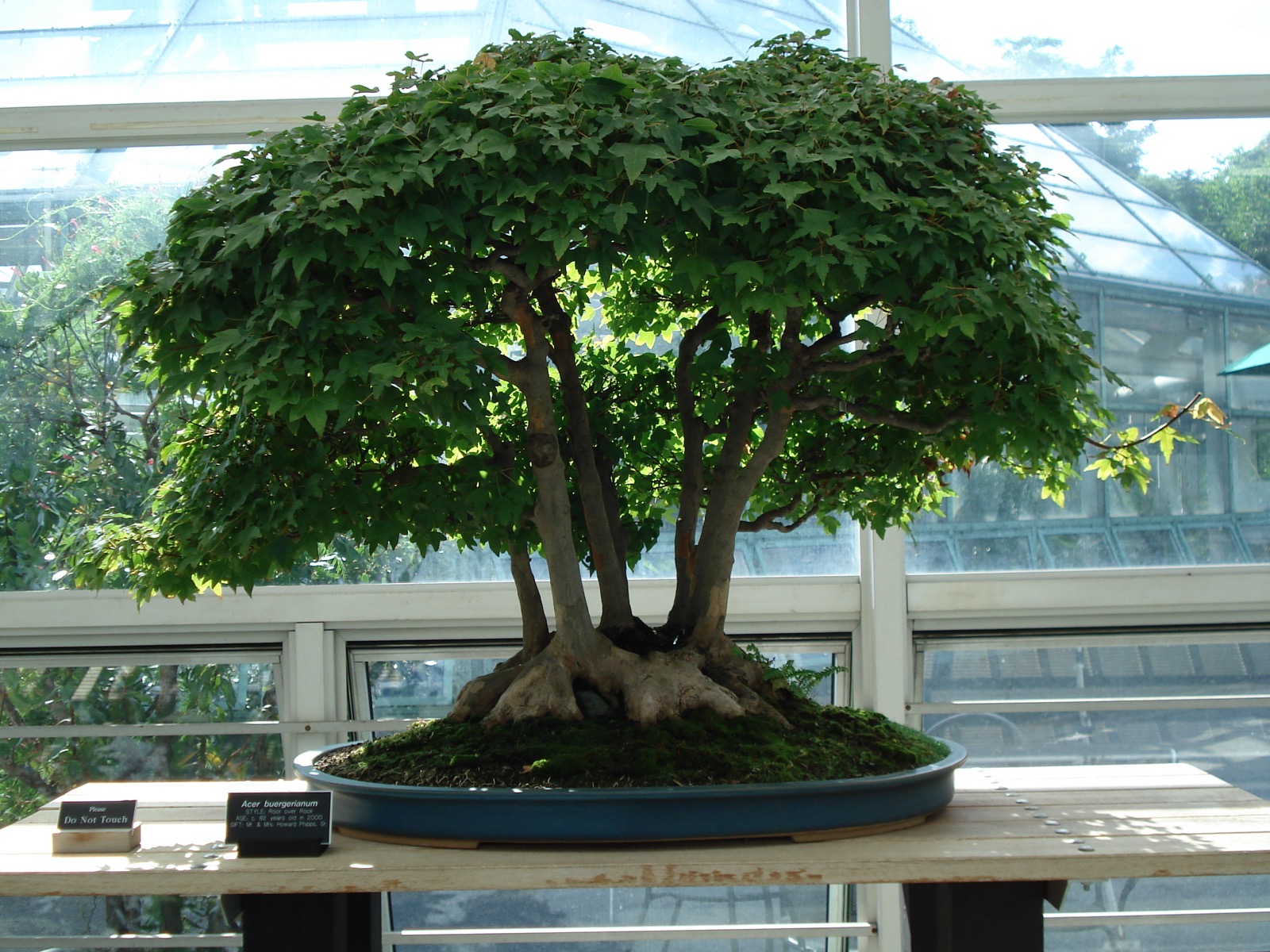
Acer buergerianum (trident maple), identified in the Brooklyn Botanic Garden's bonsai collection record as roughly 89 years old, in root-over-rock style. / Photo by Jeffrey O. Gustafson, CC BY-SA 3.0, via Wikimedia Commons — Source

A newly bound ishitsuki root gets its wire checked at three or four months. It is usually not ready to have that wire removed for another six months to a year — the point at which the root has gripped the rock firmly enough to hold its own position rather than depend on the binding. Even then, the tree does not look finished. It looks assembled: a young trunk with wire still visible near its base, waiting on years it cannot skip.
Ishitsuki asks a bonsai's roots to do exactly what a root does on a real cliff face: grip the stone instead of avoiding it, until root and rock are no longer easy to tell apart.
The stone becomes part of the tree, not a stand for it
Ishitsuki (石付き, "attached to stone") is the bonsai style in which a tree's roots are trained to travel across, or into, a rock on their way to soil — so that the stone becomes as much a part of the finished composition as the trunk above it. Growers build it in two ways. In the more common approach, the rock sits inside an ordinary pot or shallow tray, and the roots are bound to its outer surface, following every ledge and crack downward until they reach the soil beneath. In the rarer approach, the rock itself becomes the container: roots grow directly into its natural fissures, drawing on whatever soil and moisture collect there, with little or no separate soil bed at all. Some nurseries reserve the term sekijoju for one of these two approaches and keep ishitsuki for the other, though the split is not applied consistently across sources — in practice, both are usually grouped under the same style.
Not every tree qualifies as material for either approach. A young specimen with several long, still-flexible roots is needed, since a root that has already turned woody will crack rather than bend around a stone. The rock is chosen with equal care — one with genuine ledges and crevices for a root to travel through, not a smooth boulder a root can only lie against. Once tree and rock are matched, the roots are bound to the stone with thin wire or raffia, wrapped loosely enough to leave room for the root to thicken as it grows.
A rock-bound root dries out faster than an ordinary one
None of what follows the binding can be hurried. A rock-bound root has far less soil to draw water and nutrients from than a root growing in open ground, so a planting like this dries out faster than an ordinary bonsai and cannot be left unattended for long. It takes years more, sometimes decades, of steady watering and unhurried growth before the root has thickened enough that a viewer can no longer tell where the stone ends and the tree begins.
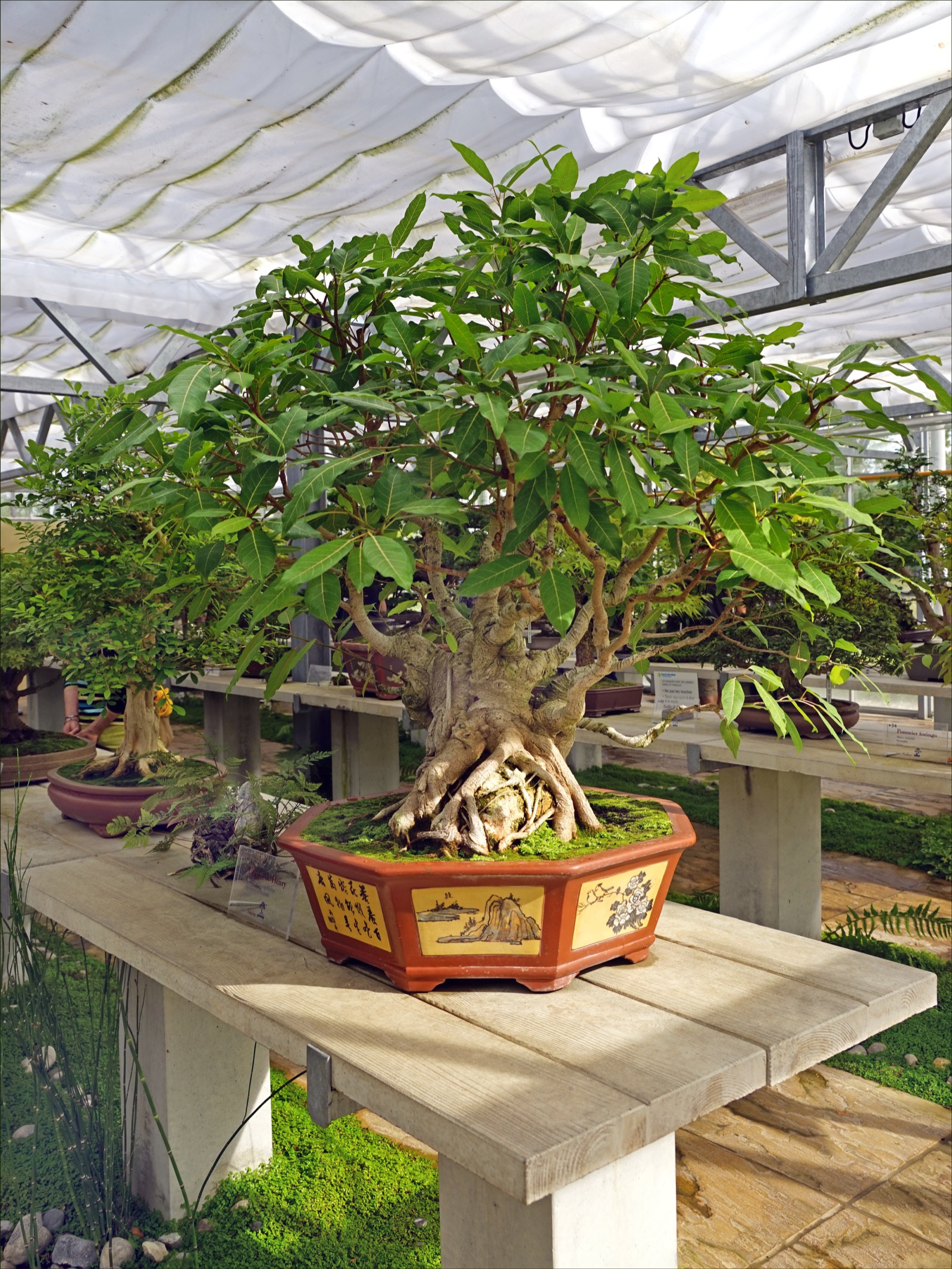
Ficus sarmentosa Henryi, recorded in the Rémy Samson bonsai collection as roughly 95 years old, in sekijoju style, Arboretum de la Vallée-aux-Loups, France. / Photo by Jean-Pierre Dalbéra, CC BY 2.0, via Wikimedia Commons — Source

That slow fusion, more than the finished shape, is the actual subject of an ishitsuki planting. Growers speak of a strong rock planting having good keshiki (景色, "scenery," the overall view a composition presents), and keshiki of this kind does not appear inside a single growing season. It is the visible residue of however many years a root has spent gripping a stone before anyone thought to call the result finished — which is also the practical test for anyone evaluating a rock planting rather than growing one: a tree offered as a finished ishitsuki within its first year or two has not yet earned the description, whatever the wiring skill behind it.
Ishitsuki copies the mountain instead of compressing it
Among the many ways bonsai borrows its shapes from a distant landscape — a bent trunk standing for decades of wind, a stand of a few trees standing for an entire forest — ishitsuki is close to a direct copy. A root meeting a boulder in a mountain valley behaves exactly as an ishitsuki root is trained to: it does not stop, it spreads across the stone and follows its cracks downward until it finds soil. Maple, especially trident and Japanese maple, is prized for the style because its fine, fibrous roots drape over a rock with more visible drama than a pine's coarser roots manage, though juniper, pine, ficus, and some flowering and fruiting species are trained this way as well.
The rock stays real, but the eye is asked to see a mountain
Ishitsuki is also, without needing to announce itself as such, a condensed exercise in mitate (見立て, "seeing-as," the Japanese practice of letting one object stand in for another). The rock in the pot is a real rock, not a sculpture shaped to resemble a mountain, yet it is asked to be read as one — a cliff face, a gorge wall, a boulder in a streambed — in much the same way a dry garden's raked gravel is asked to be read as flowing water. Set the whole composition in a shallow water tray, or suiban (水盤, a flat tray used to suggest an expanse of water or ground), and the illusion widens further: the tray's rim becomes a riverbank, the space around the rock becomes the water a valley tree would actually be standing beside. Nothing in an ishitsuki planting is a literal miniature of a landscape. Every part of it is a real, physical stand-in, arranged so a viewer supplies the rest.
The record is years, not a finished shape
An ishitsuki planting cannot be rushed into looking like anything other than what it is at any given month: a young tree with wire around its roots, or an older one still short of the point where root and stone read as one. What eventually arrives is simply years, given without a shortcut.
Azukari exists to keep that kind of year. A tree trained in this style needs its wire checked at three or four months and left largely alone for most of a year after that, then watered on a schedule tighter than an ordinary bonsai's for however many years the fusion takes — decisions an owner living nine time zones away has no way to make in person. What arrives instead, through the record kept along the way, is not a finished rock planting handed over on day one, but confirmation, season by season, that someone checked the wire when it needed checking.
For more on how bonsai borrows its shapes from nature and its methods from a wider Japanese aesthetic, see "What Valley Trees Teach," "What Is Mitate," and "Karesansui: A Landscape Without Water."
References
- Bonsai Empire — Rock Planting — on rock plantings (seki-joju / ishisuki), rock selection with cracks and holes for root growth, soil mixtures, and spring planting timing.
- InBonsai — Bonsai Root Over Rock: Complete Ishitsuki Guide — the two ishitsuki methods (rock as container vs. rock set in soil), the roughly six-to-twelve-month timeline for roots to grip a rock, wire-checking schedule, and species prized for the style.
- Wikipedia — "Bonsai styles" — definitions of sekijoju (root-over-rock) and ishizuke/ishitsuki (clinging-to-rock) as related but distinct rock-grown forms.
- Bonsai Society of Greater Cincinnati — "Root-over-Rock: Sekijoju" — technique notes and a list of species suited to the style, including maples, pines, junipers, and flowering and fruiting varieties.
- Wikimedia Commons — File: Acer Buergerianum bonsai 2.JPG — source and license (CC BY-SA 3.0, photo by Jeffrey O. Gustafson) for the header image.
- Wikimedia Commons — File: Bonsaï sekijoju dans l'Arboretum de la Vallée-aux-Loups — source and license (CC BY 2.0, photo by Jean-Pierre Dalbéra) for the second image.