
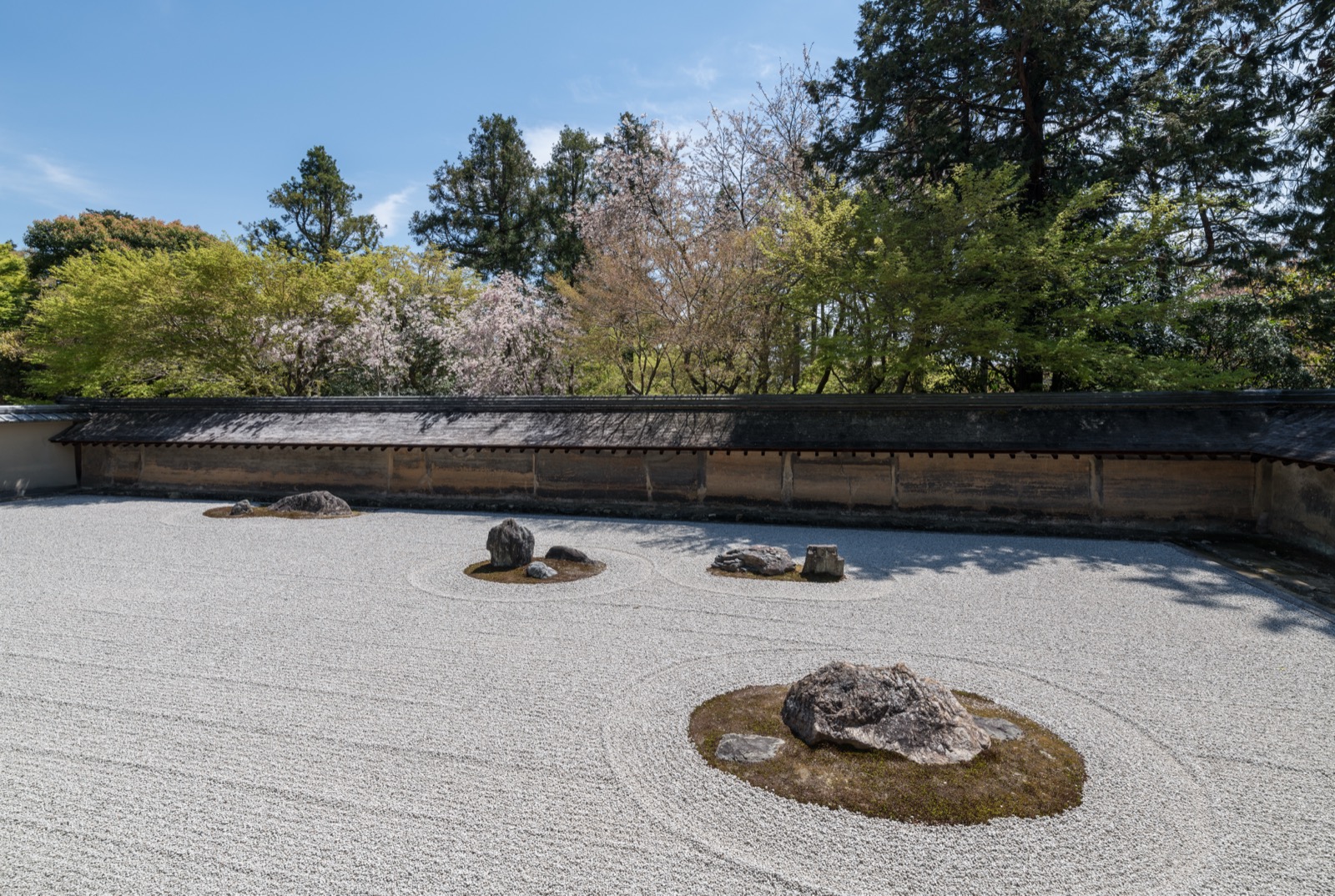
No water has ever touched the garden at Ryoan-ji. What runs through it is raked gravel, and what makes it look like water is an agreement between the garden and the person looking at it.
This is karesansui (枯山水, "dry landscape," a garden built entirely from stone, gravel, and raked sand, without a pond or a stream anywhere in it). The rocks are read as mountains or islands. The combed gravel is read as a current, a wave, or a sheet of still water. Nothing here is a special effect. It works because a set of conventions, developed over centuries at Zen temples, taught the eye what to do with an empty surface — and because the viewer still has to do the work of seeing it. This article looks at where those conventions came from, how the raking itself is done, and why the garden is only half-finished until someone stands in front of it.
A convention for reading raked lines as water
The technique itself is called samon (砂紋, "sand patterns," the lines raked into gravel or sand to suggest moving water). A wooden rake, drawn across white gravel in long parallel strokes, leaves a ridged surface that catches light the way ripples do. Tighter, closer lines read as a fast current or a small wave; wide, calm lines read as still water; a spiral raked around a stone reads as the eddy that forms where a current meets an obstacle. None of this is arbitrary decoration. Over time a working vocabulary of patterns settled into use — straight lines for a calm channel, swirling patterns for a whirlpool or for water meeting rock — so that a temple visitor trained in the convention could look at gravel and see, specifically, a river bending around an island rather than a woodland pond.
The rock plays the counterpart role. A single tall stone, or a small cluster of stones, is set to stand in for a mountain, a range of peaks, or an island rising out of the raked sea around it. At Ryoan-ji, in Kyoto, fifteen stones are arranged in five groupings — one group of five, two of three, two of two — inside a rectangle of gravel roughly 25 by 10 meters, the whole of it raked and re-raked by the temple's monks each day. What the stones are meant to depict has been argued over for centuries, with readings ranging from tiger cubs crossing a river to a scattering of distant mountain peaks, and garden historians such as Gunter Nitschke have argued the composition was never meant to resolve into one fixed picture at all. The garden's own design works against a single answer: the full composition cannot be seen at once from any single point on the veranda, so no viewer ever takes it in as a finished whole. What every reading agrees on is the mechanism — stone standing in for mass, raked gravel standing in for the water that moves around it.
Stone and raked lines can hold a whole river without a drop of water
Karesansui did not begin as a shortcut for temples without room for a pond. Rock gardens already existed in Japan by the Heian period, and Tachibana no Toshitsuna's eleventh-century garden manual, the Sakuteiki (作庭記, "records of garden making"), already used the term for gardens built without a water feature. But the form as it is recognized today took shape later, at Kyoto's Zen temples during the Muromachi period (1336–1573), as Zen Buddhism spread through the samurai class and its temples became centers of formal meditation training. A garden of only stone, gravel, and the occasional clipped shrub gave a temple a space that showed nature reduced to its bare structure — mountain, water, void — worth sitting with rather than strolling through.
Daisen-in, a sub-temple of Daitoku-ji built between 1509 and 1513, shows how deliberately the technique was used to build an actual narrative in miniature. Its long, narrow garden reads left to right as a river's entire course: stones standing in for a waterfall at its source, more stones set as rapids and a boat riding the current downstream, then the raked gravel widening into what the garden calls its "sea." At Daitoku-ji's sub-temple Zuiho-in, built in 1535, the raked patterns are kept unusually deep, so that the ridges still hold their form and catch shadow even under a fresh fall of snow — samon precise enough to survive a season it was never designed to face. A garden like this is not decoration set outside a meditation hall. It is an argument, worked out in stone and raked lines, that a mountain and a river can be present in a room without a single drop of water in it.
The garden only finishes once someone looks
None of this works without a viewer willing to do their share. A rock reads as a mountain only for someone prepared to see a mountain in it; raked gravel reads as a current only for an eye that already knows the convention linking tight parallel lines to moving water. Put differently: the monks who rake the gravel each morning are not painting a picture and handing it to you finished. They are setting a proposition, and the garden is not resolved into water and mountain until a visitor sits at the veranda and completes it in their own mind.
This is also why the patterns are raked new each day rather than fixed in place. A samon pattern left in loose gravel does not survive rain, wind, or footfall, so the monks at temples like Ryoan-ji redraw it each morning, and no two days produce quite the same lines. The garden a visitor sees at dawn is already a slightly different proposition than the one raked the morning before — the same stones, holding still, and a river that has to be re-imagined into being all over again. If you ever stand at that veranda yourself, resist the urge to solve the stones for a single answer — mountains, tiger cubs, islands, take your pick, none of it is the point. The narrower question the garden was actually built to test is whether the raked lines pull your eye into motion the way water does, or just sit there as gravel. That is the standard samon was designed to meet, and it is worth applying the next time gravel, or a tree's roots, is asking you to see something that is not physically there. A companion piece, "What Is Mitate," looks at this act of seeing-one-thing-as-another as a wider Japanese aesthetic method, tracing it from the tea room to the bonsai pot; this article has stayed with the dry garden itself, where that method first took the shape of an entire, walkable landscape built from nothing but stone and sand.
A bonsai pot asks for the same trained eye as a dry garden
The same trained eye that finds a river in raked gravel is the eye a bonsai asks you to bring to a pot.
A bonsai grown in the ishizuki (石付き, "root-over-rock," a style in which the tree's roots grip a stone rather than open soil) style sets a small tree's roots directly onto a rock, and asks the dry garden's own question in miniature: a tree beside a boulder, or a forest clinging to the side of a mountain, reduced to the scale of a pot. A tree's spreading nebari (根張り, "root flare," the visible spread of surface roots at the base of the trunk) is read the same way karesansui reads its raked lines — not as roots merely holding a tree upright, but as the ground itself, the base of a landscape the eye is asked to supply the rest of. In both cases, stone stands for more than stone, and the viewer's imagination is not a bonus but the final, necessary material the piece was built to receive.
This is worth sitting with, because it is easy to visit a dry garden or look at a root-over-rock bonsai and see only an arrangement of physical material — pebbles here, a trunk there. What the centuries at Ryoan-ji and Daisen-in actually built was a way of seeing that Japanese aesthetics carried forward into other, smaller forms: a single potted tree, cared for through the seasons, asking the same question a rectangle of raked gravel has asked visitors for five hundred years. Whether it is a garden the size of a temple courtyard or a tree the size of a single pot, the water was never the point. The point was always what appears once someone is willing to look.
References
- Wikipedia, "Japanese dry garden" — overview of karesansui history, the Sakuteiki, Ryoan-ji, and Daisen-in, and the four typical samon raking patterns (line, wave, scroll, check).
- Wikipedia, "Ryoan-ji" — layout of the fifteen stones in five groupings, the garden's approximately 248-square-meter dimensions, and its UNESCO World Heritage status.
- Wikipedia, "Daisen-in" — construction of Daisen-in between 1509 and 1513, and its garden read as a river's course from mountain source to sea.
- Yomimono.com, "Enjoying the Deep, Beautiful Samon of Daitoku-ji Zuiho-in" — on Zuiho-in's 1535 founding and its unusually deep raked patterns, maintained by the temple's own priest.
- Karesansui-meguri, "What Is Samon in a Dry Garden?" — explanation of samon, its alternate name hokime ("broom-tracks"), and the range of named raking patterns used to depict water.
- Wikimedia Commons, "Kare-sansui zen garden, Ryoan-ji, Kyoto" — photograph used above, by DXR, licensed CC BY-SA 4.0.
