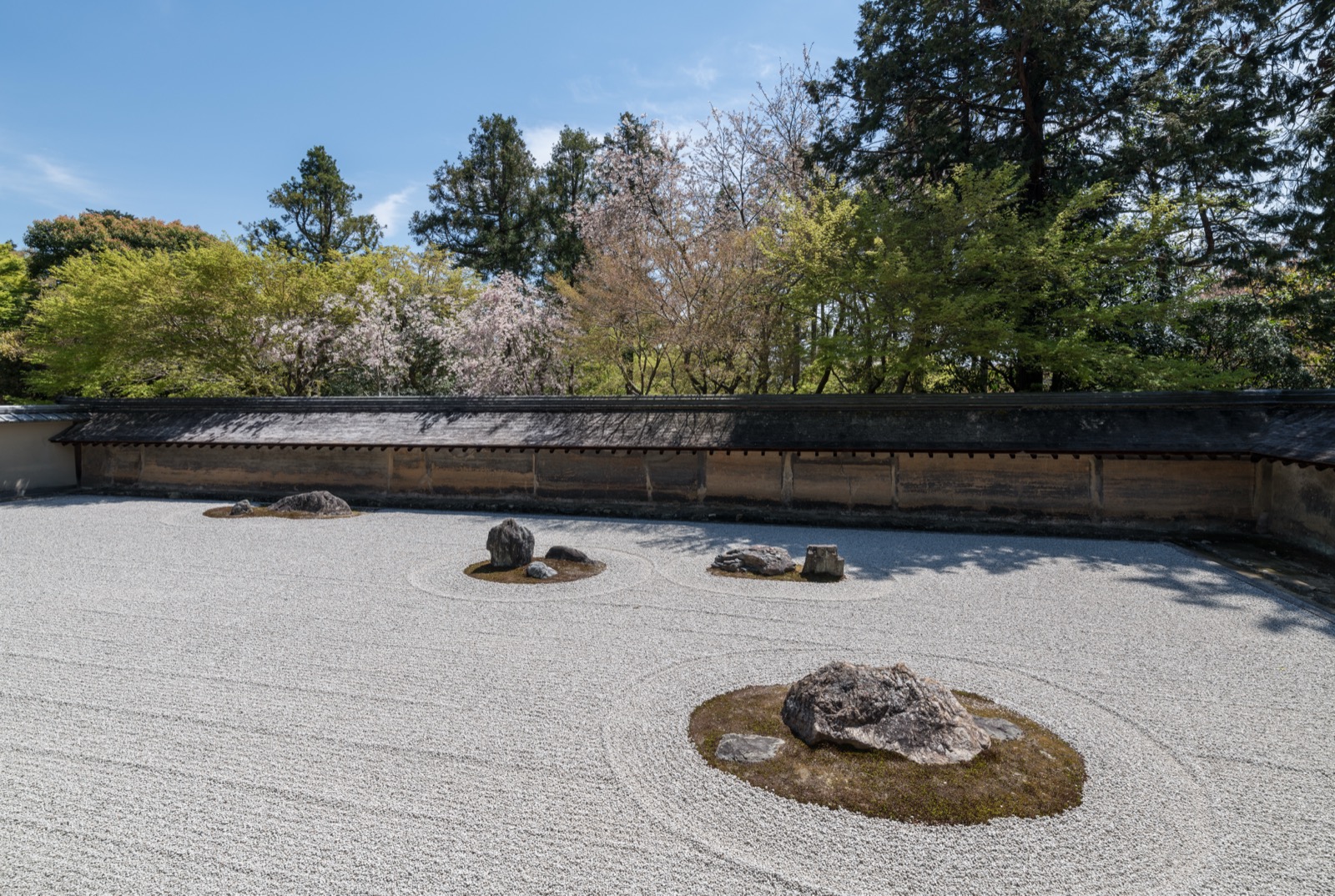
Fifteen stones, five groupings, one rectangle of raked white gravel: that is the entire garden at Ryoan-ji in Kyoto, built in the late fifteenth century, and it holds no water and not a single tree. A stone becomes a mountain, and gravel becomes the sea, only in the moment a viewer decides to see it that way — the beauty belongs as much to the one who looks as to the one who arranged the stone.
This act of seeing one thing as another has a name in Japanese: mitate (見立て, "seeing-as," the practice of perceiving one object through the form of another). It is not an optical trick, and it is not a metaphor confined to poetry. It became a working method that shaped how Japan built gardens, chose tea bowls, and eventually trained a tree into the shape of a landscape. This article follows that method from a bare garden of stones to a tea master's basket, and ends with the tree that still carries the idea today.
The garden supplies a shape, not a scene
Walk into Ryoan-ji and there is nothing to identify: no pond, no stream, no planting bed. The garden is counted among the finest surviving examples of karesansui (枯山水, "dry landscape," a garden built without water), and one standard account of the form describes its stones and raked gravel as "intended to imitate the essence of nature, not its actual appearance, and to serve as an aid for meditation."
None of the fifteen stones is a literal mountain. None of the gravel is literal water. A grouping of rock stands in for a mountain range or a distant island; the gravel, combed into fine parallel lines, stands in for moving water. The garden supplies only the arrangement — the mountain and the sea arrive when a viewer looks at the stone and agrees to see it that way. Karesansui is, in this sense, mitate built directly into landscape design: the designer's task is not to depict water but to leave a shape convincing enough that a viewer will supply the water unprompted.
This inverts an assumption many visitors bring to a Japanese garden. The garden is not there to represent nature for you. It hands over an incomplete image and leaves the rest of the work to whoever is standing in front of it.
Rikyu turned repurposing into a discipline
Mitate did not stay inside temple gardens. By the sixteenth century it had become a working principle of the tea ceremony, and the tea master most closely associated with carrying it there is Sen no Rikyu (千利休, 1522–1591), credited with bringing the concept into chanoyu (茶の湯, the tea ceremony) as a deliberate aesthetic tool.
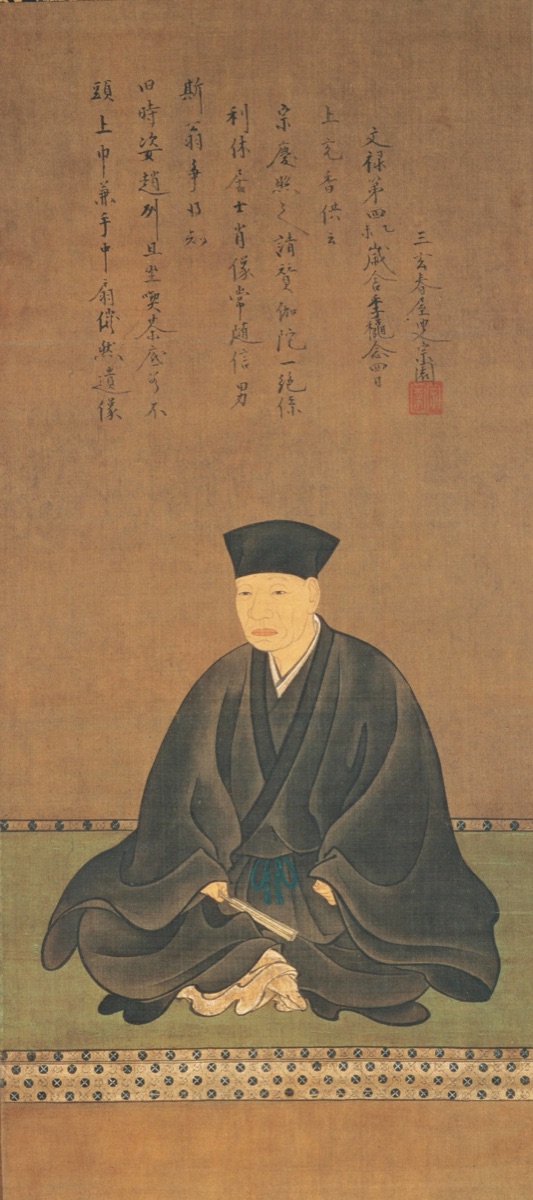
Sen no Rikyu, the tea master most closely associated with bringing mitate into the tea ceremony.
Rikyu's version of mitate meant taking an object built for one purpose and seeing it, without alteration, as serving another. The Omotesenke school of tea, one of the tradition's principal lineages, defines the term plainly in its own account of tea utensils: mitate is "to see an object, not in the form that was originally intended for it, but as another thing." Its listed examples include a water-carrying gourd flask repurposed as a flower container, and a boat's low boarding entrance reimagined as the nijiriguchi (躙口, the crawl-through entrance of a tea room). Rustic Korean bowls made for daily use were brought into the tea room and treated as tea bowls, not because they were made for the ceremony but because a discerning eye judged them fit for it.
None of this was about scarcity or thrift. It argued that beauty and worth are not properties stamped into an object at the moment of its making — they are conferred later, by the eye that recognizes them in a setting the maker never anticipated. A fisherman's basket did not become elegant when Rikyu placed flowers in it. It became elegant when someone was willing to look at it that way.
The viewer finishes what the maker started
What connects the dry garden and the tea room is a single working assumption: an arrangement is not finished until someone looks at it and closes the gap between what is physically present and what it is being asked to resemble.
This places real responsibility on the viewer, not only the maker. A rock garden built with painstaking care shows nothing at all to a visitor unwilling to look for a mountain in a stone. A tea bowl selected with Rikyu's discernment looks, to an untrained eye, like a rough piece of pottery and nothing more. The maker's craft supplies the possibility of seeing; the viewer's practiced eye is what actually brings the mountain, the sea, or the bowl's elegance into being. Mitate asks for restraint from whoever arranges the scene, and patience from whoever looks at it.
This is also why mitate has never been treated in Japan as a lesser, playful cousin of "real" representation. A garden with an actual pond has done less imaginative work than one that convinces a visitor gravel is water. The more restrained the material, the more the finished beauty depends on the viewer's own act of seeing — which is exactly why karesansui and Rikyu's tea utensils are still studied centuries later as one aesthetic method, not two customs that happen to share a name.
A bonsai is a mitate that never finishes
A bonsai is a mitate of an entire landscape. A trunk leaning under the memory of wind reads as a mountainside pine shaped by decades of weather, though the tree itself is small, potted, and has felt no such wind — the lean is arranged so a viewer supplies the weather anyway. The moss at its base stands in for a forest floor it has never touched. The pot beneath it works less like ground than like a frame, narrow enough that the eye leaps past it to the scene the tree implies.
This is the same operation as the stone at Ryoan-ji standing in for a mountain, and the same operation as a gourd flask standing in for a vase — except a bonsai never lets the viewer finish the job once and move on. A tree changes with the season and with age, so the gap between what is present and what it implies has to be closed again every time someone looks. That is also why mitate and suiseki (水石, viewing stones) sit so close together as practices — a companion piece, "Bonsai and Suiseki," looks at how an unaltered stone is read as a mountain or a waterfall, while this article has traced the wider aesthetic of seeing-as that suiseki belongs to. For how the same act of seeing applies to a tree rather than a stone or a bowl, see "Bonsai Is Not a Small Tree," and for how mitate fits into the broader practice of arranging bonsai, stones, and space together, see "What Is Keido?"
The next time an arrangement looks unfinished — a bare garden, a plain bowl, a small tree in a pot — that gap is not a flaw to overlook. It is the half of the work that was always meant to be yours.
References
- Wikipedia, "Japanese dry garden" — overview of karesansui, its Muromachi-period Zen origins, and Ryoan-ji as a representative example.
- Omotesenke Fushin'an, "Tea Utensils: 'Mitate'" — the Omotesenke school's own definition of mitate and its examples of repurposed objects in tea practice.
- Kogei Art Kyoto, "Mitate: The Creative Spirit of Japanese Art and the Way of Tea" — on Sen no Rikyu's use of mitate in tea bowls, hanging scrolls, and the design of the tea room.
- Wikipedia, "Sen no Rikyu" — biographical background on the tea master credited with shaping wabi-cha and the aesthetic use of mitate.
- Wikimedia Commons, "Kare-sansui zen garden, Ryoan-ji, Kyoto" — photograph used above, by DXR, licensed CC BY-SA 4.0.
