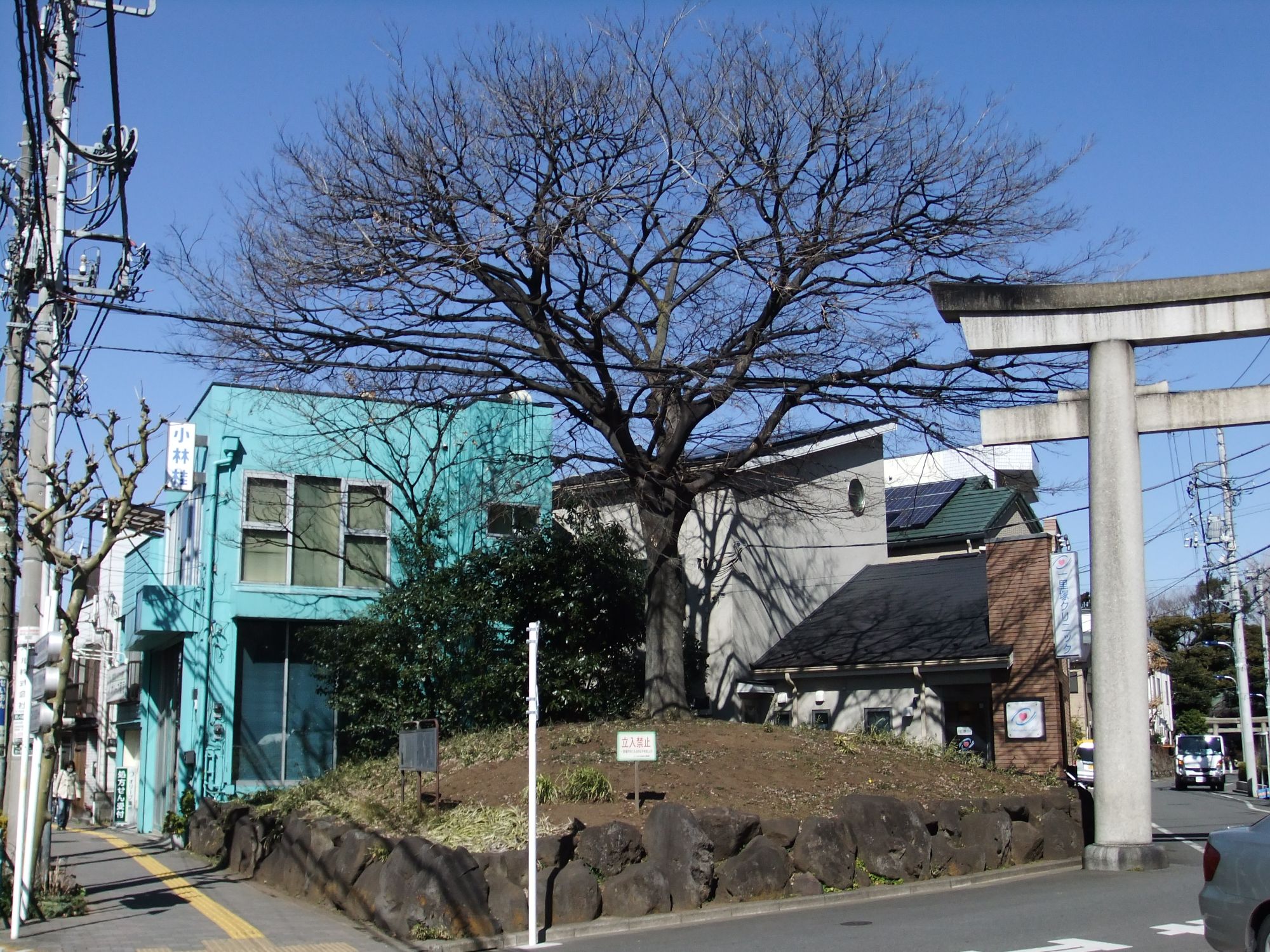
A winter enoki spreading over the mound of Nishigahara Ichirizuka, a road marker planted in 1604. Photo by Tak1701d, public domain, via Wikimedia Commons — Source

A tree that grows entirely alone — no neighbor crowding one side, no cliff forcing a lean, no coastal wind combing its branches into a single sweep — ends up with the plainest shape in nature: a trunk rising straight or gently curved, a crown spread wide and even in every direction. It sounds like the least interesting tree to study. It is, in fact, one of the most instructive.
A tree given open ground and nothing to fight for grows the most balanced form in nature, and that plain balance is exactly what a bonsai artist training a chokkan or a moyogi is trying to reproduce.
A crown with room on every side
Arborists draw a firm line between an "open-grown" tree and a forest-grown one, and the difference comes down to company. A tree competing with neighbors for a gap in the canopy grows tall and narrow, its lower branches starved of light and shed early, its trunk running up with little taper because there is no reason to build strength low down. A tree with no competitor does the opposite: it keeps its lower branches, because light reaches them from every side, and it spreads outward rather than upward, because there is nothing above it to climb over. The result, as arborists comparing the two forms have put it, is a tree "well adjusted to its setting" — wide, low-crowned, thickly tapered from base to tip, and structurally sound enough to stand alone against wind a forest would otherwise have blocked for it. Japanese forestry keeps its own version of the same distinction, sorting species into yoju (陽樹, "light-loving trees") that thrive in exactly this kind of open exposure, and inju (陰樹, "shade-tolerant trees") that need a forest's shelter to get established at all. Pines and keyaki (欅, "zelkova") are classic yoju — one reason they are so often the species found standing by themselves in open country, and, not coincidentally, among the species most often trained as bonsai.
Trees planted to stand alone
Japan's clearest historical case of the deliberately solitary tree is not a wild specimen at all, but a planted one. In 1604 the Tokugawa shogunate ordered mounds raised at one-ri intervals — a ri (里) then measuring roughly 3.9 kilometers — along the great roads radiating from Nihonbashi in Edo, so that travelers and porters could reckon distance and fare. Each ichirizuka (一里塚, "one-ri mound") was planted with a single tree, most often an enoki (榎, "Japanese hackberry," Celtis sinensis var. japonica) or a Japanese red pine, chosen for shade rather than beauty. The tree had one job: stand where it could be seen from a distance across open farmland, and give a resting traveler somewhere to sit. Most of the thousands built across the country were leveled after an 1876 abolition order and the road-widening that followed; a bare sixteen are still protected today as National Historic Sites. One, at Nishigahara in Tokyo, survives because local residents and the industrialist Shibusawa Eiichi petitioned to have a modern road diverted around it rather than through it — its enoki, pictured above, still spreads a full, symmetrical crown over the mound more than four centuries after it was planted for exactly that purpose. Another, at Nomura in Mie Prefecture, carries a muku (椋, "Japanese muku tree," Aphananthe aspera) estimated at around 400 years old. Neither tree had to compete for anything. That absence of competition is precisely what a passing bonsai artist would notice first.
Two forms, one habit
This is the habit an artist is reading when they set out to train a chokkan or a moyogi, the two forms introduced in our overview of bonsai's tree shapes. A conifer growing alone, its apex never shaded out and never pulled sideways toward a gap in a canopy, tends to hold its single leading shoot straight upward rather than lean the way a forest tree must — more or less the origin of chokkan's uncompromising vertical line. A broadleaf tree grown the same way, free to widen rather than climb, develops the low, evenly branched, gently irregular crown that gives moyogi its logic: not a straight line, but a balanced one. One bonsai style guide states the standard plainly, describing the informal upright as modeling "a mature tree that grows in an open space with plenty of sunlight, free from extreme environmental influences" — a fair description of an ichirizuka enoki, or of any solitary tree left to answer to nothing but the light falling on it from every side. It is worth setting this beside the other trees this series has looked at. A fukinagashi pine is shaped by an opponent, the coastal wind, that never lets up. A solitary field tree has no such opponent. Its form is not a record of resistance; it is a record of the absence of one — arguably a harder shape to train convincingly into a pot, precisely because there is no dramatic story to lean the design on.
The plain kind of good fortune
That is also what sets this tree apart from the ones this series returns to more often — the wind-bent coastal pine, the rock-gripping root, the storm-scarred ridge tree. A solitary tree standing among rice fields or beside a village road was not tested by hardship. Its good fortune was ordinary: enough ground, enough light, enough years left undisturbed by axe or storm. Bonsai has room for both kinds of tree. It is easy to romanticize the ones shaped by struggle and overlook what a species does with a plain chance to grow well, which is, after all, the more common condition most trees actually get.
Closing
An artist training a chokkan or a moyogi is not inventing a shape. They are reading the same plain arithmetic a field tree works out on its own — sunlight from every side, no rival to answer, no reason for the trunk to do anything but stand where it was left. Azukari keeps its trees in the hands of artists who still check their work against that standard: not a fashion, not a flourish, but the shape a tree settles into when it is finally given room enough to be itself.
For more on how bonsai's basic forms are read, see "Reading a Bonsai's Form," "Chokkan: The Formal Upright," and "What Coastal Pines Teach."
References
- Wikipedia — Ichirizuka — the 1604 establishment of one-ri road markers by the Tokugawa shogunate, their planting with enoki or red pine, the 1876 abolition order, and the sixteen mounds surviving today as National Historic Sites.
- Wikipedia — Nishigahara Ichirizuka — the Tokyo mound's enoki plantings and its preservation through a petition led by Shibusawa Eiichi that diverted a modern road around it.
- Wikipedia — Nomura Ichirizuka — the Mie Prefecture mound's muku tree, estimated at around 400 years old, and its 1934 designation as a National Historic Site.
- "From Acorn to Ancient" — contrasting open-grown and forest trees, Arboriculture — the structural differences between open-grown and forest-grown trees in crown width, taper, and branch retention.
- Bonsaiable — Informal Upright Bonsai Fundamentals — moyogi described as modeling a mature tree grown in an open space with plenty of sunlight, free from extreme environmental influences.