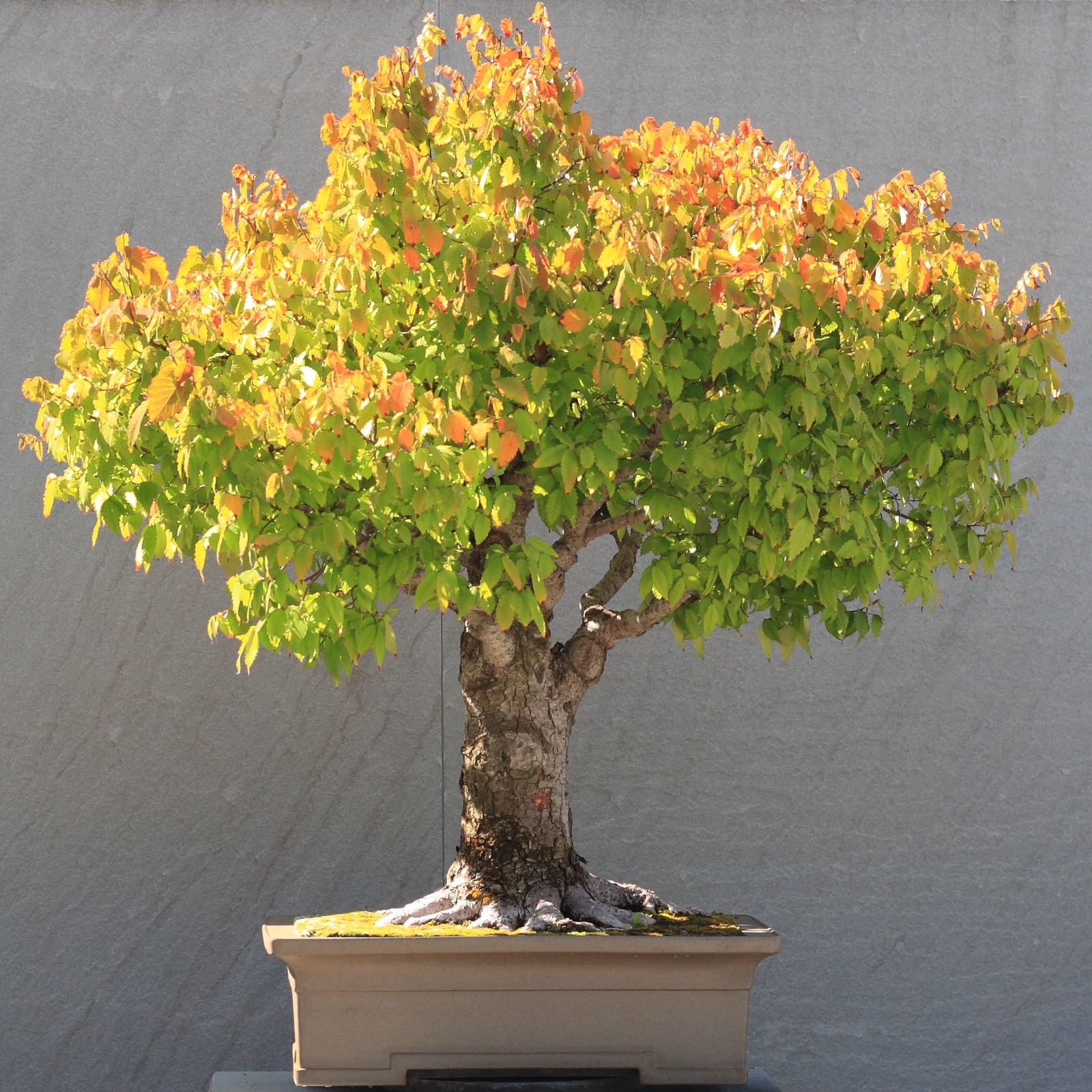
Photo by Sage Ross, CC BY-SA 3.0, via Wikimedia Commons — Source

The broom style, hoki-zukuri (箒作り, "broom-made," also known as hokidachi, 箒立ち, "broom-standing"), is the shape a Japanese zelkova finds almost on its own: a single upright trunk that splits into branches radiating outward in every direction, tracing the same rounded, umbrella-like head the tree wears when it grows to full size in open ground.
No other bonsai style is so closely tied to one species. Pines are trained into a dozen different silhouettes; the keyaki (欅, the Japanese name for Zelkova serrata), more often than not, becomes a broom.
The trunk stops a third of the way up
The style has a fairly precise architecture. The trunk rises straight and does not run to the top of the tree — it divides, typically at around a third of the total height, into a spray of branches that fan out and up. The lower third stays bare, showing trunk and nebari (根張り, "surface roots"); the upper two thirds fill in as a dense, ball-shaped crown. Seen from a distance, the whole tree reads as a single dome balanced on a short, thick column.
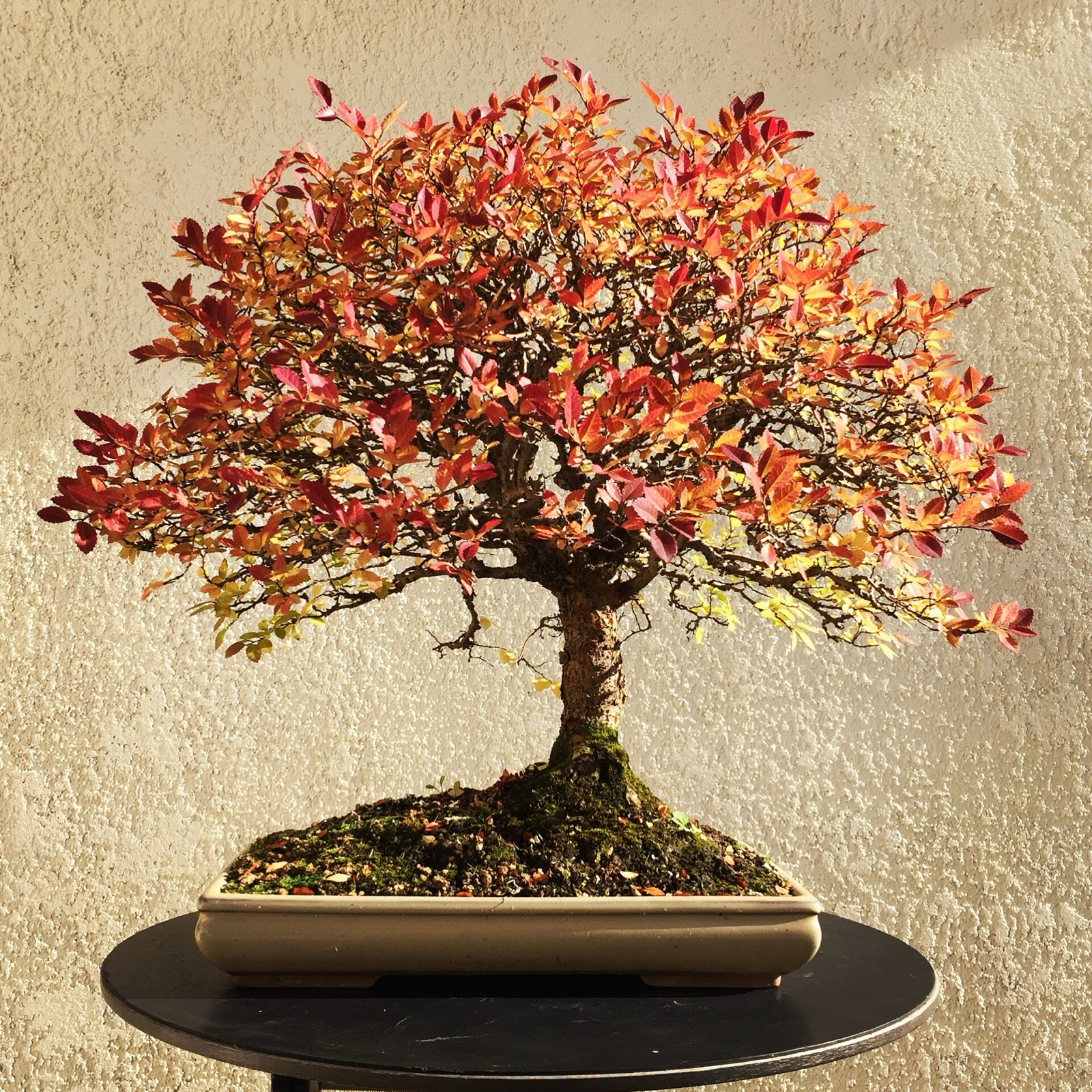
A broom-style zelkova in autumn color: the trunk divides low, and everything above it is branch. Photo by Nejikan, CC BY-SA 4.0, via Wikimedia Commons — Source

At the Omiya Bonsai Art Museum in Saitama, a specimen catalogued as A-114 — a keyaki reported at an estimated 120 years old and only 67 cm tall — is shown as an example of exactly this construction. The museum's own description states that its foliage "has been tailored to radiate out in a bonsai style called hoki-zukuri," adding that "a sense of stability is created from its sprawling roots and thick trunk" and that the combination "gives off the feel of a large tree." A tree well under a meter reads, at a glance, as something considerably bigger — which is precisely the trick the style is built to perform.
The style was recognized, not invented
The style did not have to be invented for the species; it mostly had to be recognized. Zelkova serrata — a member of the elm family, Ulmaceae, native to Japan, Korea, Taiwan, and eastern China — is described in botanical references as having "a short trunk dividing into many upright and erect spreading stems forming a broad, round-topped head." Anyone who has walked a Japanese avenue lined with mature keyaki has already seen the broom shape at full scale; the bonsai version compresses the same silhouette into a container. One long-running care guide calls the species outright "the prototype of the broomstyle."
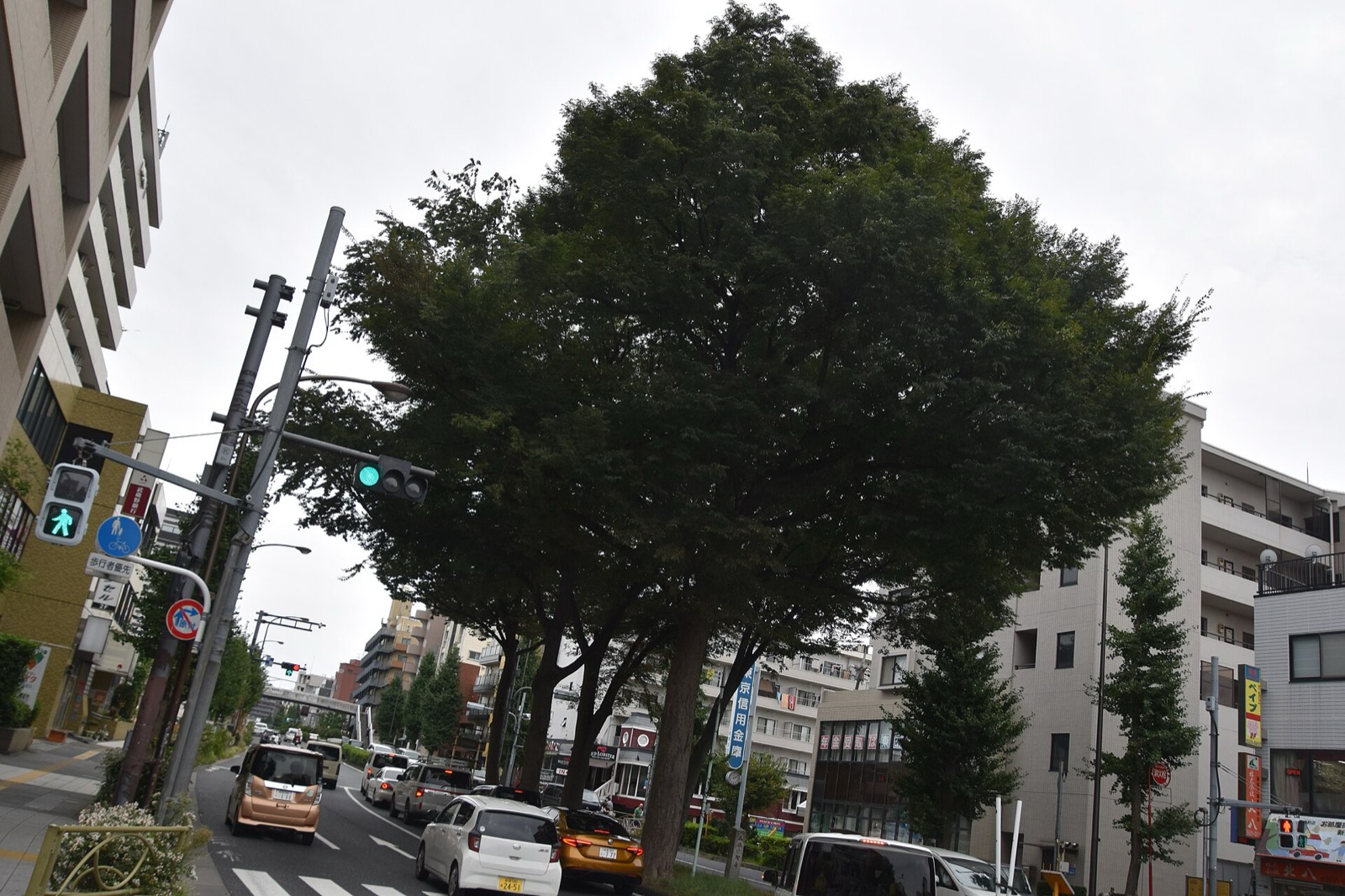
The same silhouette at full scale: mature keyaki on a street in Itabashi, Tokyo. Photo by Fred Cherrygarden, CC BY-SA 4.0, via Wikimedia Commons — Source
.jpg)
That familiarity runs through daily life as much as through gardens. Keyaki wood is valued in Japan for furniture, particularly the traditional chest known as tansu (箪笥, a wooden storage cabinet), and is considered close to ideal for the shells of taiko (太鼓, traditional drums). The species is also notably resistant to Dutch elm disease, which has made it a common replacement for stricken American elms as a street tree outside Japan. It is, in short, a working tree as much as an ornamental one. Among the zoki (雑木, deciduous trees grown for form or foliage rather than flower or fruit), the zelkova sits closer to the center of the broom-style canon than any other species — its natural habit does most of the design work, and the artist's task is mostly to keep it honest.
The crown is built two leaves at a time
Achieving a convincing broom takes patient, repetitive pruning rather than dramatic intervention. The standard practice is to let each new shoot extend until it carries four to six leaves, then cut it back to two — a cycle repeated through the growing season that steadily multiplies the twigs and thickens the branch structure. On younger trees, growers traditionally tie the branches and twigs together into bundles in autumn, and then tie those bundles to one another, as a way of encouraging the broom shape.
The payoff shows most clearly once the leaves are gone. One well-regarded care guide calls "the winter silhouette and fine ramification" of the zelkova extremely important and the species' nicest feature — the same fine branch structure that, as we discussed in "How to Read the Branches," rewards close looking on any deciduous tree, since nothing is left to hide a poorly placed limb. Summer foliage softens the outline into a green dome; winter strips it back to the skeleton the whole design was built around.
Four feet that read as thirty meters
One zelkova in the National Bonsai & Penjing Museum's Japanese Collection — the tree at the top of this page — has been under cultivation since 1895 and was given to the museum by Yoshibumi Itoigawa in 1976. The museum's own description calls it a tree that, at only about four feet, "gives the appearance of a giant tree with a thick trunk, powerful surface roots, and tapered branching" — the broom style's central ambition, stated almost exactly.
That ambition is easier to place within the broader vocabulary of bonsai forms: where a formal upright states its power through a single unbroken line, the broom states it through multiplication — dozens of small branches standing in for the crown of a tree that, left in open ground, would need thirty meters and the better part of a century to earn that same silhouette. It belongs, too, among the field trees bonsai keeps returning to as a model: a lone keyaki standing beside a rice paddy or a shrine gate is, in effect, the broom style's full-scale reference photograph.
A broom repays attention twice a year
A zelkova kept this way asks for the same unglamorous attention as any deciduous bonsai — steady water through summer, full sun to keep new growth compact, protection from hard frost — but it repays that attention twice a year rather than once: first in the density of its summer crown, then in the bareness of its winter frame. Few species kept as bonsai show their structure this plainly, in both directions at once.
That, in the end, is the quiet appeal of the style: nothing about a good broom is hidden. The trunk, the point of division, the count and spacing of the branches — all of it stays on view, all year, in a shape borrowed directly from a tree most people in Japan pass on the street without a second look. Azukari's part, when a keyaki like this is placed in someone's care, is simply to keep that plainness honest season after season — the pruning that holds the radiating branches in place, recorded and passed along, so the tree an owner receives keeps reading, at pot scale, as the same tree that has always stood at the corner of the avenue.
References
- The Omiya Bonsai Art Museum, Saitama — Collection A-114, Keyaki (Japanese Zelkova) — museum description of a Zelkova serrata specimen, estimated age 120 years, trained in hoki-zukuri ("broom style").
- National Bonsai Foundation — Japanese Collection — collection record for the Japanese zelkova (Zelkova serrata), in training since 1895 and donated by Yoshibumi Itoigawa in 1976.
- Bonsai Empire — Zelkova, Japanese Elm care guide — on the species as "the prototype of the broomstyle," pruning technique (shoots to 4–6 leaves, cut back to 2), and traditional autumn bundling of branches.
- Wikipedia — Zelkova serrata — on the species' native range, family (Ulmaceae), natural growth habit, use of keyaki wood for tansu and taiko, and resistance to Dutch elm disease.