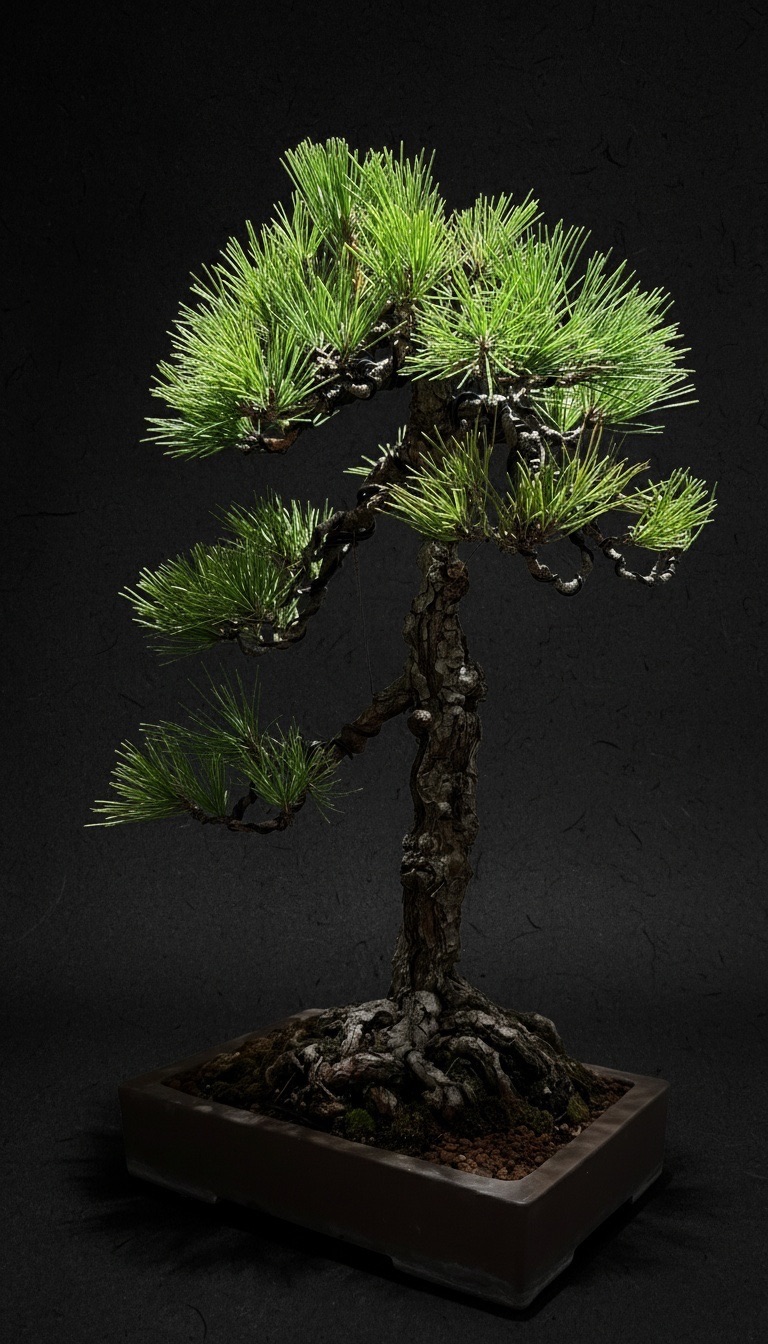
Japanese black pine, a species commonly worked through kaisaku, its trunk line and branch order the result of decisions made and remade over decades.
One artist looked at a shimpaku juniper that had already reached exhibition standard and called the result "well kept at a sub-optimal state." Nothing about the tree was diseased or structurally wrong; by ordinary standards it was finished. He reworked it completely anyway.
Kaisaku (改作, "remaking") is the deliberate, sometimes drastic reworking of a bonsai that already looks finished — removing branches an owner assumed were permanent, changing the angle from which the tree is meant to be seen, and rebuilding its structure around a form the artist can picture years before it exists.
A finished-looking tree is exactly what kaisaku targets
To most people, a well-kept bonsai in its twentieth or fortieth year already looks done: a settled trunk line, branches in their accustomed places, a silhouette an owner has grown used to seeing on the bench. Kaisaku (改作) begins exactly there, with a tree many would already call finished. The shimpaku juniper above is the clean case — it had simply stopped moving toward whatever more it could still become, and the small, careful pruning of an ordinary season was never going to close that gap.
That is the real difference between seasonal care and kaisaku. Ordinary pruning refines a form that has already been decided. Kaisaku reopens the decision itself.
Repotting season opens the roots along with the branches
Japanese practice around kaisaku names a handful of concrete moves rather than one single technique: changing the angle at which the trunk sits in the pot, cutting back hard to reveal an entirely different branch structure, reconsidering the whole line the trunk is asked to describe, and — when repeated seasons of cutting back have left the growing tip swollen or shapeless — replacing it with a new leader grown to take its place. This work is generally timed to the repotting season, when the tree is already out of its pot and its roots, not only its branches, are genuinely open to reconsideration. A tree still sitting undisturbed in last year's soil is not ready for a decision like this; one lifted out for repotting already is.
A branch's future counts for more than its history
Every established branch on a tree carries a history: years of wiring, thickening, the patience it took to grow it into position. Kaisaku asks an artist to look past that history and ask a colder question — does this branch belong to the tree the new design calls for, or does it only belong to the design the tree used to have. One well-documented restyling of an old blackthorn shows what that question can cost in practice. The artist worked branch by branch, cutting back growth that had taken well over a decade to build, and turned several of the resulting stumps into jin (神, bleached deadwood left exposed rather than concealed) instead of pretending the cuts had never happened. Removing one large branch rarely stays contained to that branch alone — it usually forces every branch above and around it to be reconsidered too, since nothing on a trained tree is ever really independent of the rest.
This is why kaisaku is discussed as much in terms of nerve as of technique. A misjudged cut in routine maintenance grows back within a season or two. A large limb, once removed at the trunk, does not return, and a tree that has just lost a significant share of its canopy needs real strength in reserve to recover from the wound at all. An artist who takes on kaisaku accepts that the tree may look worse, for a year or several, before it looks better — and commits to the cut on the strength of their own judgment that it will.
If there is one test worth carrying out of this piece, it is the artist's question turned outward: before crediting anything you tend — a business line, a garden, a routine — for its history, check whether it still serves the future you are actually building toward.
The new design exists years before the first cut
Because the risk of a bad cut runs in only one direction, kaisaku is rarely improvised. The clearest documented cases describe artists who had seen the new design long before a saw was ever raised to the tree. The blackthorn grower above has written about envisioning a complete restyle years in advance, then waiting — for the tree, and for himself — to be ready before carrying it out; the new design existed in his thinking well before a single established branch was cut. That gap between seeing the future tree and building it is where most of kaisaku's real work happens: picturing a trunk line, a front, a branch structure that does not exist yet, and then removing, one cut at a time, everything currently in the tree that stands in its way. The tree an owner sees the week after a kaisaku is rarely the tree the artist is picturing. It is only an early stage of it — sparse, freshly cut, still years from the form the work was planned for.
Believing in an unseen tree is what separates artist from caretaker
None of this is possible without a kind of confidence that the tree the artist can already see is real, even though no one else can see it yet. A finished-looking bonsai gives an owner very little reason to doubt it. Kaisaku exists because an artist, looking at that same tree, sometimes sees something it has not yet been allowed to become — a stronger trunk line hidden behind a branch that has simply been in the way for twenty years, a different and better front the tree has never once been turned to show. Acting on that belief, and being wrong about it often enough to know the risk is real, is close to what separates an artist from someone who only maintains trees.
The decision is what kaisaku leaves behind, not the wound
Kaisaku is one of the clearest illustrations of an idea explored elsewhere on this site: a bonsai is never finished. Most seasons, that fact shows up quietly, in a shoot pinched back or a wire loosened. Occasionally, it shows up as a decision to take a tree that looks complete and remake it, because an artist has come to believe a better tree is still waiting inside the one already there.
For a tree kept at Azukari, that decision does not end the tree's record — it becomes part of it. The seasonal notes an owner receives from Japan can, in time, include a year like this: not routine trimming, but the kind of remaking that only a tree meant to be tended for decades can afford to undergo. A kaisaku is not a correction of a mistake. It is what happens when an artist decides a tree still has more of itself left to become.
References
- Faites du Bonsaï — "Vocabulaire japonais pour le bonsaï" — glossary entry defining kaisaku (改作) as a complete restyling of a tree's form and dimensions, distinct from routine maintenance.
- Bonsai Workshop — "Reworking a Show-Ready Tree" — an artist's account of restyling an already exhibition-quality shimpaku juniper, including the reasoning that incremental seasonal work could not move the tree beyond a "sub-optimal" finished state.
- Hans van Meer Bonsai — "Restyling My Old Blackthorn Bonsai (Completely)!" — a documented case of a major restyle envisioned years before it was carried out, including branch-by-branch removal and the conversion of cut branch stumps into jin.
- 盆栽.com — 「盆栽のつくり変え4つの具体例」 — a Japanese-language explanation of concrete kaisaku methods (changing the trunk's angle in the pot, cutting back to a new branch structure, replacing the leader) and their usual timing around the repotting season.