
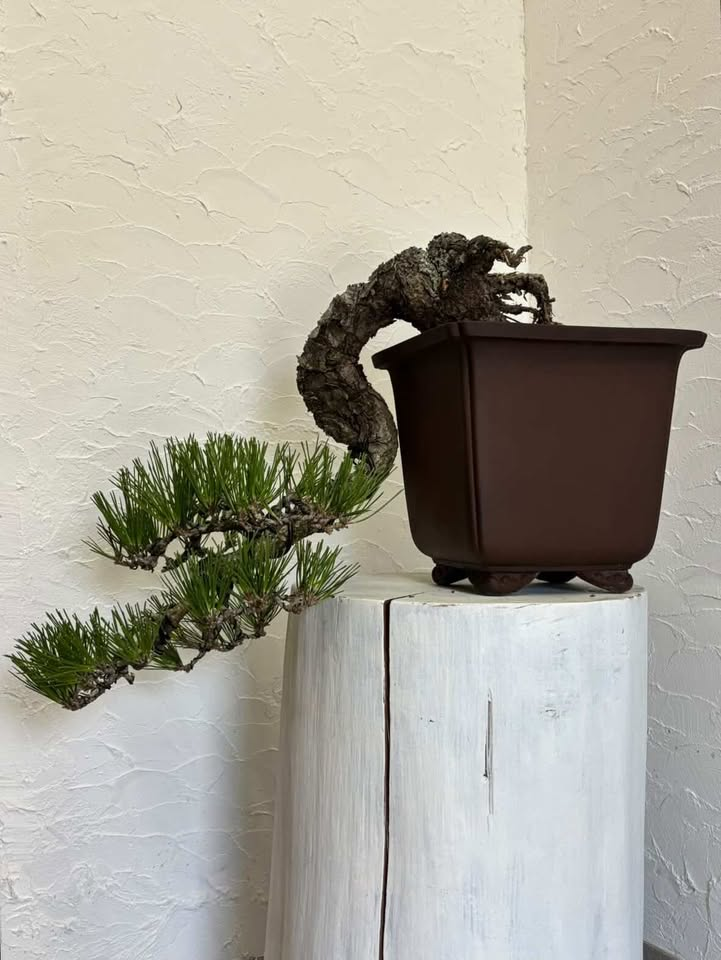
Japanese black pine, 45 years, cascade style / Photo: Azukari
A grower handed an unfamiliar bonsai turns the pot slowly, a few degrees at a time, and then stops. Hand them the same tree a month later and they will usually stop somewhere close to the same place. What they are hunting for is not a pleasing angle. It is the tree's one correct viewing direction, and it has a name.
A bonsai's shomen (正面, "front") is the single direction its artist has judged correct, and every later decision about the tree — where to cut, where to hide a scar, how to display it — answers to that one choice.
Every other angle is built to fail
A garden tree can be walked around. A bonsai, once trained, cannot be looked at from just anywhere and still make sense. Branches are kept relatively open on the side meant for the viewer, while more of them are left to fill in the ura (裏, "the back"), so that depth builds behind the trunk rather than in front of it. Turn the same tree around and, by design, it tends to look thinner, more crowded, or simply unfinished. That collapse is the evidence: the front was never accidental.
The front is found by elimination, not invention
Nobody invents a front from imagination. An artist finds it by testing a young or newly collected tree from every side and discarding the angles that fail.
The nebari (根張り, surface roots) come first: the face where roots spread most evenly, without a gap staring back at the viewer, tends to win. From there the eye moves to the tachiagari (立ち上がり, "the rise," the stretch of trunk between the roots and the first branch). Growers generally favor the side where this stretch curves gently toward the viewer rather than away from them; one Japanese bonsai primer calls that forward-curving face the trunk's hara (腹, "belly") and treats the belly as the front. From that side, roughly half to two-thirds of the trunk should stay visible, with no branch crossing directly over it. Direction matters as much as shape: one US grower working through the same exercise on a hinoki settles it on agreement between the apex and the main branch, on the principle that the key branch should point the same way the apex leans.
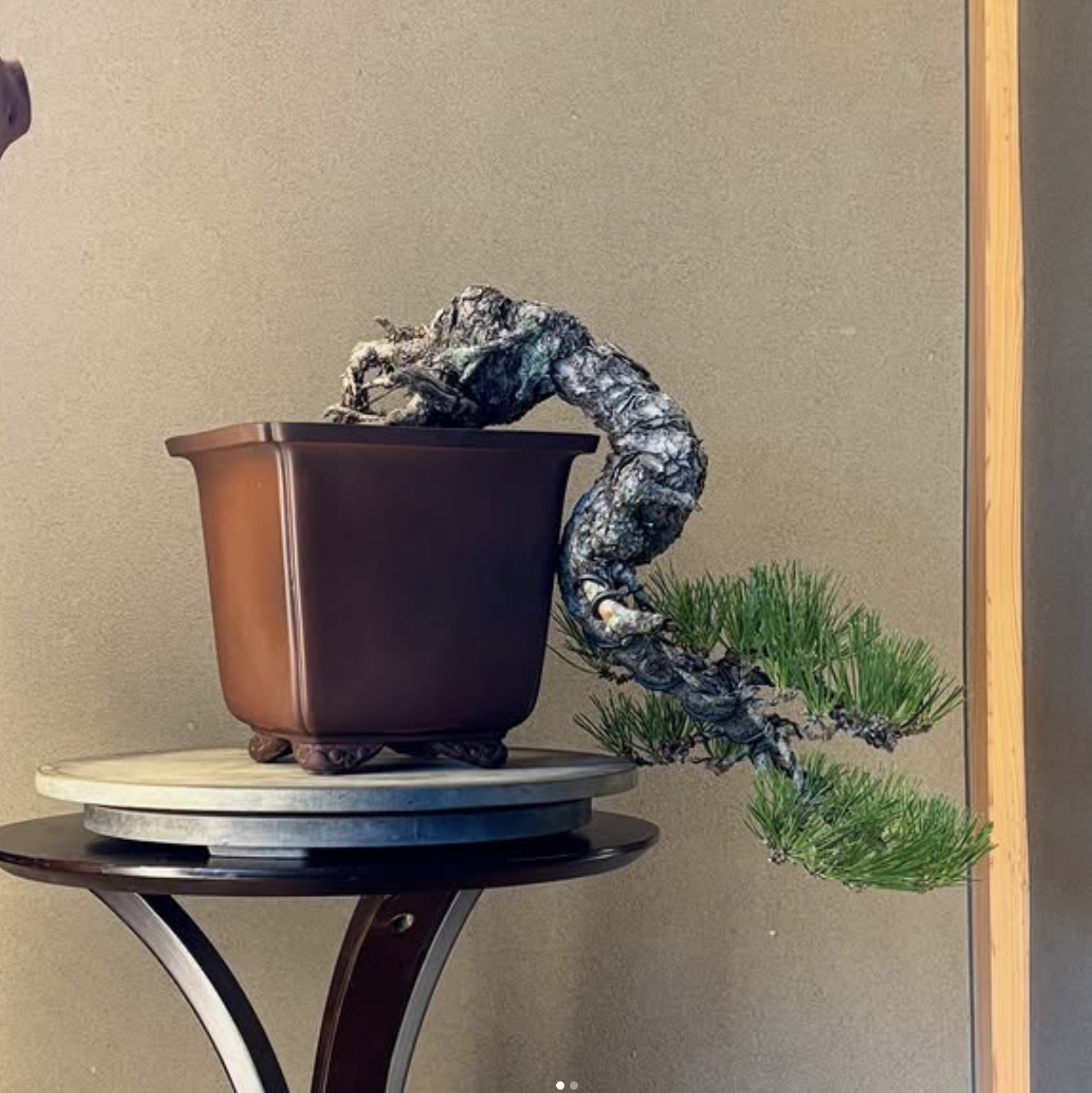
Japanese black pine, 45 years, cascade, grown in Kagawa / Photo: Azukari
That gives anyone looking at a tree a usable test, in the order a grower applies it: roots spreading evenly toward you, the trunk's belly curving your way, half to two-thirds of the trunk clear of branches, apex and main branch pointing in one direction. Toward the back, the artist crowds in whatever branches don't serve the front, so the tree reads as if it has real depth behind the plane you're looking at. Wiring and any pruning scar are placed, or hidden, out of that same front sightline. Only when all of this holds from one particular angle, and starts to fall apart from every other, does that angle become the tree's shomen.
The care routine exists partly to defend the choice
Choosing a front is not a private preference the artist keeps to themselves; it is a commitment the tree's entire care routine has to protect. At repotting, standard practice is to set the root base on the soil and adjust both the tree's angle and its front-facing orientation before the pot is filled — a small correction made every few years, in service of a decision made once. Later pruning follows the same logic: a cut that would look fine from the back is avoided if it would show from the front.
That discipline is what makes formal display possible at all. When a tree is set out in a tokonoma (床の間, an alcove for display) or on an exhibition stand, it is turned to face the one direction its artist settled on, sometimes years before the tree ever reached a public hall. A visitor walking a row of trees at a show never has to guess which side is meant for them — every tree there has already answered that question. A bonsai, in this sense, is closer to a hanging scroll than to a sculpture: composed for one side, and shown that way every time.
Finding the front turns looking into reading
Once you can find a tree's front on your own, looking at a bonsai stops being a matter of taking in a pleasant shape. You start to see a sequence of decisions: which branch was kept and which was cut for this one face, which flaw was pushed out of sight, how far the trunk was allowed to lean toward the viewer before the composition read as reaching forward rather than falling. We wrote earlier about the front as the first of five ways of reading a bonsai — where to stand, how to let the eye travel from roots to apex. This article is the layer beneath that first step: not just where to stand, but why that one spot, and no other, is where the artist meant the viewer to be. A tree's chosen form and its front are usually settled together — a trunk trained toward the curve of moyogi (模様木, "informal upright") or the fall of kengai (懸崖, "cascade") is already leaning toward the direction it wants to be seen from.
What I want people to notice in October
Most owners will never rotate their own tree looking for its front. Someone else did that work, seasons or years before the tree changed hands, and every branch since has grown in service of the angle they chose.
On October 20 I will spend a day at Shunkaen, in Tokyo, with a small group visiting from abroad. Nobody in that garden will have to ask which side of a tree to stand on; every pot will already be turned. What I want them to notice is that the turning was decided by a person, often decades ago, on a tree that was not yet worth photographing. That decision is also the part most easily lost at a distance. Azukari keeps a tree in Japan under its artist's hand, and the photographs and seasonal records an owner receives are taken from the settled front — which is to say the camera is asked to stand where the artist stands. Get that wrong and an owner nine time zones away receives a shape. Get it right and they receive the decision.
References
- Wikipedia — Bonsai aesthetics — on a bonsai's distinct front, front/back branch asymmetry, hidden pruning scars, and the forward-tilted apex.
- Bonsai4me — A Guide to Bonsai Critique — on how much of the trunk should be visible from the front, branches not crossing the trunk, and foliage mass kept toward the back for depth.
- Bonsai Tonight — Which way does it go? — on testing several angles and aligning the key branch with the direction of the apex.
- InBonsai — Bonsai Repotting Guide: Step-by-Step for Beginners — on adjusting a tree's angle and front-facing orientation as a standard step during repotting.
- Kimi's Mini Bonsai Days — 盆栽の表と裏 — on the forward-curving face called hara becoming the front, on even nebari as a condition for it, and on extra branches at the back for depth.