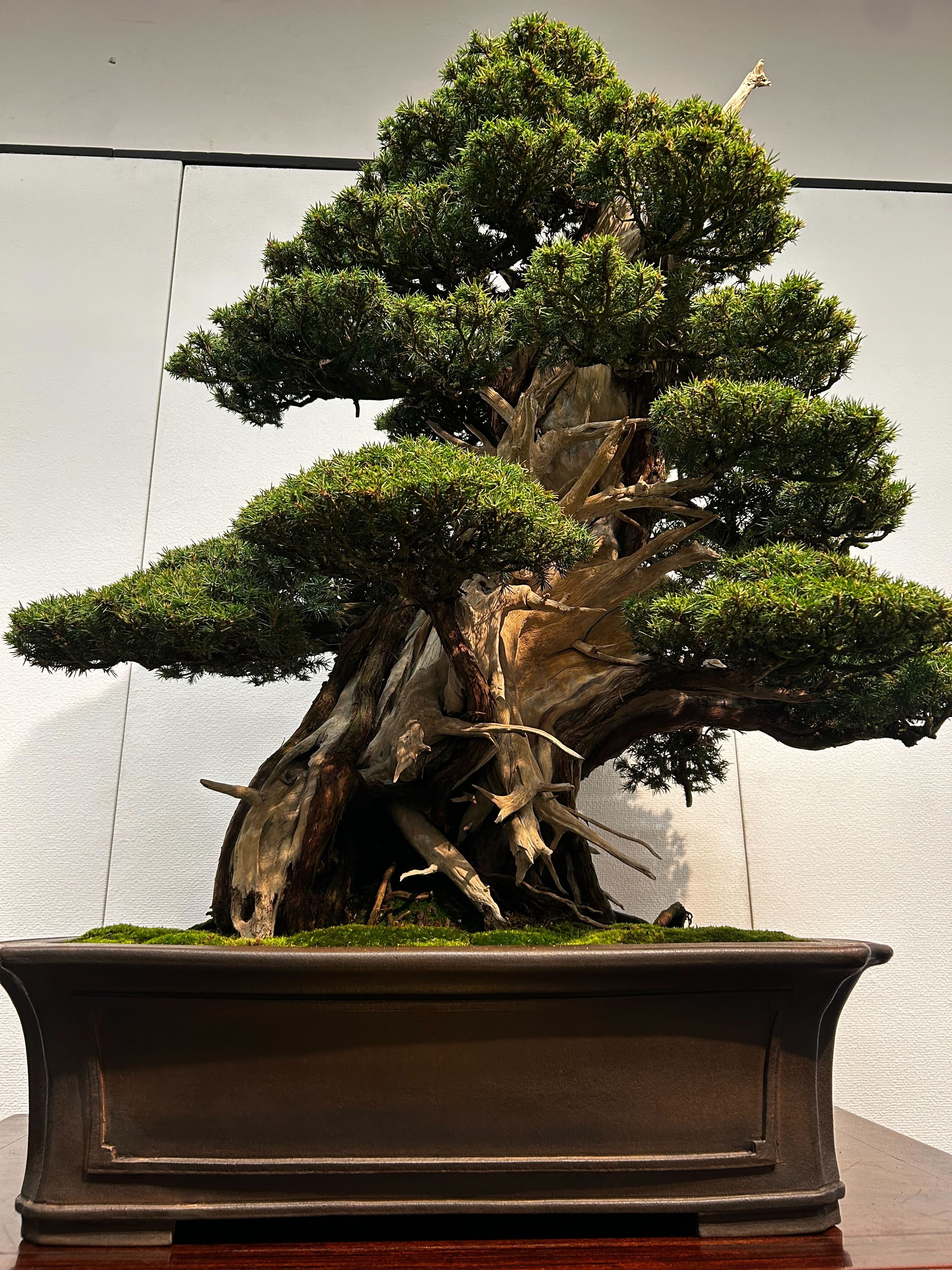
A tosho needle juniper. The density and taper of its pads are not something anyone assembled — they are what a great many cuts, made over many years, left behind.
A branch removed at the trunk does not come back in the same place. New growth may eventually appear near the wound, but the length that branch held, its taper, its exact position in the tree's rotation of first, second, and back branches, is gone the moment the cut is made. Wiring can be loosened and reset. A shoot pinched today can be allowed to extend tomorrow. A structural cut cannot be revised, only lived with. That one fact, more than any theory about beauty, is why sentei (剪定, "pruning") is treated in Japanese bonsai practice less as maintenance than as the central act of shaping a tree.
A bonsai's form is decided almost entirely by what is cut away, not by what is added — and every practical question in pruning, from which branch to remove to when to remove it, follows from that one asymmetry.
Not every branch earns its place
Left alone, a tree grows only by addition. Every bud that survives winter pushes a new shoot in spring, and every shoot that survives becomes a candidate for a branch the year after. A young pine, or field material freshly collected, can throw far more growth than any finished bonsai will ever keep: shoots crowding the same stretch of trunk, branches doubling back over each other, growth racing upward at the expense of everything below it. None of this is a flaw in the tree. It is what an untrained tree does, and it is the raw material an artist has to work with.
Most trees grow with what is known as apical dominance: the topmost and outermost buds are favored with the tree's energy, so growth there thickens fastest while branches lower down and further in slowly lose vigor and can die back for lack of it. Left uncorrected, this pulls a bonsai's proportions the wrong way — thick, coarse growth at the top, thin growth near the base, the reverse of the tapering silhouette a mature bonsai is meant to show. The fix is counterintuitive: an artist prunes hardest exactly where the tree wants to grow most, cutting the vigorous top and outer shoots back harder than the weaker interior and lower ones, so the energy the tree would otherwise waste is redirected to the growth that matters. A bonsai's branches do not get to stay simply because they are healthy. Choosing which ones remain is where the design happens.
A structural cut and a light trim run on different clocks
Bonsai practice separates two kinds of pruning, and the difference is not just of degree. Structural pruning is the larger, less frequent work: removing or shortening a heavier branch to set the trunk line, the first branch, the placement of the apex. It is usually done just before or after the growing season, when sap flow has slowed and the tree can absorb a significant wound without excess stress. Maintenance pruning runs on the opposite clock: light, frequent trimming through the growing season that keeps an already-set outline tight, shortening new shoots before they harden and coarsen the silhouette.
A healthy tree can generally tolerate losing up to about a third of its foliage in a single structural session, and growers are cautioned against stacking that kind of session onto other stressful work, such as repotting, in the same season. The timing is not a formality. It is what makes it possible for the tree to survive the one kind of cut that can't be taken back.
Good judgment sits between two failures
Because a structural cut cannot be undone, the actual skill in pruning sits less in the tool than in the decision to use it. A widely repeated piece of advice among Japanese growers names the safer of the two failures: when in doubt about a branch, leave it. There is always next year, and a more practiced eye, to reconsider. The opposite failure is just as familiar to growers — cutting a tree back to exactly the outline it held the season before, year after year, without ever letting a shoot advance the design. Practitioners sometimes call this treading water: the tree pushes new growth, and that growth is removed before it can be put to any use, so the design never actually moves.
Sound judgment sits between these two failures — cautious enough to let a tree keep developing, restrained enough not to undo its structure before it can be assessed. What makes this a trained skill rather than a mechanical one is that every cut carries an aesthetic judgment and a horticultural one at once: a branch may be wrong for the tree's eventual silhouette and still be exactly the branch the tree needs to keep this season, to stay strong enough to recover from removing the others. Weighing those two considerations against each other, cut by cut, over a tree's lifetime, is a large part of what separates a trained eye from an untrained one — the same eye at work in reading a bonsai's branches before a single cut is made.
Addition can't do what a cut does
A branch can be added to a bonsai: grafted where the trunk is bare, or bent into a new position with wire. Neither operation replaces what disciplined removal does. A graft supplies material; it does not supply the years of taper, ramification, and negative space that make a branch look as though it had always belonged there. Wire redirects growth that already exists; it cannot manufacture the restraint that keeps a branch pad open enough to read clearly against the ones around it. Addition, in bonsai, solves a shortage. It does not produce the clarity that subtraction produces, because that clarity is exactly what disappears when too much is left in place.
This is the deeper reason sentei is this tradition's clearest form of the art of subtraction: a tree's eventual form is not assembled from parts added to it. It is what is left standing after a great many decisions to take something away.
The record disappears, but the shape doesn't
Pruning recurs every season for as long as a tree is cultivated, in the same unglamorous rhythm as daily watering. Each season's cuts add to a record that is mostly invisible once healed — no tag on the tree says which branch went, or in which year, or why. What an owner eventually sees is only the residue of that record: a form that reads as inevitable, because so much of what didn't belong to it has already been taken away.
The two failures above give anyone tending a tree, or judging a decision to remove anything, a usable test: is a branch staying because it earned its place this season, or because no one has yet found the nerve to take it off. Under Azukari's model, an artist in Japan applies that test every growing season, long before an owner on the other side of the world sees the tree again — not one decorative flourish, but a great many small refusals to leave in what doesn't belong.
References
- Bonsai Empire — Pruning Bonsai, cutting branches to shape the tree — the distinction between structural and maintenance pruning, seasonal timing, apical dominance, and the guideline that a healthy tree tolerates losing up to roughly a third of its foliage at once.
- Bonsai4Me — Maintenance Pruning Part One: The Need for Regular Pruning — apical dominance in trees generally, why lower and inner branches lose vigor without correction, and how pruning harder at the top redistributes strength through the tree.
- Bonsai Mirai — Pinching vs. Pruning — the distinction between pinching and deliberate structural pruning, the caution against a repeating "grow and cut back to the same outline" cycle, and pruning decisions as combined aesthetic and horticultural judgments.
- Bonsai Life (Japanese) — "The courage to cut": a complete guide to pruning and how to judge which branches to remove — the framing of pruning as requiring "the courage to cut," guidance on identifying branches to remove, and the restraint principle of leaving a branch uncut when in doubt.