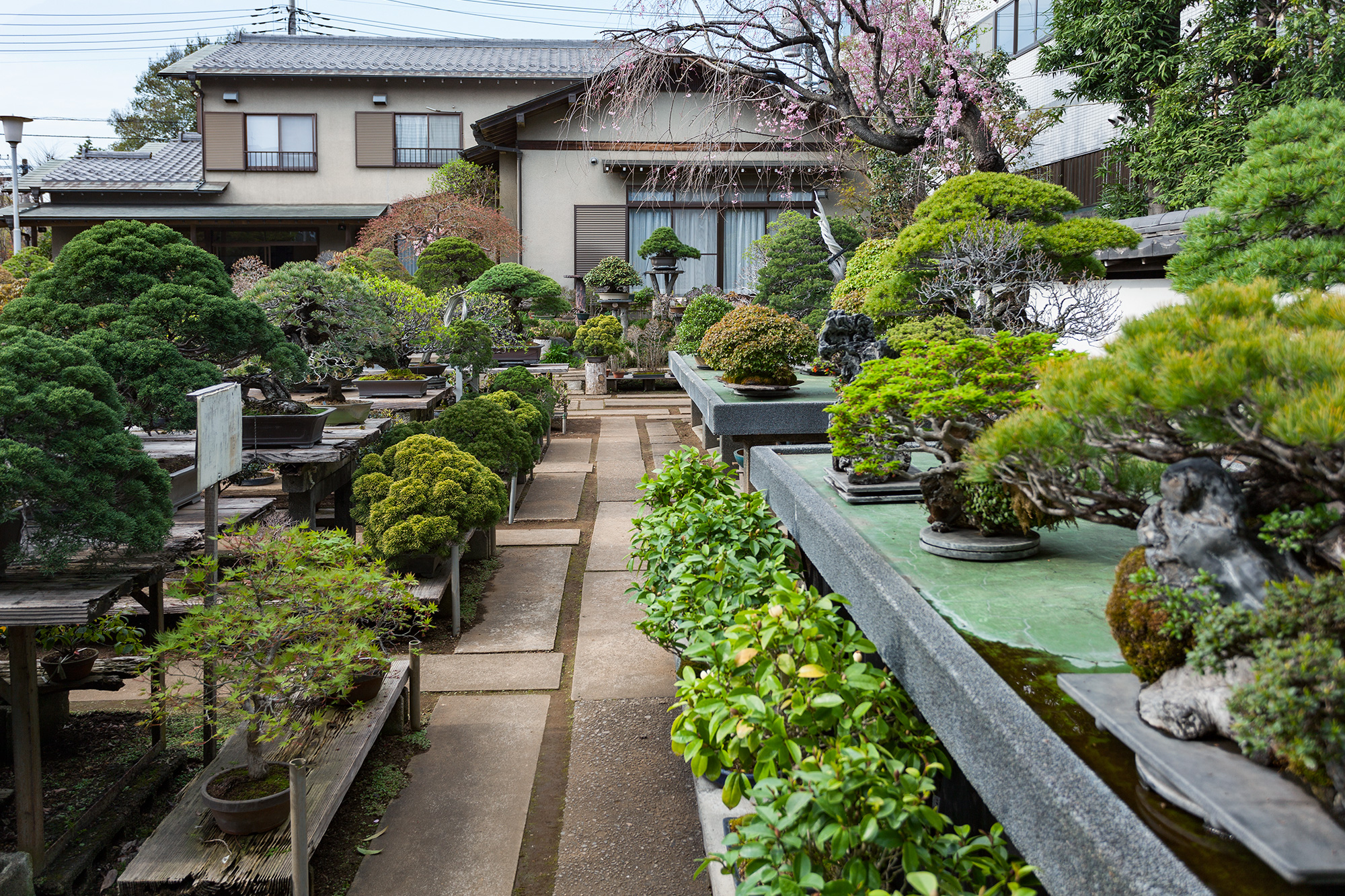
Fuyo-en, one of the six resident gardens of Omiya Bonsai Village, Saitama. The benches run straight up to the owner's own house — there is no counter, no register, and no clear line between the garden and the home behind it. Photo by TypeZero, CC BY-SA 4.0, via Wikimedia Commons — Source

A first-time visitor to a Japanese bonsai nursery usually arrives with a shopper's instinct: walk the rows, read a label, decide, pay, carry the tree out. Almost nothing about the place is built to satisfy that instinct.
Most of what surprises a foreign visitor inside a Japanese bonsai-en (盆栽園, "a bonsai nursery") is not the trees at all — it is the absence of everything a shop is supposed to have: a price on the pot, a clear line between what is for sale and what is not, a transaction that ends when the visitor walks back out the gate.
A bench with two kinds of tree
Walk down a row of benches (tanaba, 棚場, "the growing area where trees are set out") at an ordinary nursery and there is no visible way to tell which trees belong to the garden and which belong to a customer who is somewhere else entirely. A pine dropped off for wiring sits a few feet from a pine grown from a cutting the nursery intends to sell. Both get watered on the same schedule. Both get the same attention from the same pair of hands.
That mixing is not an accident of space; it is closer to a description of what a bonsai-en actually does. Seikou-en, one of the six resident gardens of Omiya Bonsai Village in Saitama, lists routine care for customer-owned trees — pruning, wiring, repotting — alongside short-term boarding of up to a month, priced against a standard rate sheet rather than posted anywhere for browsing. A visitor scanning the benches for a "for sale" sign is looking for a distinction the nursery itself does not make at a glance. We go into how this custody arrangement actually works, tree by tree, in Inside a Bonsai Nursery; the short version is that a bench full of bonsai in Japan is, more often than an outsider assumes, a bench full of other people's ongoing projects.
A world without a price tag
The second surprise follows directly from the first. If a nursery cannot tell you at a glance which tree is for sale, it is not going to tell you at a glance what one costs, either. Fujikawa Kouka-en, a well-known garden near Osaka, handles inquiries from overseas buyers by email and Instagram rather than a catalogue with figures attached; a price is arrived at after the garden has actually seen the tree, or at minimum a clear set of photographs of it. Seikou-en works the same way for its own maintenance clients — an estimate drawn up individually against the Japan Bonsai Cooperative Association's rate table, not a number anyone could look up in advance.
None of this is a sales tactic. It reflects something closer to the truth: two bonsai of similar size and species can be priced very differently once age, form, and a documented record of care are weighed against each other, a process we look at directly in How Are Bonsai Prices Set? A visitor used to a fixed retail price experiences the absence of one as strange. Inside the nursery, it is simply how a living, one-of-a-kind object has always been priced.
The relationship comes before the sale
What replaces the price tag, in practice, is a relationship. Visiting Omiya Bonsai Village, guides for foreign travelers advise keeping one's voice down on its residential streets, asking before touching any tree, and asking before taking a photograph inside a private garden — this is, after all, someone's home as much as it is a business. A polite greeting to the owner is not a formality to get past on the way to the trees; among the gardens that welcome outside visitors at all, it is often the entire opening of the conversation that eventually leads to a purchase.
That conversation tends to matter more the second and third time a visitor has it. Toju-en, another of Omiya's resident gardens, has held bonsai classes open to the general public since 1966 — not a one-time sales pitch but a standing invitation to keep coming back and be taught. A garden's willingness to sell its best material, in turn, has always leaned on recognizing the person asking. The owner's judgment about a tree and the owner's judgment about a customer are, in a Japanese bonsai-en, not really two separate skills.
Not a shop you finish with
Put the three surprises together and the shape of the place comes into focus. A Japanese bonsai nursery keeps its inventory and its custody arrangements on the same benches because, functionally, they are the same activity: keeping trees alive and improving under a trained eye, regardless of who currently owns them. It prices trees individually because no two are alike and a number fixed in advance would flatten a distinction the whole culture is built around. And it runs on relationship rather than a single transaction because most of what a nursery actually offers — the eye, the years of hands-on judgment, the willingness to keep watching a tree after it changes owners — cannot be handed over at a register.
For a visitor who has only seen Omiya or a district like it once, on a single trip, that can feel like a door that never fully opens. It is the same door, though, that a nursery has always held open for anyone willing to keep returning — and it is the door Azukari was built to hold open at a distance: a tree that stays on the bench, in the hands that already know it, with its owner kept part of the relationship through the seasons rather than left with a receipt and a memory of one visit.
References
- Fujikawa Kouka-en — Overseas Buyers — description of the inquiry process for overseas buyers (email and Instagram rather than a listed catalogue price) and the post-purchase monthly maintenance arrangement.
- Seikou-en (清香園) — Bonsai Maintenance — routine maintenance services (pruning, wire work, repotting) and short-term boarding of up to one month for customer-owned bonsai, individually estimated against the Japan Bonsai Cooperative Association's rate sheet rather than posted publicly.
- Bonsai Empire — "Japanese gardens and Bonsai in Japan" — Kinashi's roughly 250-year growing history, its share of the domestic pine market, and its approximately one hundred nurseries, of which about a dozen are considered high-end.
- Wazakura Japan — "Omiya Bonsai Village: A Wazakura Japan Travel Guide" — visitor etiquette for Omiya Bonsai Village, including keeping one's voice down, asking before touching trees, and asking before photographing inside private gardens.
- Omiya Bonsai Village — Gardens — the village's six resident gardens, including Toju-en's bonsai classes for the general public held since 1966.
- Wikimedia Commons — File: OmiyaBonsai 芙蓉園 Fuyo-en Hiroshi Takeyama 001.jpg — source and license (CC BY-SA 4.0, photo by TypeZero) for the header image.