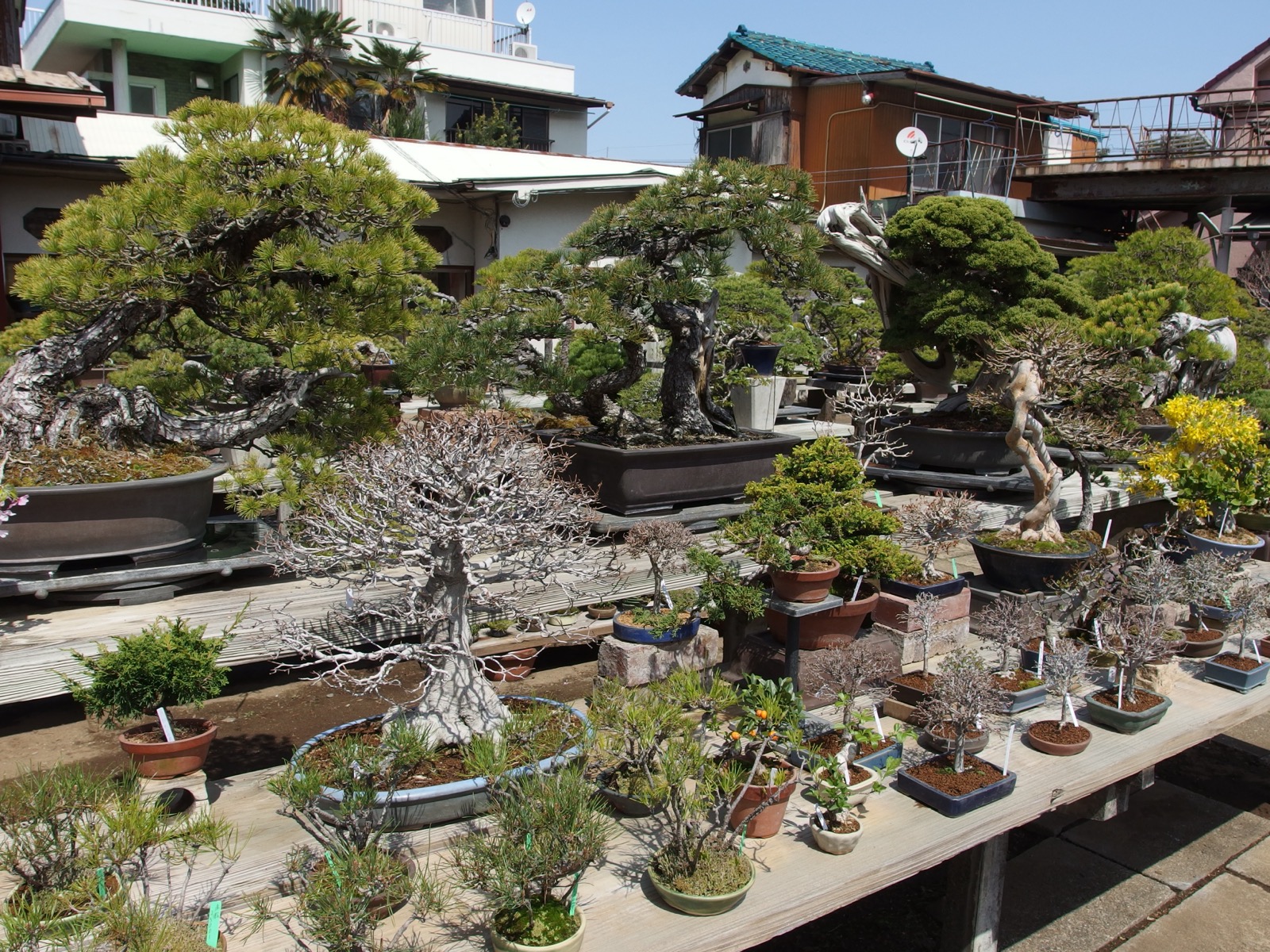
A working nursery inside Omiya Bonsai Village, Saitama. Pines line the benches in growing rows, price tags tucked among them — a production floor first, a shop second. Photo by Guilhem Vellut, CC BY 2.0, via Wikimedia Commons — Source
.jpg)
Ask most visitors what a bonsai nursery is, and they picture a shop: a gate, a row of trees with prices attached, a purchase, a bag to carry it home in. What is actually there is closer to a workshop crossed with a boarding house — long benches of trees at every stage of a project that, in most cases, is not finished, and is not even the visitor's to finish.
A bonsai nursery (bonsai-en, 盆栽園, "a bonsai garden") exists to keep hundreds of trees alive and improving, season after season — and a large share of those trees, on any given day, belong to someone who isn't there.
Not a shop, but a growing ground
Walk into an ordinary bonsai-en and the first thing that registers is how little of it looks like a showroom. Most of the ground is given over to benches (tanaba, 棚場, "the growing area, and by extension the shelf itself" — more on why placement matters this much), propagation beds, a greenhouse for young stock, and a workshop corner with tools, wire, and pots stacked by size. The trees staged and photographed for a customer are usually a small fraction of what a nursery is actually growing.
Scale the picture up and it sharpens further. Kinashi, in Kagawa Prefecture, is one of Japan's oldest bonsai-producing districts, with a documented growing history running past 250 years and, it is said, a substantial share of the country's domestic pine trade. Roughly a hundred nurseries operate there side by side — yet only about a dozen are generally regarded as high-end, houses capable of training raw material into bonsai of real quality rather than simply propagating it. A nursery, in other words, is not one thing. It runs on a spectrum from mass propagation to individual, decades-long training, and the growing ground — not the sales counter — is the part every point on that spectrum has in common.
Many of the pots are not for sale
Look closer at the benches and a second fact becomes visible: not every pot carries a price, because not every tree belongs to the nursery. Taking in trees that belong to someone else — to prune, wire, repot, or simply keep safe for a season — is ordinary business for a Japanese bonsai-en. Seikou-en, one of the six resident gardens of Omiya Bonsai Village in Saitama, lists routine maintenance for customer-owned bonsai — pruning and shaping, wire work, repotting — alongside short-term boarding of up to a month, priced against a standard rate sheet set by the Japan Bonsai Cooperative Association. Fujikawa Kouka-en, near Osaka, extends the same idea further: a tree bought from the garden can simply stay there afterward, under an ongoing monthly maintenance arrangement, with the owner sent photos and video of its condition at intervals and the option to have it entered into exhibition on their behalf.
None of this is exotic. It is the everyday shape of what, elsewhere, we have called the culture of entrusting — an azukari (預かり, "a thing kept in trust") relationship between an owner and the person actually holding the shears. A bench full of bonsai in a Japanese nursery is, more often than a visitor assumes, a bench full of other people's ongoing projects.
The owner's eye sets the rank
If a bonsai-en is not defined by its size or its inventory, what separates the dozen high-end houses in a place like Kinashi from the ninety or so around them? Mostly, it comes down to a single, hard-to-measure asset: the eye of the person running the place. Knowing which piece of raw, unshaped material is worth years of a craftsperson's attention and which is not. Knowing which client's tree can be handed to a junior apprentice and which cannot. Knowing when a tree has reached a stage where letting it rest is the better decision than reaching for the shears again.
That eye is also, usually, inherited or earned rather than bought outright. Fujikawa Kouka-en, founded in 1950 in Ikeda, Osaka, and counted today among the largest bonsai gardens in western Japan, is now run by its second-generation garden master. The nursery's standing was not reset to zero when it passed from one generation to the next; the eye that built its reputation the first time was handed down along with the benches. It is the same reason, discussed elsewhere, that an experienced grower reads a bench before reaching for the shears — judgment, at a bonsai-en, is the actual product, and it shows up in daily decisions long before it shows up in a finished tree.
From a place to buy to a place to belong
Put these pieces together and a bonsai-en starts to look less like a retail floor and more like an institution people return to, again and again, over years. Some of Japan's bonsai districts have formalized this directly: at Omiya Bonsai Village, one of the resident gardens, Toju-en, has held bonsai classes open to the general public since 1966, turning what could have been a one-time purchase into a standing invitation to keep learning on-site. A buyer who leaves a tree at Fujikawa Kouka-en under its maintenance arrangement is, in a smaller way, doing the same thing — staying connected to a bonsai-en long after the transaction that first brought them there.
That shift, from a place you buy from once to a place you keep a relationship with, is not a marketing idea. It is closer to how Japanese nurseries have always worked, for the many owners who could not tend a tree themselves even before anyone thought to make the arrangement formal. Azukari takes that same, already-ordinary shape — a tree on a bench, an artist checking it through the seasons, an owner receiving its record from somewhere else — and builds it into something a person anywhere can join. What happens inside a bonsai-en was never really about the sale. It was always about who keeps coming back to the bench.
References
- Fujikawa Kouka-en — Overseas Buyers — description of the monthly maintenance arrangement for bonsai kept at the garden after purchase, including photo and video updates and optional exhibition entry.
- Fujikawa Kouka-en — official site — the garden's 1950 founding in Ikeda, Osaka, its description as one of the largest bonsai gardens in western Japan, and its current second-generation garden master.
- Bonsai Empire — "Japanese gardens and Bonsai in Japan" — Kinashi's roughly 250-year growing history and pine market share, its approximately one hundred nurseries with about a dozen considered high-end, and the Taishoen garden's professional operation and foreign-student program.
- Seikou-en (清香園) — Bonsai Maintenance — routine maintenance services (pruning, wire work, repotting) for customer-owned bonsai and short-term boarding of up to one month, priced against the Japan Bonsai Cooperative Association's rate sheet.
- Omiya Bonsai Village — Gardens — the village's six resident gardens, including Toju-en's public bonsai classes held since 1966 and Seikou-en's founding in Omiya in 1943.
- Wikimedia Commons — File: Bonsai nursery @ Omiya Bonsai Village (13593836174).jpg — source and license (CC BY 2.0, photo by Guilhem Vellut) for the header image.