
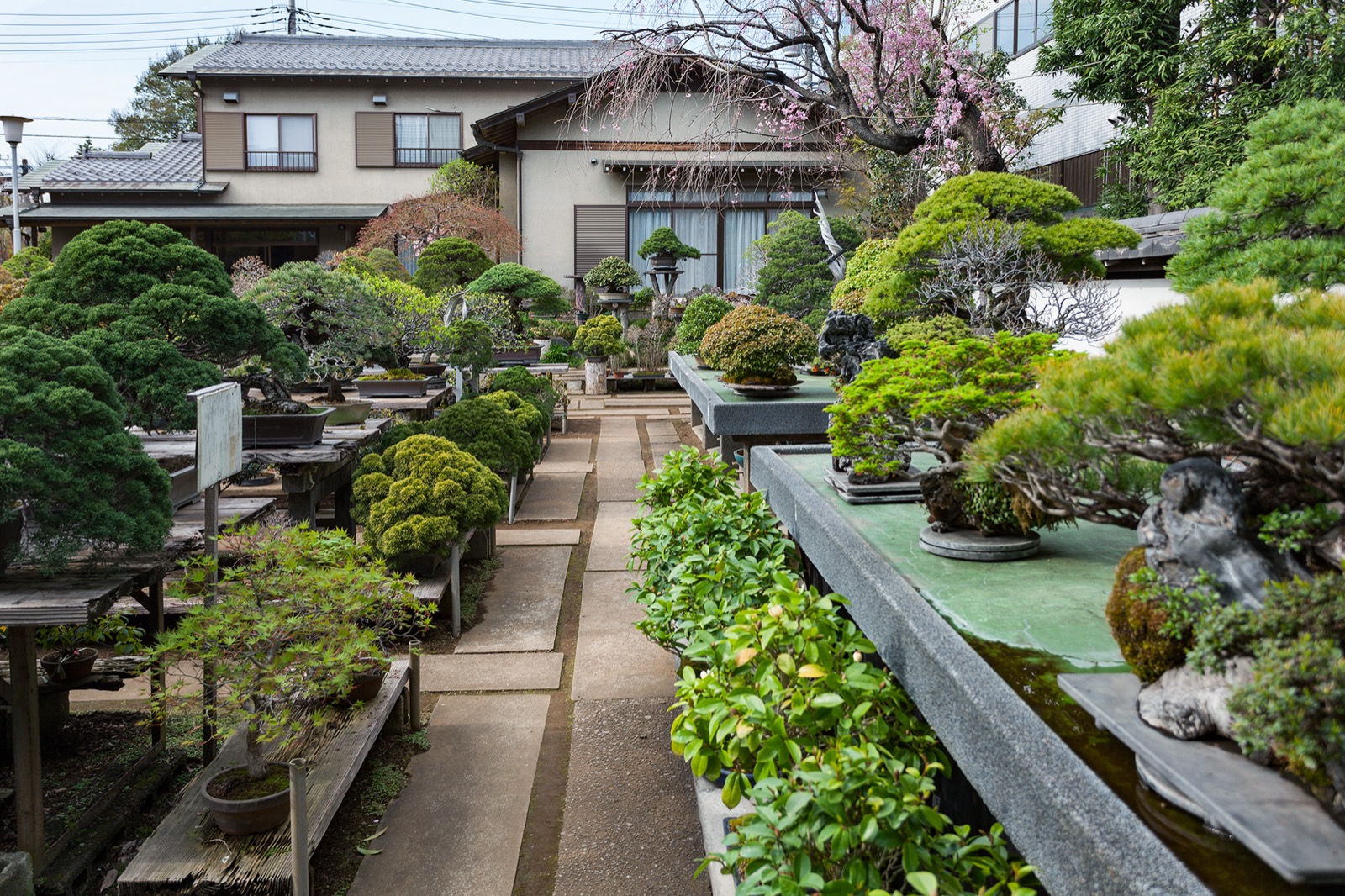
Fuyo-en, a nursery in Omiya Bonsai Village, Saitama. The raised stone benches are a formal version of the ordinary tanaba shelf every grower builds. Photo by TypeZero, CC BY-SA 4.0, via Wikimedia Commons — Source

Before a grower ever picks up shears or wire, a decision has already been made that will do more to determine a tree's fate than either tool: where the pot goes.
A bonsai's health is set less by what is done to it than by where it is made to stand.
Sunlight and airflow set the baseline
A bonsai pot holds a few centimeters of soil, sometimes less. That thin volume heats, cools, and dries far faster than the ground a full-sized tree would root into, which is why placement affects a potted tree more immediately than it would the same species growing in open soil. Most bonsai are said to need somewhere in the range of four to six hours of direct sun a day to hold their vigor, and growers generally favor morning light over afternoon light, since the hours between roughly noon and four in high summer carry the greatest risk of scorched foliage and overheated roots. Species vary: pines and junipers tolerate long, direct exposure and are often placed in full sun, while Japanese maple and other thin-leaved broadleaf trees are usually given morning sun and afternoon shade to avoid leaf burn. A tree denied enough light does not fail outright; it thins out gradually, pushing longer, weaker shoots and paler foliage, a slow decline that fertilizer alone cannot correct.
Airflow works alongside light rather than beneath it. Growers in Japan generally avoid setting a pot straight on the ground, and for practical reasons: contact with bare earth raises the risk of insect damage, traps heat and moisture against the pot wall, and lets weeds root in through the drainage holes. A pot lifted onto a bench sits in moving air on every side, which helps the soil surface dry evenly between waterings and makes conditions less hospitable to the pests and fungal problems that thrive in stagnant, humid corners. None of this is exotic technique — it is closer to a baseline that everything else in bonsai cultivation, from watering on down, is built on top of.
Tanaba: a shelf that is designed, not improvised
The Japanese word for this shelving is tanaba (棚場, from tana, "shelf," and ba, "place" — the growing area where the shelf stands and, by extension, the shelf itself). At a home grower's scale, a tanaba can be as plain as cedar boards resting on stacked cinder blocks, built to bring the pots to roughly waist height — around fifty centimeters off the ground is a commonly cited target for a simple home setup. At a professional nursery the same idea is engineered more deliberately: growers who have rebuilt their own shelving over years describe raising bench legs to around a meter, high enough that the potting surface, once a pot is set on it, lands close to standing eye level for viewing and daily inspection.
The choices behind a tanaba are practical rather than decorative. Wood is generally preferred over bare metal for the shelf surface, since metal absorbs summer heat and can scorch roots or dry a pot out faster than the watering schedule accounts for. Height is set with more than convenience in mind — how much sun a given row of pots will receive as the sun's angle changes through the day, sightlines from the house so a grower notices a tree in distress at a glance, and how exposed a bench is to prevailing wind, which can dry pots quickly but also helps keep foliage healthy. None of these decisions are visible in a finished bonsai the way a well-wired branch is, but they shape the tree just as surely.
Placement that changes with the season
A tanaba is not a fixed arrangement so much as a starting position, adjusted through the year, in step with the rest of a grower's seasonal work. Shade cloth rated at roughly thirty to fifty percent is a common way to soften the harshest weeks of summer for trees that need protection, usually hung with a gap of twenty to thirty centimeters above the foliage so air can still move beneath it, and it tends to come off again once the risk of scorching passes. Some growers build removable frames into the tanaba itself for exactly this purpose, folding the shade netting away in the evening so the trees can still take the night dew, and removing it entirely once the season no longer calls for it. Cold-sensitive material is moved again in winter, sometimes under eaves or into a cold frame, while species that tolerate frost are often left in the open, since some seasonal exposure is part of the growth cycle rather than a threat to it. Even short stays indoors are usually kept brief — a few days at most — with pots rotated back outside afterward and kept clear of heating vents, which dry a small pot out far faster than the tree can signal distress.
Environment before technique
It is possible to wire a branch into a beautiful line and still lose the tree behind it to a corner that traps heat, or to spend a season perfecting a pruning schedule for a maple quietly weakening in afternoon sun it was never suited to. Technique corrects a tree that is already fundamentally sound; placement is what makes it sound in the first place. This is one reason an experienced eye, walking a tanaba, checks the shelf before it checks the shears — not because pruning and wiring do not matter, but because they only have room to matter once light, air, and season have already been set right.
Closing
None of this shows up in a single photograph of a finished tree. A tanaba is read over a year, not a glance — in how a row of pots is angled toward the morning sun, in a shade cloth that appears in July and disappears in September, in the small daily habit of checking a bench before checking a branch. It is the quiet, unglamorous half of what happens inside a bonsai nursery.
At Azukari, a tree's placement stays part of an artist's ongoing work in Japan long after an owner joins its record. Which shelf a tree sits on this month, how much shade it needs this week, when it comes off the tanaba for winter — these are decisions an owner overseas rarely sees, and they are exactly the decisions that keep the tree they are entrusted with alive to be seen at all.
References
- Bonsai Empire — "Where to place your Bonsai tree" — general sunlight guidance (roughly four to six hours daily) and the effects of insufficient light on foliage and growth.
- Miyagi Bonsai — "Do Bonsai Need Shade in Summer?" — species-specific sun tolerance (junipers and pines versus Japanese maple), the midday-to-afternoon scorch window, and shade-cloth percentages.
- 盆栽の学校 — "立派な棚は必要ない!この盆栽どこに置けばよい?" — a home grower's DIY tanaba built from cinder blocks and cedar boards to roughly fifty centimeters, and the reasoning for wood over metal shelving.
- 真柏盆栽美術館もろや — "美術館で使っている盆栽棚を紹介します" — a nursery's account of why pots are kept off bare ground (pests, heat, poor airflow, weeds) and bench-leg heights used in professional display shelving.
- GreenSnap — "盆栽の棚場 あれこれ" — a grower's record of rebuilding a home tanaba across several iterations, on the importance of shelf height for sun exposure, sightlines, and wind protection.
- Wikimedia Commons — File: OmiyaBonsai 芙蓉園 Fuyo-en Hiroshi Takeyama 001.jpg — source and license (CC BY-SA 4.0, photo by TypeZero) for the header image.