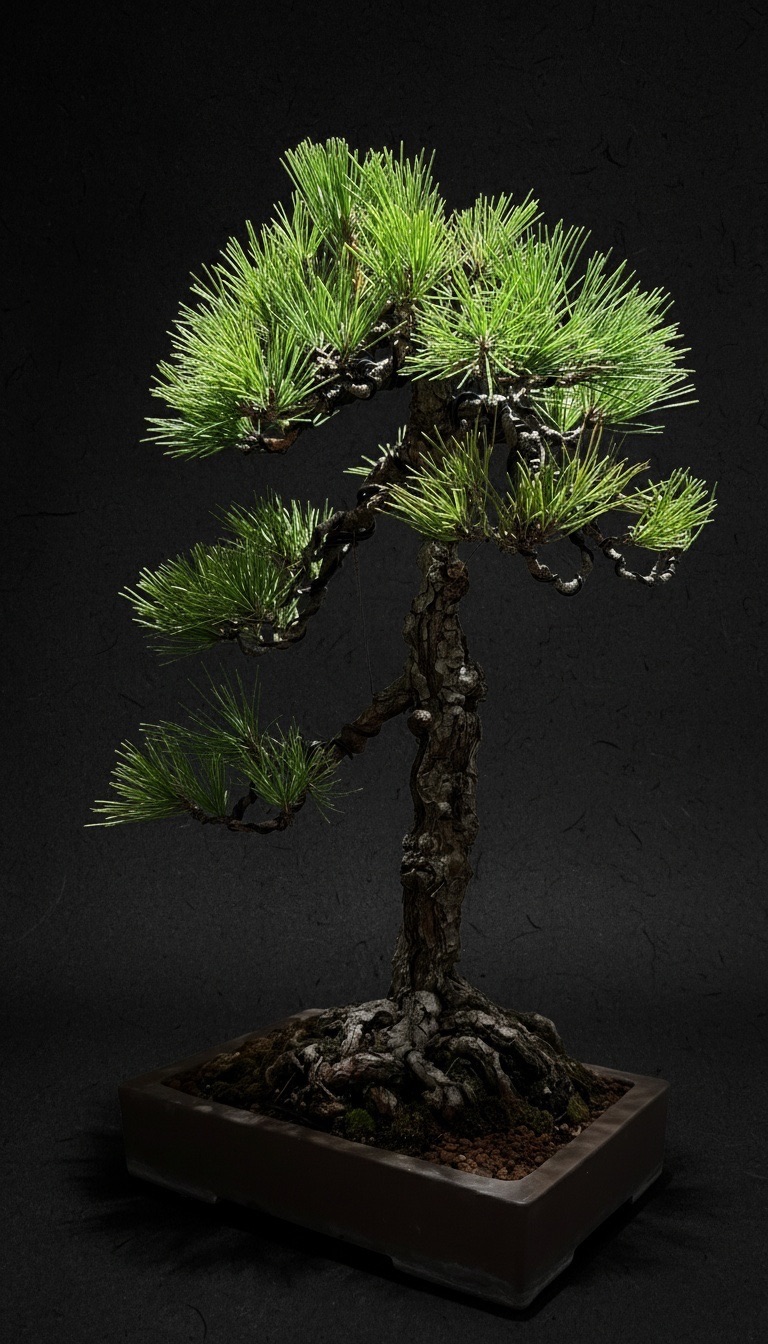
A black pine (kuromatsu) bonsai in a ceramic pot. Its dense pads of needles and deeply fissured bark are exactly the terrain a daily inspection has to cover — leaf by leaf, crack by crack.
In bonsai, the single most reliable defense against pests and disease is not a treatment schedule — it is a look taken every day, close enough to notice what has changed since yesterday.
A small pot leaves no room to spare
A bonsai lives in a volume of soil that a tree of the same age growing in open ground would fill in a single season of root growth. That confinement is not only a matter of scale. A tree rooted in the ground can send roots past a patch of poor drainage, spread a colony of pests across a much wider root system, or simply outgrow a minor injury before it becomes a real problem. A bonsai's roots have nowhere to go. Whatever stress arrives — scale insects settling on a branch, a fungus taking hold in damp soil, poor air movement through crowded foliage — has to be absorbed inside the same few liters of soil and the same limited canopy the tree has always had. Growers describe the logic plainly: a stressed tree becomes a target, and a shallow, confined pot gives that stress fewer places to dilute. Good placement, with real light and air reaching the foliage, is one of the few ways to soften this vulnerability before a problem ever starts.
The look that costs nothing extra
Because a bonsai offers so little margin, the advice repeated across nearly every serious guide to its health comes down to the same habit: inspect the tree closely, and inspect it often. Some guides frame this as a dedicated weekly routine — checking the tops and undersides of leaves, the branch junctions, the soil surface, even underneath the pot. In Japanese practice, this habit is usually folded into something that already happens daily: watering. As we wrote elsewhere, the daily act of watering a bonsai is already an act of close observation — the color of the soil, the fullness of the leaves, the give of a branch. Turning a leaf over and glancing along the bark while the watering can is already in hand costs a grower nothing beyond a few extra seconds of attention, and it is exactly the kind of look that catches trouble a week's distance would miss.
What that look is trained to catch
Most of what threatens a bonsai is small enough to overlook entirely on a hurried pass. Kaigaramushi (カイガラムシ, "scale insects") fix themselves to bark and branches beneath a hard, waxy shell that thickens as they mature; caught as newly hatched larvae, before that shell has formed, they can still be brushed away, but a mature colony resists most sprays and generally has to be picked off by hand, insect by insect. Hadani (ハダニ, "spider mites"), barely half a millimeter long, favor hot, dry weather and colonize the undersides of leaves, where they stay nearly invisible until fine webbing or a dull, stippled discoloration gives them away — by then, some leaf damage is usually already done. Aphids cluster more visibly around new shoots and are comparatively easy to deal with, but left alone in numbers they can stall the very growth a grower has spent a season shaping. Fungal problems — mildew whitening the foliage, rust freckling the underside of a leaf, sooty mold settling in after a sap-sucking pest has left its residue behind — tend to take hold on a tree already weakened by something else, which is one more reason the tree's underlying health matters as much as catching any single pest. None of these threats looks dramatic when it starts. All of them are, in their early days, still small enough to stop.
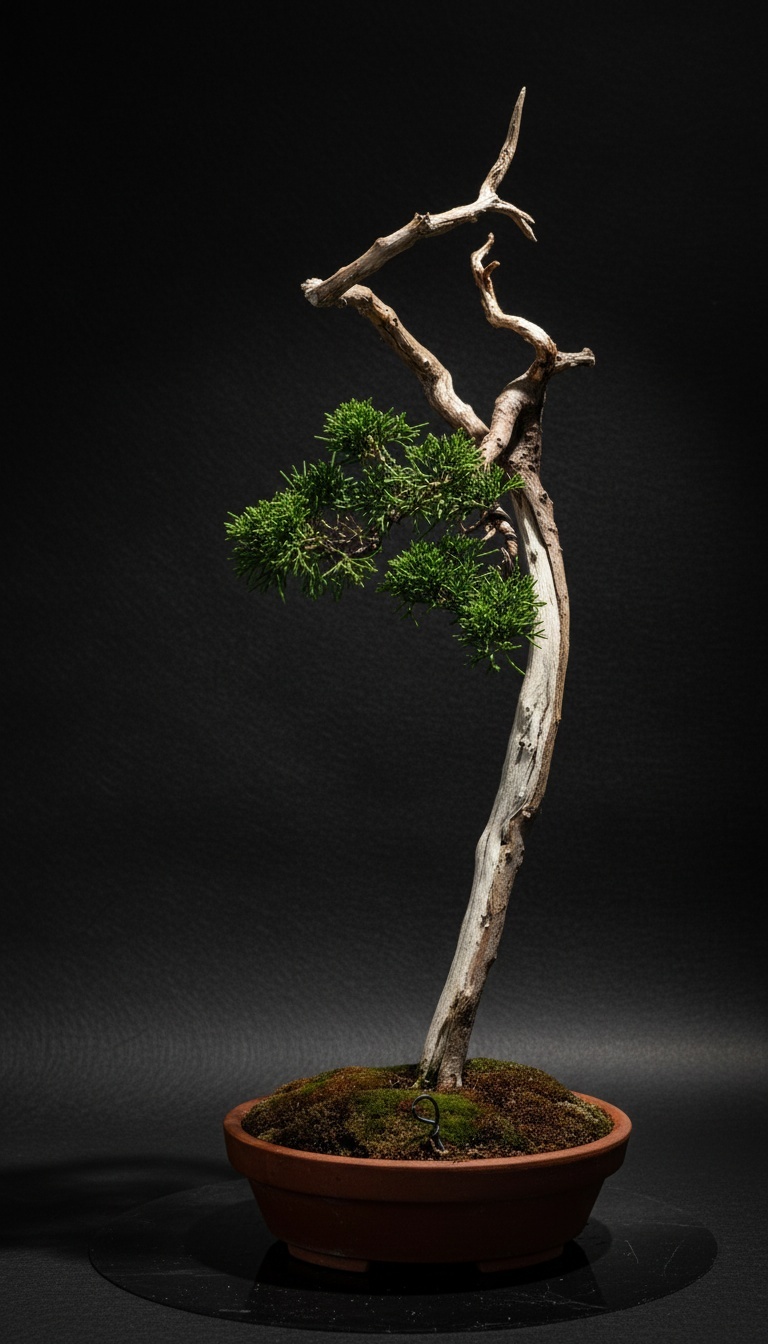
A shimpaku juniper bonsai, its foliage close enough to check needle by needle. Early damage on a conifer this dense is easy to miss from a step back and easy to catch from a few inches away.
A hundred years, undone by one insect
Age offers a bonsai no exemption from any of this. A pine cultivated for a century still stands in a container no larger, proportionally, than the one holding a young tree still in training, and its roots are just as unable to outrun a problem developing underground. Vine weevils make the point well: the adults notch leaf edges in a way that is easy to notice, but their larvae work unseen in the soil, feeding on roots, and by the time damage above the soil line becomes obvious, a grower may already be looking at a tree past saving. A bonsai's long life is not simply banked against future threats the way its accumulated years might suggest. It is renewed, tree and threat alike, every single season, and a pest left unwatched for long enough can undo in a summer what a hundred years of careful cultivation built.
Closing
None of this calls for expertise a beginner cannot acquire. It calls for the discipline of looking — turning a leaf over, running a finger along a branch, noticing that something is not quite as it was yesterday — repeated often enough that nothing has the chance to grow past a stage where it can still be caught. In bonsai, that ordinary vigilance is inseparable from the deeper practice of tending a tree at all.
Azukari treats this daily watch as a matter of course rather than an extra service. The artist tending a tree in Japan already inspects it as part of the same routine that waters and feeds it, season after season, so a problem that might go unnoticed for a week from a distance is caught within a day, close at hand. What reaches the owner is the tree's ongoing record — the vigilance itself continues quietly, the way it always has, whether or not anyone abroad happens to be watching.
References
- Agriculture Notes by Agriculture.Institute — Common Pests and Diseases in Bonsai and How to Manage Them — on why a confined pot concentrates stress, and on regular close inspection (leaf undersides, branch junctions, soil surface) as the primary defense.
- Bonsai4Me — A Basic Guide to Pests and Diseases That Affect Bonsai — identification and treatment notes for scale insects, spider mites, aphids, vine weevils, mildew, and rust.
- Bonsai Empire — Bonsai Pests and Diseases — general inspection guidance and the role of tree health in resisting infestation.
- Bonsai Empire Japan — 害虫や病気など — Japanese-language overview of common pests and the role of a healthy growing environment in prevention.
- みんなの趣味の園芸(NHK出版)— カイガラムシ — on scale insect biology, and why timing treatment to the newly hatched larval stage, before the protective shell forms, is critical.