
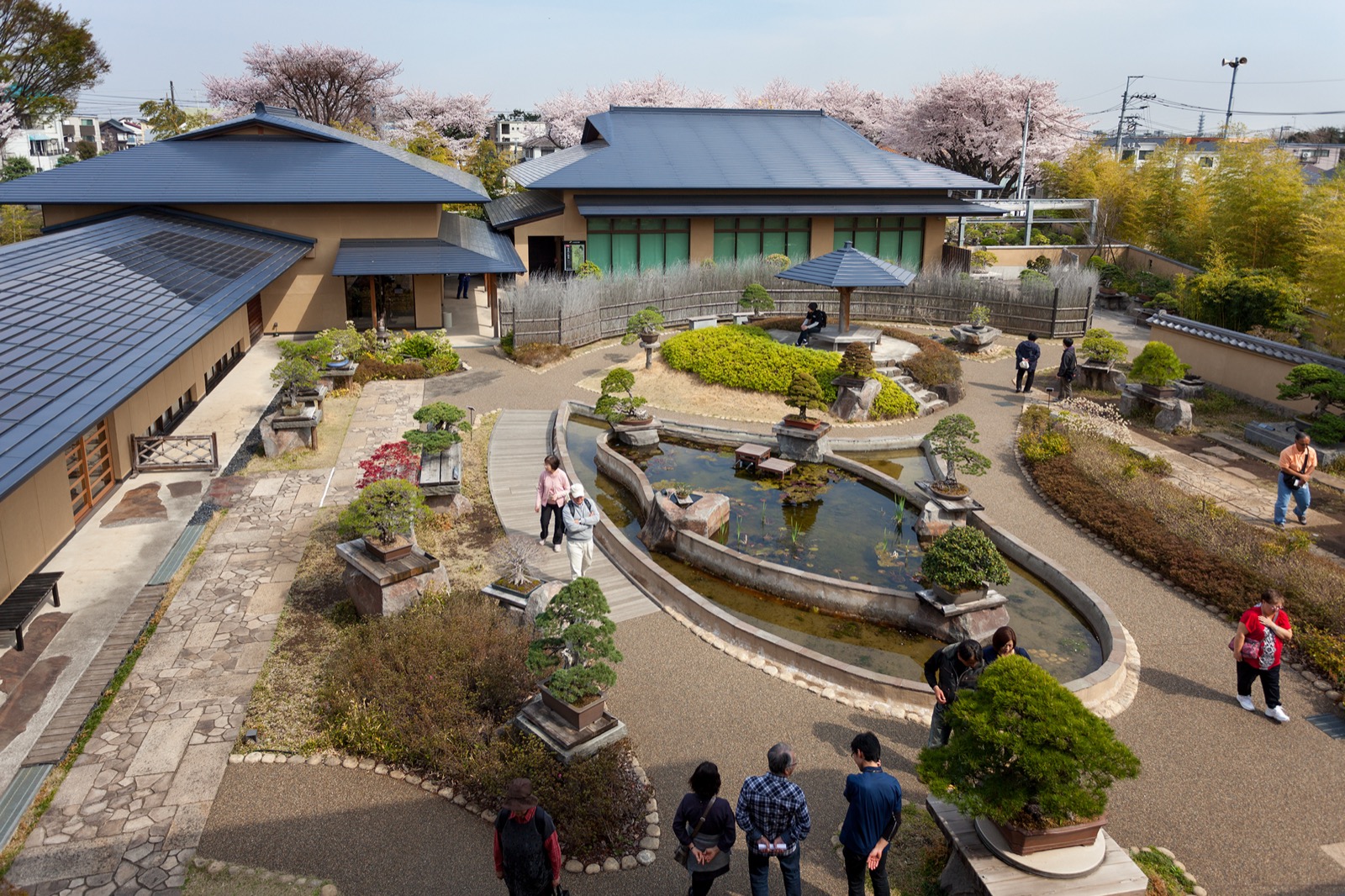
Visitors in the garden of the Omiya Bonsai Art Museum, one of the institutions that grew up around Omiya Bonsai Village. Photo by TypeZero, CC BY-SA 4.0, via Wikimedia Commons — Source

Omiya Bonsai Village, on the northern edge of Saitama City, is not a shopping street or a museum district built for tourists — it is a hundred-year-old neighborhood founded by bonsai professionals so they could grow bonsai, and it remains the closest thing Japan has to a capital of the craft.
It began as an act of relocation after a disaster, grew into a self-governed settlement with its own rules, shrank as the twentieth century wore on, and is now marking its first full century while trying to secure a second. Here is what that history actually looks like.
A Neighborhood Born of Disaster
Before 1923, a number of Tokyo's professional bonsai growers worked out of the Dangozaka district of Hongo, in the city center. The Great Kanto Earthquake of September 1923 devastated that part of Tokyo, and with it the smoke, crowding, and shrinking plots that had already been making the capital a difficult place to raise trees. A handful of growers began looking north, to open farmland outside the city, for space, cleaner water, and air that would not blacken a pine's needles.
They settled in what was then Osato village (大砂土村, absorbed into Omiya after the war), and the settlement's founding, in March 1925, is credited to a small group of pioneering nurserymen — among them Ritaro Shimizu, who led the effort and later became the first head of the village's growers' cooperative, and Tomekichi Kato, whose garden, Mansei-en, is one of the originals still open today. They and the growers who followed them drew up rules for anyone who wanted to live there: own at least ten bonsai, keep the garden open to visitors, build nothing taller than a single story so no house would shade a neighbor's trees, and fence each property with a living hedge rather than a wall. A bonsai neighborhood, in other words, that was designed from its first year to be looked into, not shut off.
A Guild of Growers, Not a Marketplace
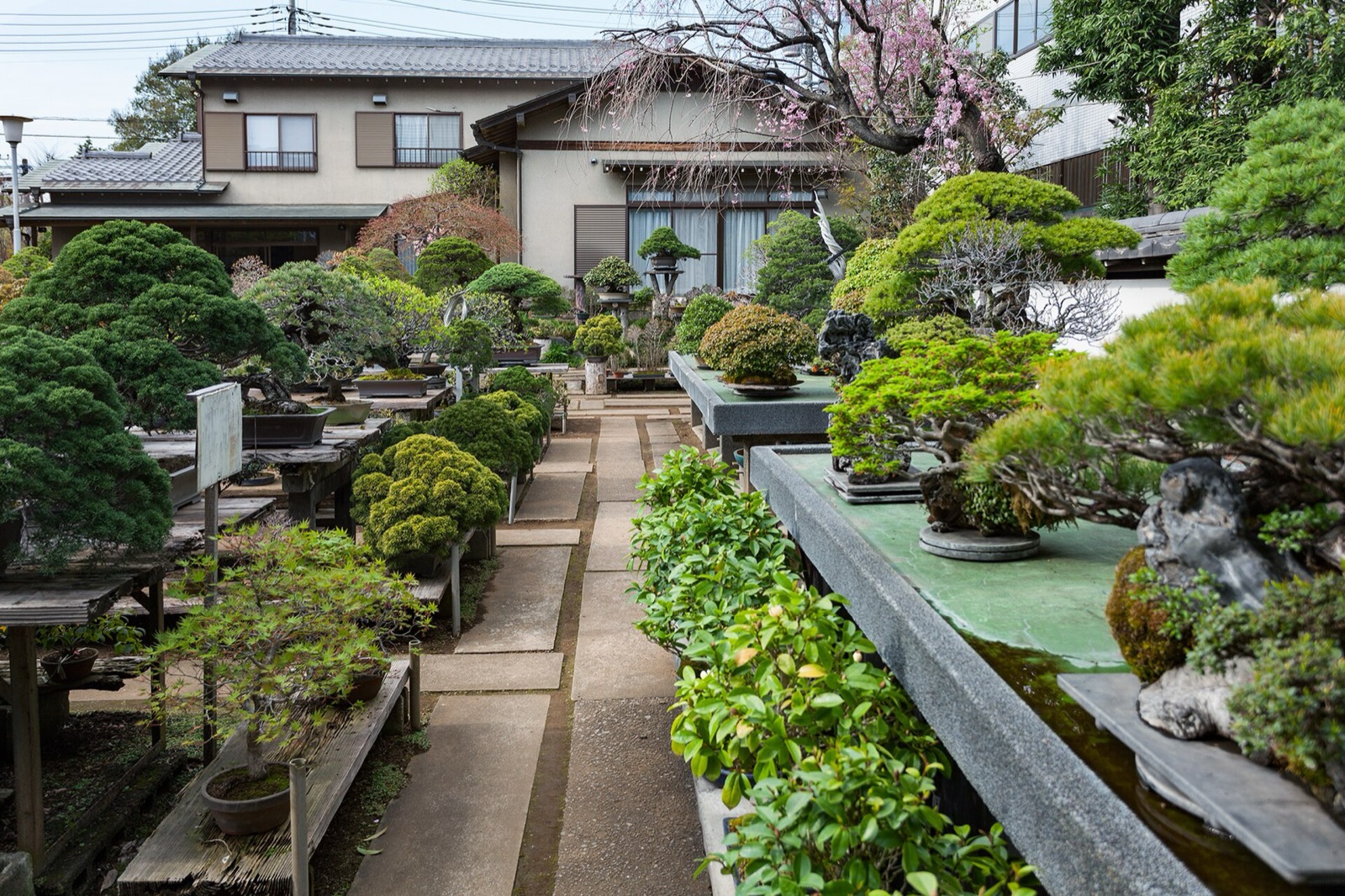
Fuyo-en, one of the six gardens still working in the village — trees on benches along a path, with the owner's house at the end of it. Photo by TypeZero, CC BY-SA 4.0, via Wikimedia Commons — Source

More nurseries followed over the next several years. By around 1930 the settlement had grown to roughly thirty gardens, and in 1928 its residents formed a cooperative to govern the community together. This was never a retail district in the ordinary sense — it was a cluster of working nurseries, each cultivating its own trees under its own name, bound by a shared understanding of what the place was for.
Tomekichi Kato's own nursery, Mansei-en, passed in 1946 to his son, Saburo Kato, who trained under his father from boyhood. Saburo Kato went on to become one of the most consequential figures in twentieth-century bonsai: a leading voice in the Nippon Bonsai Association, a founder of the World Bonsai Friendship Federation, and the organizer, decades later, of the first World Bonsai Convention. Mansei-en is one of the original gardens still open in the village today, and the Kato name runs through the settlement's history from its first year to its years of greatest international reach.
Bonsai-cho, Still the Center — But a Smaller One
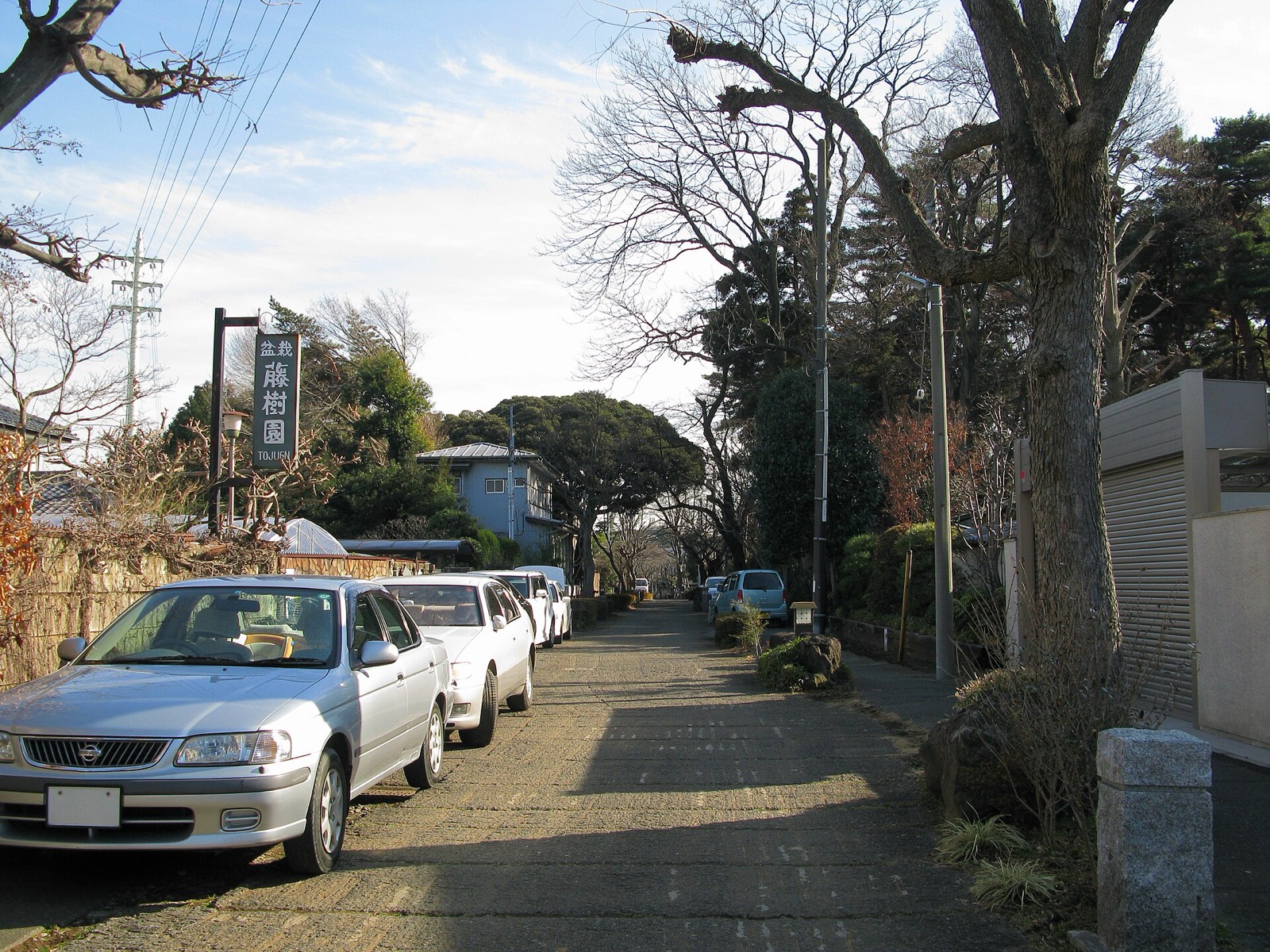
A street in Bonsai-cho, the signboard of Toju-en at the roadside. Photo by 京浜にけ, CC BY-SA 3.0, via Wikimedia Commons — Source

In 1957 the district was separated administratively from the surrounding neighborhoods of Omiya, Dotejuku, Doro, and Nishihongo and given its own official place name: Bonsai-cho (盆栽町, "Bonsai Town") — believed to be the only town name of its kind in Japan. In 2001, Omiya City merged with neighboring municipalities to form Saitama City, and Bonsai-cho came along with it, still carrying the name.
The village's growth did not hold. From a reported peak of more than thirty gardens, the neighborhood is down to six that remain open to the public today — Kyuka-en, Seiko-en, Toju-en, Fuyo-en, Mansei-en, and Shosetsu-en. Saitama City has attributed the decline mainly to the age of the garden owners and a shortage of successors willing to take on multi-generation nurseries, the same succession pressure that runs through much of Japan's traditional crafts. In March 2025 the village marked its hundredth anniversary, and the city has since been funding public campaigns — promotion of Omiya bonsai led by younger professionals, inside the city and beyond it, and a gift of a miniature bonsai to families with a newborn child — aimed at carrying the place into a second century.
What has grown alongside the gardens is the Omiya Bonsai Art Museum, which opened next to the village in 2010 as, by its own description, the world's first public museum built entirely around bonsai. Its collection includes trees with long, documented histories — among them the white pine "Higurashi," said to be around 450 years old — displayed alongside the historical and folk materials that explain how a neighborhood like this one came to exist in the first place.
Where the World Comes to Look
Omiya sits roughly thirty minutes north of central Tokyo by train, close enough for a day visit and far enough to feel like a different kind of place once you arrive. That accessibility, combined with the density of expertise concentrated in six working gardens, has made the village a fixture of international bonsai life since at least 1989, when it hosted the first World Bonsai Convention, drawing a reported 1,200 attendees from 32 countries. The eighth convention returned in 2017 and drew a reported 120,000 visitors from more than 40 countries over its run.
Many of the overseas visitors who make the trip are already in Japan for Kokufu Bonsai Ten, the country's oldest and most prestigious exhibition, held every February in Ueno. For a number of them, Kokufu is simply the starting point of a longer itinerary, and Omiya is the next stop on it — a chance to see trees on the bench rather than on a stage, and to speak directly with the growers who tend them.
A Village Kept Open
The rule that has outlasted almost everything else about Omiya Bonsai Village is its oldest one: keep the garden open. A century on, that founding decision still shapes what the place is. These are working nurseries, not showrooms, and yet from the beginning their owners chose to let outsiders walk in and look — an early, practical version of the idea that a tree being grown by one person can still be seen, and in some sense shared, by many others.
That is close to the logic behind azukari (預かり, "to receive something in trust"), an old idea in Japanese bonsai culture in which caring for a tree and owning it are treated as two different responsibilities that can be held by two different people. Azukari takes its name from the same idea: a tree stays in Japan, growing under a professional's care, while its owner joins that tree's ongoing record from wherever they happen to live. Omiya Bonsai Village has been running a version of that arrangement, quietly, since 1925 — trees raised for decades by people whose life's work this is, in gardens built, deliberately, so that no wall would stand between the tree and the people who came to see it.
References
- Omiya Bonsai Art Museum — About Omiya Bonsai Village — official museum account of the village's 1925 founding as a self-governed community and its approximately thirty gardens at their 1930 peak.
- Omiya Bonsai — History — official village history page on the 1923 earthquake relocation, the 1925 founding, and the village's founding rules.
- Omiya Bonsai — Gardens — current listing of the six bonsai gardens open to the public in the village today.
- Japan Travel (JNTO) — Omiya Bonsai Village — on the village's international recognition, including the 1989 and 2017 World Bonsai Conventions.
- Wikipedia — Omiya Bonsai Village — on the district's administrative history, including its 1957 designation as Bonsai-cho and 2001 incorporation into Saitama City.
- Saitama City, via PR Times — crowdfunding campaign for the village's 100th anniversary — on the decline from more than thirty gardens to six, attributed to owners' age and a shortage of successors, and the city's 2025 centennial initiatives.