A category of travel has taken shape around bonsai that has almost nothing to do with buying one. Its itinerary is built instead around looking — at trees that cannot be shipped, cannot be rushed, and in most cases are not for sale at all.
Bonsai tourism is the practice of planning a trip to Japan around seeing bonsai in person — an exhibition hall in February, a nursery bench any month of the year — rather than around acquiring one.
A Trip Built Around a Tree
Specialist operators now run tours with no other stated purpose than getting a small group of enthusiasts in front of the right trees. Eisei-en, run by the American bonsai artist Bjorn Bjorholm, organizes trips timed to the Kokufu Bonsai Exhibition and states plainly what such a tour is solving for: the language barrier, the unfamiliar train system, and access to gardens that do not simply open their gates to any visitor who arrives unannounced. Demand has been high enough that both of the operator's tours built around the 2026 centennial edition of Kokufu sold out well ahead of the exhibition, with further tours already planned for 2027 and beyond.
Bonsai Empire, one of the largest English-language bonsai resources online, frames a Japan trip in similarly absolute terms for a serious enthusiast: home to the finest bonsai anywhere, worth the trip at least once. Neither operator is describing a shopping excursion. They are describing something closer to what a devoted opera-goer does when planning a season around Bayreuth, or a wine lover around a single harvest.
Two Fixed Points: Ueno in February, Omiya Year-Round
Nearly every bonsai itinerary in Japan orbits two places, and they serve different purposes.
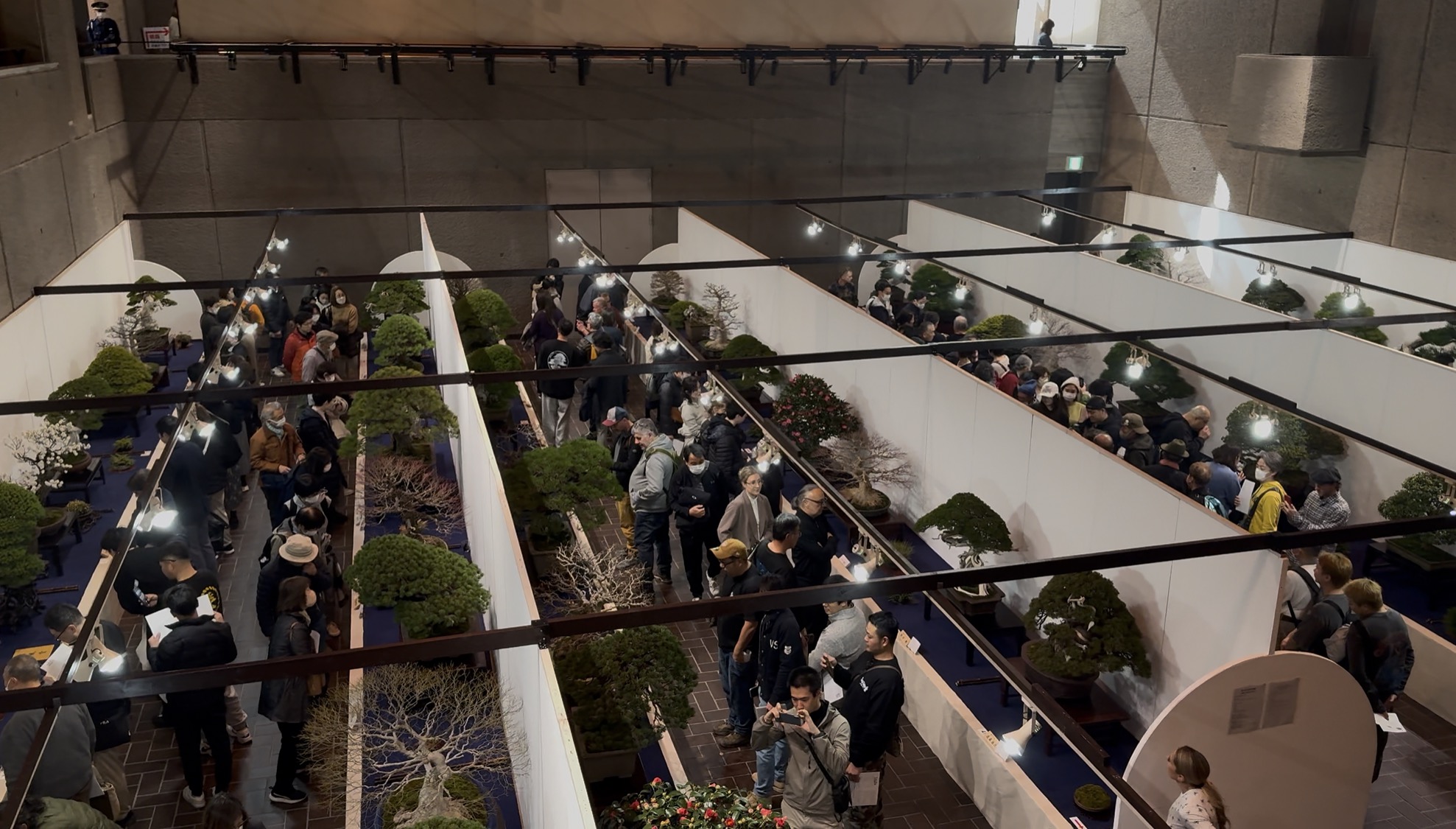
The Kokufu Bonsai Exhibition — Japan's oldest and most prestigious bonsai show, running continuously since 1934 aside from a wartime gap — is staged each February at the Tokyo Metropolitan Art Museum in Ueno, organized by the Nippon Bonsai Association. For the exhibition's run, the neighboring Ueno Green Club, a modest cluster of bonsai shops at the western edge of Ueno Park normally open only on weekends, transforms into something closer to a trade fair, with well over a hundred vendor stands set up for what is sometimes called the Spring Bonsai Festival. The Association's own office sits just outside the Green Club's grounds. For one week a year, Ueno becomes the single densest concentration of bonsai commerce and connoisseurship on the calendar — then, for the other fifty-one, it quiets back down to a handful of weekend stalls.
Omiya Bonsai Village, roughly thirty minutes north of central Tokyo by train, offers the opposite rhythm: six working gardens and a dedicated art museum, open to visitors every week of the year, not just one. Founded in 1925 by bonsai professionals relocating after the Great Kanto Earthquake, the village was built from its first year on a rule that its gardens stay open to outsiders, and it has drawn a steady stream of overseas visitors and dignitaries for decades. Many travelers treat Kokufu as the starting gun and Omiya as the destination that follows — a chance, once the exhibition has closed, to see trees on ordinary growing benches rather than under exhibition lighting, and to speak directly with the people who tend them.
Beyond the Exhibition Halls
Ueno and Omiya are the two fixed points, but they are not the whole map. Serious itineraries increasingly extend to working nurseries well outside Tokyo — Masahiko Kimura's garden in Saitama, spoken of by visitors in the same breath as a museum; the collection Shinji Suzuki maintains in Nagano; and Kinashi, in Kagawa Prefecture, a growing district with a documented history running past 250 years, still home to roughly a hundred working nurseries. None of these places was built with tourism in mind. Each is a production ground first, tending trees that in many cases belong to owners who live elsewhere entirely and will not see them again for a season or more. A visitor who is let onto the benches is being shown a workplace, not a display.
Why a Guide, Not Just a Map
That distinction — production ground rather than display — is precisely what makes an unaccompanied visit difficult. A nursery gate with no posted hours, an artist mid-repot who speaks no English, a train transfer with no romanized signage: these are ordinary friction for a solo traveler and the exact reason guided operators exist at all. The tours built around Kokufu do not sell access to trees so much as access to fluency — in the language, in the etiquette of walking into someone's working nursery, and in knowing which gate, on which weekend, is worth the trip.
What Looking Turns Into
Almost nobody who makes this trip leaves with a tree in hand. Export from Japan is slow by design, and most of what a visitor is shown was never on the market to begin with. What travelers carry home instead is closer to a fixation: having stood in front of a tree shaped across decades or centuries, in a form no photograph fully carries, the ordinary response is to want some ongoing claim on it — not a photograph of it, but a real, continuing relationship with a tree still growing, still being tended, still in Japan.
That is the same instinct Azukari was built around, minus the flight. An owner's tree keeps growing under a professional's care in the same country these travelers cross an ocean to visit, its condition recorded through the seasons, its next chapter still unwritten. Bonsai tourism turns a stranger into someone who has seen the trees. What tends to follow is wanting to be, in some small way, part of their record.
References
- Nippon Bonsai Association — Kokufu Bonsai Exhibition event page — official venue (Tokyo Metropolitan Art Museum, Ueno), 2026 centennial dates, and organizing body.
- Eisei-en (Bjorn Bjorholm) — Japan Bonsai Tours — operator description of Kokufu-timed tours, stated purpose (language, transit, garden access), and confirmation that both 2026 centennial tours sold out.
- Bonsai Empire — Japanese Gardens and Bonsai in Japan — overview of Kanto-region nurseries, Kokufu-ten, Kimura's and Suzuki's collections, and Kinashi's 250-year growing history.
- Bonsai Empire — Ueno Green Club — on the Green Club's location, weekend shop hours, and its transformation during the Kokufu period.
- Japan Travel (JNTO) — Omiya Bonsai Village — official tourism board description of the village's six gardens, museum, and international visitor history.