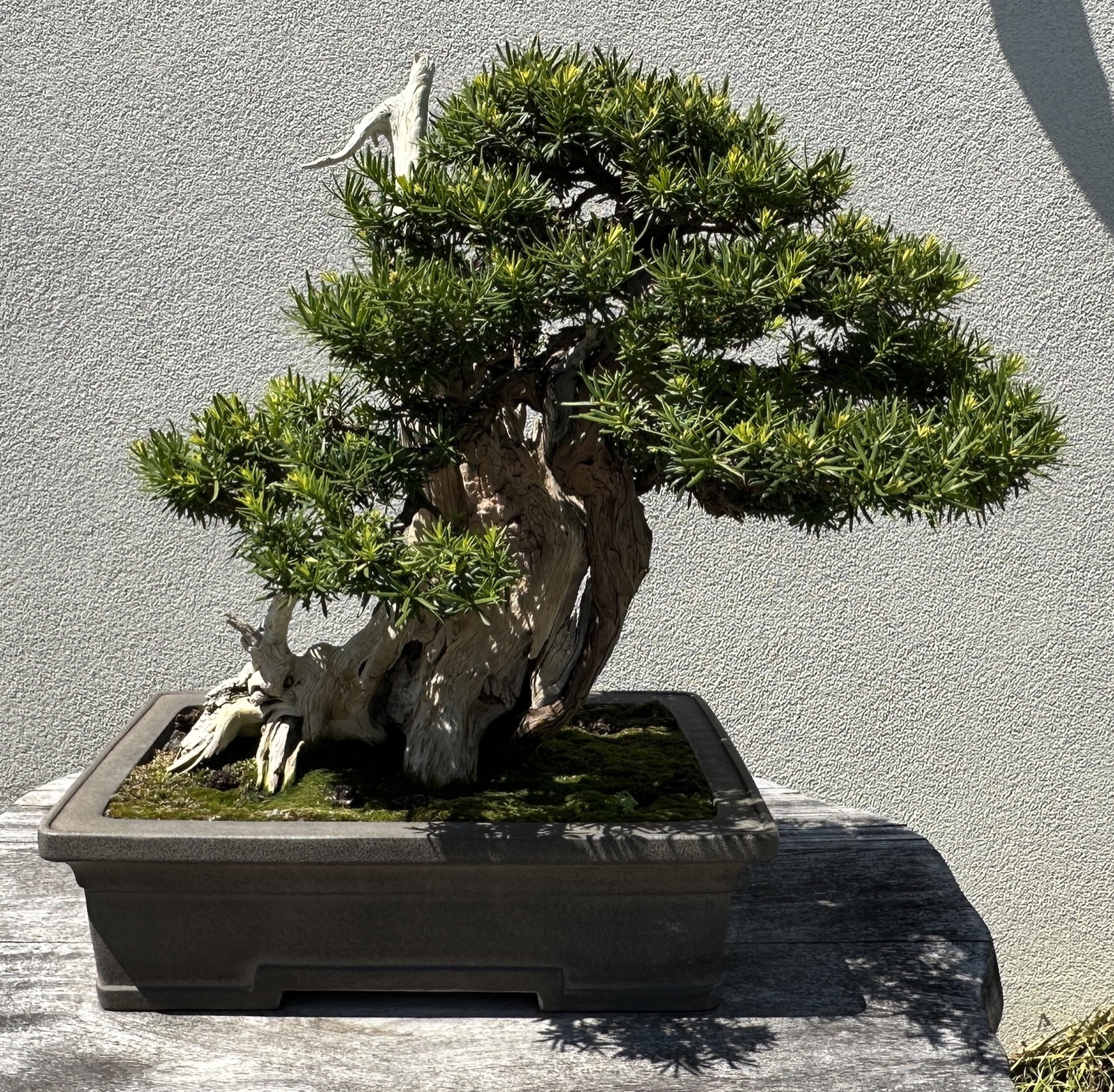
A Japanese yew (ichii) bonsai, its trunk carrying a wide run of aged deadwood beneath dense, dark green foliage. Photo by APK, CC BY 4.0, via Wikimedia Commons — Source

Stand an ichii next to a white pine in full candle or a black pine with its plated, silvered bark, and it will not win the room. Its needles stay a flat, unbroken dark green through every season. Its trunk thickens slowly and without drama. And yet growers who have kept one for a decade rarely part with it. It asks for shade other conifers refuse, tolerates a cold that would kill a pine outright, and once a year quietly produces one of the most unlikely colors in the conifer world.
Ichii, the Japanese yew, is bonsai's quietest conifer — a tree valued less for immediate impact than for the dark, dense calm it holds through every season, and the improbable history bound up in its name.
A quiet green, marked in red
Ichii (一位, Taxus cuspidata) carries its foliage differently from a pine. Where a pine's needles gather in bundled pairs or fives, ichii's are flat, linear, and arranged in two neat combed rows along the shoot, giving the whole tree a dense, almost furred silhouette rather than a pine's open, brush-like one. The color rarely varies: a matte, near-black green that holds through winter with little of the yellowing or bronzing common in other conifers.
Then, in autumn, that steadiness breaks. Ichii is dioecious, and a female tree ripens a scatter of small, cup-shaped structures called arils — not a cone, but something closer to a berry, glossy and bright red, each one cradling a single seed. It is an unusual thing for a conifer to produce anything that reads as fruit, and the contrast against the tree's own dark needles is sharper than anything a pine offers. One caution belongs here: almost the entire tree, foliage, bark, and especially the seed inside the aril, contains toxic taxine alkaloids. Only the soft red flesh of the aril itself is not toxic, and growers who keep ichii, particularly around children or pets, treat that distinction with care.
Hardy where others struggle
Ichii grows wild from Hokkaido down through Honshu, Shikoku, and Kyushu, and on into Korea, northeastern China, and the far southeastern edge of Russia around the Amur basin, Sakhalin, and the Kuril Islands. It is not confined to the north, but it is in cold, often mountainous ground that it grows thickest and most naturally, and in Hokkaido it has long carried its own regional name, onko, alongside the Ainu name rarmani. In open ground the species tolerates cold that would kill most pines outright — cultivation references rate it hardy well into USDA zone 4, surviving temperatures near -34°C.
A bonsai in a shallow pot does not get to rely on that. Without the insulation of open soil, a potted ichii's roots are far more exposed than the same tree growing in the ground, so growers still bring container specimens under cover once temperatures fall much below -10°C, even though the species itself shrugs off far worse. It is one of the few conifers that also tolerates real shade well, which makes it a useful tree for a bench position a pine would refuse.
A name earned by rank
The name ichii is not descriptive; it is honorary. In the Japanese court system, shoichii (正一位) was the highest of the imperial ranks, and shaku (笏, a narrow ceremonial baton carried by court officials) were, by tradition, carved from this tree's pale, fine-grained wood. According to Gifu Prefecture's own account of its symbols, the tree was once presented to the emperor as shaku material and was granted that same top rank in return — and has been called ichii, "first rank," ever since.
The tradition has a specific home: Kurai-yama (位山, "Rank Mountain"), a 1,529-meter peak in the Hida region of Takayama, Gifu, whose slopes hold a natural stand of old-growth ichii. Japan's Ministry of the Environment lists a giant specimen there, roughly 18 meters tall with a trunk over three meters around, estimated at more than a thousand years old — and records the practice of presenting shaku cut from Kurai-yama's ichii to the imperial court as far back as 1159, a custom said to have continued through the Showa, Heisei, and Reiwa enthronement ceremonies. Gifu has since made ichii its official prefectural tree. A separate old specimen on Mount Sentsu in Tottori Prefecture, the Sentsuzan-no-Ichii, is estimated at some 2,000 years old — a reminder that age in bonsai points to something the wild trees of this species have always been unusually good at holding onto.
The understated choice among conifers
In bonsai classification, ichii sits inside the broad category known as shohaku (松柏, literally "pine and cypress," used to mean evergreen conifers generally) alongside pines, junipers, spruce, and cedar, set apart from the flowering and fruiting zoki trees. But within that company it plays a different role than goyomatsu or kuromatsu, whose refined candles or weathered bark are usually the first thing a visitor's eye finds. Ichii suits nearly every classical form — upright, slanting, cascade, literati — with the notable exception of the broom style its dense habit resists, and its slow growth rewards patient, minimal intervention over dramatic yearly change. It is, among the many trees grown as bonsai, closer to a supporting register than a lead: the tree a collection holds not to announce itself, but to give the eye somewhere quiet to rest between the showier pines.
Closing
An ichii does not ask to be the tree a visitor notices first. It asks only to be kept — in shade a pine would refuse, through a cold a pine would not survive, its dark needles and occasional red arils marking the seasons without ever performing for the room. That is a particular kind of patience to ask of an owner, and a particular kind of trust to place in the hands doing the yearly work. Azukari exists for exactly that arrangement: a tree tended in Japan by an artist who understands what a quiet conifer needs, its seasonal record kept and shared with the owner who has taken on one stretch of its long, undramatic life.
References
- Gifu Prefecture — "Symbols of Gifu" — official page naming ichii as Gifu's prefectural tree and recounting the shaku/court-rank origin of its name.
- Ministry of the Environment, Japan — Giant Tree Survey: "Ichii of Kurai-yama" — the Kurai-yama specimen's estimated age and dimensions, the 1159 record of shaku tribute, and the continued tradition through modern enthronement ceremonies.
- The Gymnosperm Database — Taxus cuspidata — native range, needle description, and traditional Japanese uses of the wood.
- Wikipedia — Taxus cuspidata — toxicity of foliage, bark, and seed versus the non-toxic aril flesh; the onko/rarmani names; and the 2,000-year-old Sentsuzan-no-Ichii in Tottori Prefecture.
- Bonsai4me — "Taxus / Yew Bonsai" — cultivation notes on shade tolerance, cold hardiness of container specimens, and suitable bonsai styles.
- The Japan Foundation, Wochi Kochi — "The Joys of Viewing Bonsai in Autumn" — describes the shohaku conifer category, which explicitly includes yew alongside pine, juniper, spruce, and cedar.