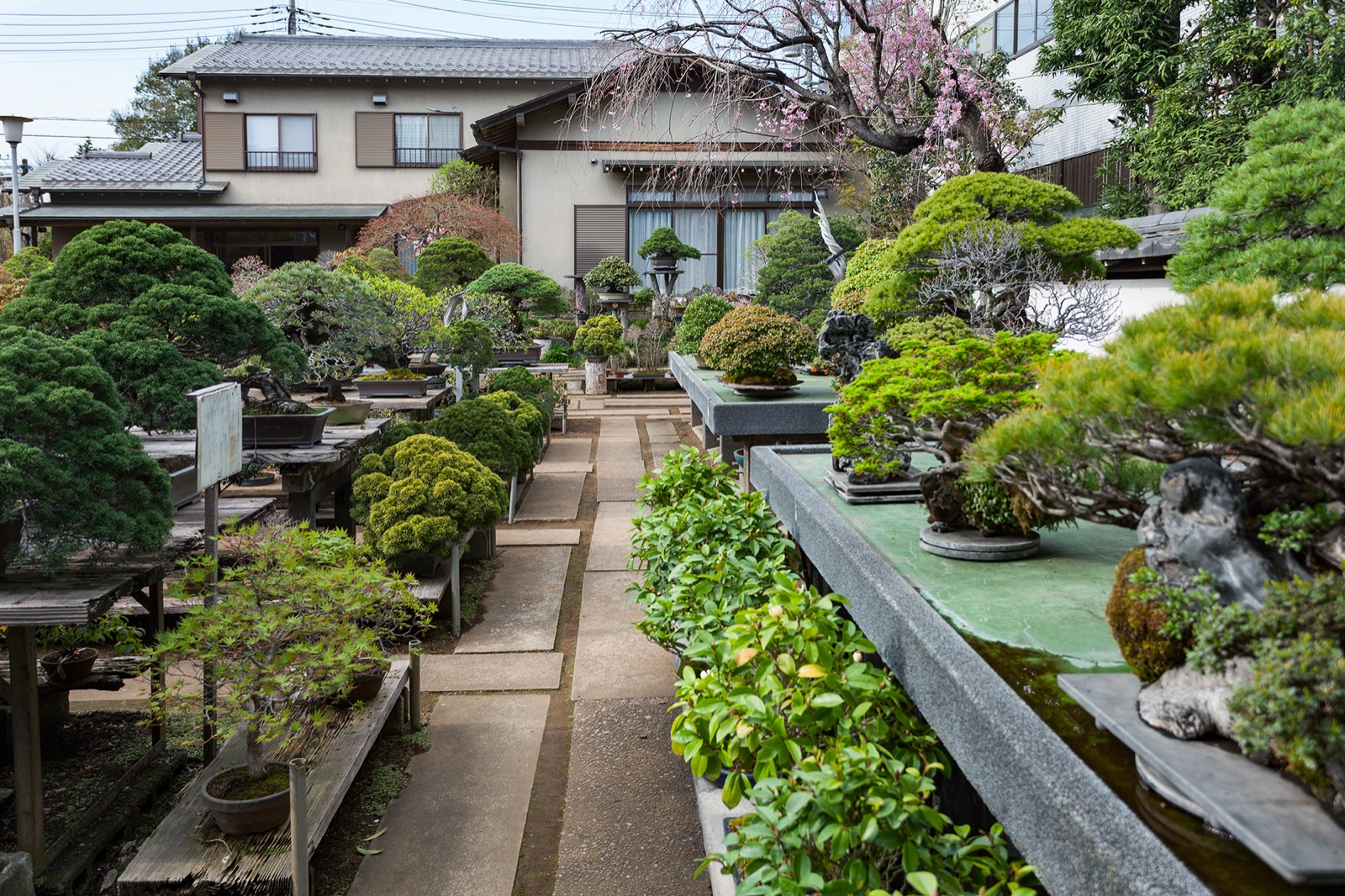
Fuyo-en, a nursery in Omiya Bonsai Village, Saitama. A row of ordinary benches — the setting most first trees are actually kept in, long before anyone talks about style or design. Photo by TypeZero, CC BY-SA 4.0, via Wikimedia Commons — Source

Buy one hardy outdoor species, decide exactly where it will stand before it arrives, and spend the first months watching it rather than working on it. Almost every early bonsai lost to a beginner traces back to skipping one of those three steps — usually the wrong species indoors, or a tree that was pruned and re-potted before its owner had learned to read it.
Choose one tree, and make it a forgiving one
The easiest early mistake is choosing on looks alone. A small, densely branched pine or a maple with fine autumn color is often the tree that catches a beginner's eye first, and it is also usually the least forgiving one to learn on. Hardier, more common outdoor species are the better start: Chinese elm, prized for tolerating a wide range of conditions and pushing new shoots readily after pruning, and juniper — particularly Juniperus procumbens 'Nana', a low, dense form widely sold as a beginner tree — are both frequently recommended precisely because they absorb a beginner's mistakes without dying from them. In Japan, nurseries point newcomers toward goyomatsu (五葉松, Japanese white pine) and shinpaku (真柏, Japanese shimpaku juniper) for the same reason: slow, steady growth that holds its shape and rarely punishes an owner for a missed week of care. What all of these share is not beauty but patience — a tree that gives its owner time to learn.
One tree, not several, matters just as much as the species. A single pot means a single set of conditions to learn — one soil, one watering rhythm, one microclimate on one bench or balcony — instead of several trees each demanding a slightly different read at once.
Decide where it will live before you decide what it is
Most bonsai are outdoor trees. Only a narrow band of tropical and subtropical species can be kept indoors long-term, and even those need far more direct light than a windowsill usually provides. This means the honest first question is not "which tree do I want" but "where does it actually have to live" — a bright, wind-protected spot outdoors for the vast majority of species, or a south-facing window with supplemental light for the handful of tropical exceptions such as ficus. Placement decides the outcome of a bonsai's first year more than any other single factor, including how carefully it is pruned or how precisely it is watered. Settling that question before buying, rather than after, is what keeps a first tree's location from becoming a second, harder problem to solve.
The first skill is not pruning — it is watching
Bonsai culture in Japan has a saying for this: mizuyari sannen (水やり三年, "three years [just] to learn watering"). It is not meant literally as a fixed term, but as a way of saying that correct watering — reading a specific tree's specific needs, day by day — takes far longer to learn than it looks like it should, and that everything else in bonsai care is built on top of it. A nursery apprentice's first months are typically spent almost entirely on watering and observation, well before they are trusted with wire or shears.
For a beginner with one tree, this translates into a simple daily habit rather than a fixed schedule: check the soil surface each morning, water thoroughly when it has started to dry rather than on a set interval, and watch how quickly it dries again afterward. Soil that looks pale and feels dry an inch down is ready for water; soil that is still dark and cool underneath is not, regardless of how many days have passed since the last watering. That single habit, repeated daily, teaches more about a tree's actual needs — its light, its pot, its root volume, the specific microclimate it sits in — than any general guide can.
Knowledge follows observation, not the other way around
It is tempting to read extensively before buying a first tree — wiring angles, repotting cycles, feeding schedules — and there is a place for all of it later. But most of that knowledge only becomes useful once there is a specific tree to apply it to, sitting in a specific spot, showing specific signs. A beginner who spends the first season mostly watching one hardy tree, learning what its ordinary, healthy state looks like, ends up better prepared to act on later guidance than one who tries to apply every rule at once to a tree they have not yet learned to read.
This is also, in miniature, the same rhythm that shapes bonsai practice in Japan at every level: a slow, attentive relationship with one tree at a time, built through daily contact rather than a single burst of effort. Entrusting a tree to someone else's care, whether a nursery back home or an artist in Japan, does not remove that rhythm — it simply moves who is doing the daily watching. For anyone choosing where to actually acquire that first tree, from a local nursery or further afield, the same principle applies before and after the purchase: start with one tree, place it correctly, and let watching it teach you the rest.
References
- Bonsai Empire — "Best Bonsai trees for Beginners" — on recommending hardy species such as juniper and Chinese elm for outdoor beginners, and on deciding indoor vs. outdoor placement before choosing a species.
- Bonsai4Me — "A Guide To Watering Bonsai" — on watering by daily observation rather than a fixed schedule, and on the Japanese saying that watering correctly takes roughly three years to learn.
- 近代出版 Bonsai.co.jp — "水やり" (beginner bonsai course) — on the mizuyari sannen saying and on checking soil color and dryness daily before watering.
- 盆栽妙 — "初めての盆栽" (choosing a first bonsai) — on recommending hardy species such as goyomatsu, shinpaku, and choju-bai for beginners, outdoor placement with at least a few hours of direct sun, and adjusting placement when a tree's condition declines.