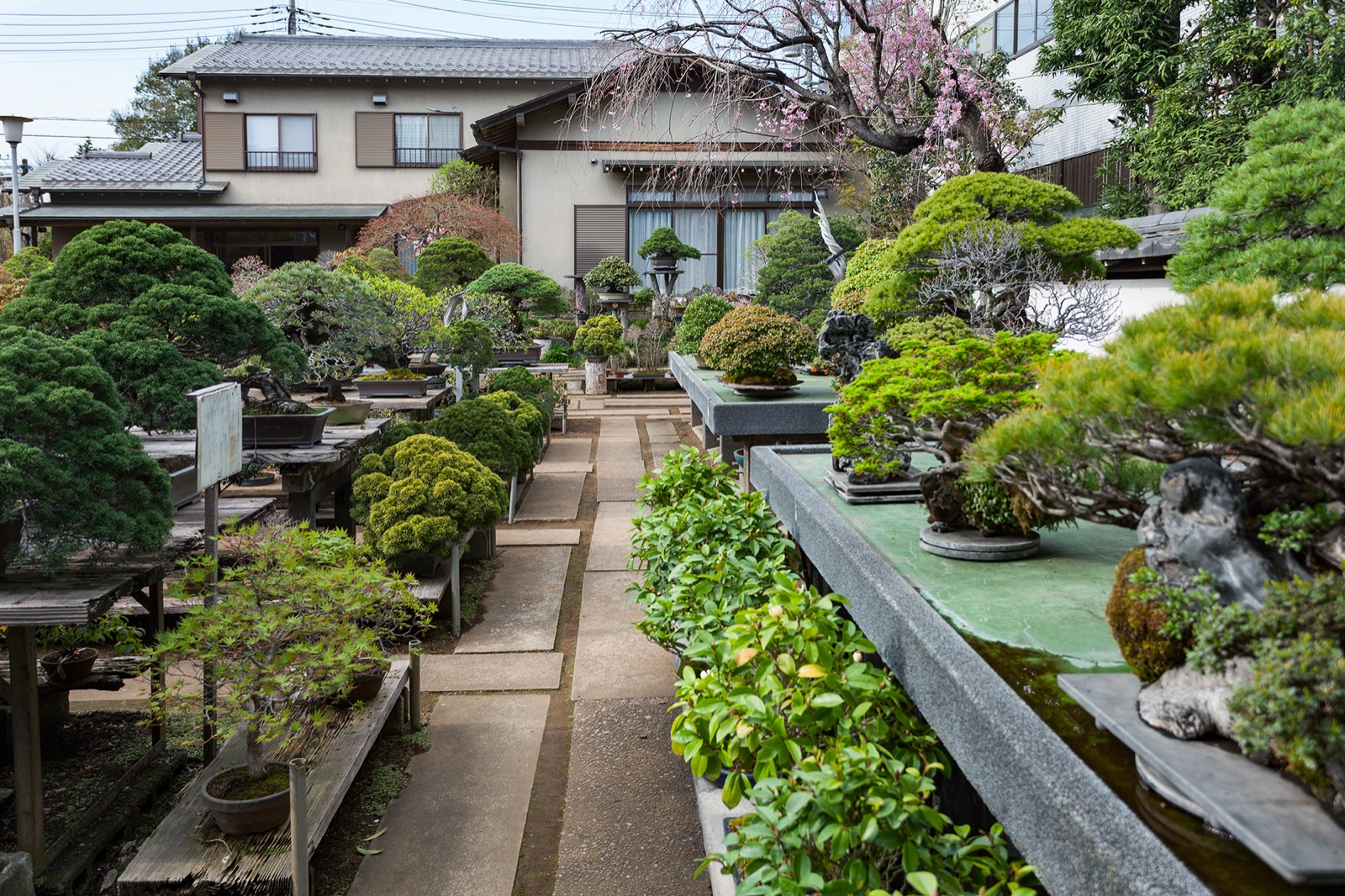
Fuyo-en, a nursery in Omiya Bonsai Village, Saitama. Rows of pots on open-air benches — the ordinary condition for most bonsai, not a special one. Photo by TypeZero, CC BY-SA 4.0, via Wikimedia Commons — Source

No, not most of them. The great majority of bonsai are temperate trees — pine, juniper, maple — that need real sunlight, moving air, and a cold winter to stay healthy. Only a small group of tropical and subtropical species can be kept indoors long-term, and even those need far more light than a windowsill provides.
The world's most common bonsai misunderstanding
Bonsai arrives in most people's imaginations as a houseplant: a tidy little tree that lives on a shelf or a desk. It is an understandable guess — a tree small enough to fit in two hands looks like something built for indoor life. But the guess is backwards. As one long-running bonsai reference site puts it flatly, "there is no such thing as an indoor bonsai or an indoor tree" — every bonsai is, at root, an outdoor tree that has been trained and kept small, and the training does nothing to change what the species itself needs to survive. The size of the pot changes nothing about what is inside it.
Most bonsai are outdoor trees, full stop
Species like pine, juniper, maple, elm, and azalea are temperate trees. In the wild they experience four real seasons, and that cycle is not optional scenery — it is a physiological requirement. As days shorten and temperatures fall toward roughly 4 to 10°C, a temperate tree reads those two signals together and enters dormancy: growth halts, energy is drawn back into the roots, and internal tissue effectively goes into standby for winter. Kept indoors, a tree never receives that signal. Central heating holds the air at a near-constant temperature and windows filter out much of the light intensity a tree would get outside, so a temperate species can be pushed to keep growing weakly through winter instead of resting — a pattern that, left uncorrected, produces smaller leaves, thinner spring growth, and a tree more vulnerable to disease with each passing year. It will not usually die in the first season. It fails slowly, which is part of why the mistake is so common — by the time the decline is obvious, a year or more of the wrong environment has already passed.
The exception: tropical and subtropical species
A narrow band of species is the actual exception to all of this. Ficus, jade (Portulacaria afra or Crassula), Fukien tea, and a handful of other tropical and subtropical trees never evolved a dormancy requirement in the first place, because the climates they come from do not have a winter to prepare for. These are the species sold as "indoor bonsai," and the label is accurate for them in a way it is not for a juniper or a pine. Even so, indoors is still a compromise environment for a tropical tree, not a natural one: light indoors is markedly weaker than outdoor light, humidity is usually far lower than these species are used to, and still air lacks the natural circulation a tree gets outside. In practice this means placing the tree directly in front of a south-facing window, sometimes supplementing with grow lighting for several hours a day, and raising humidity with a water tray or regular misting — active substitutes for conditions a tree outdoors gets for free.
Placement decides the outcome, not effort
None of this is really about how attentive an owner is. It is about where the pot sits. Placement is the single largest factor in whether a bonsai thrives — light, airflow, and the seasonal cycle a tree is exposed to matter more than any pruning or watering schedule layered on top of the wrong environment. A juniper watered perfectly on a heated windowsill is still a juniper being denied the winter it needs; a ficus given the right south-facing spot and enough supplemental light can do reasonably well indoors precisely because its species never needed that winter to begin with. The question "can bonsai live indoors" is really a question about species, asked in the wrong order.
What this looks like in Japan
Japanese growers do bring bonsai indoors — briefly. A tree set inside for a tokonoma (床の間, "an alcove for seasonal display in a traditional Japanese room") display might spend a day or two on show before returning to its bench outside to recover. The point of the custom is the opposite of what "indoor bonsai" usually implies: indoors is where a tree is shown, not where it is grown. The bench, the open air, and the turning of the seasons remain the tree's actual home for the other 363 days of the year.
At Azukari, that same principle holds for every tree in an owner's care: it stays on a working nursery bench in Japan, moved through shade cloth, cold frames, and open sun by an artist who tracks the season, not a shelf indoors thousands of miles from where it needs to stand.
References
- Bonsai4Me — "Indoor Bonsai" — on the "no such thing as an indoor bonsai" position, the dormancy requirement of temperate species, tropical species as the exception, and the temporary tokonoma display custom in Japan.
- Miyagi Bonsai — "The Science of Bonsai Dormancy" — on the temperature and daylight signals that trigger dormancy, and the weak growth, smaller leaves, and disease risk that result when temperate species are denied it.
- Bonsai Empire — "Indoor Bonsai tree care guidelines" — on Ficus, jade, and other tropical/subtropical species suited to indoor cultivation, and the light and humidity measures indoor growing requires.
- Bonsai Empire — "Outdoor Bonsai tree care guidelines" — on outdoor species (juniper, pine, maple, elm) and the seasonal exposure they need.
- 盆栽日和 — "盆栽(室内)おすすめの種類と育て方を徹底解説" — on gajumaru (ガジュマル, Ficus microcarpa) and ficus as suitable indoor species, and the light and airflow measures indoor cultivation in Japan requires.