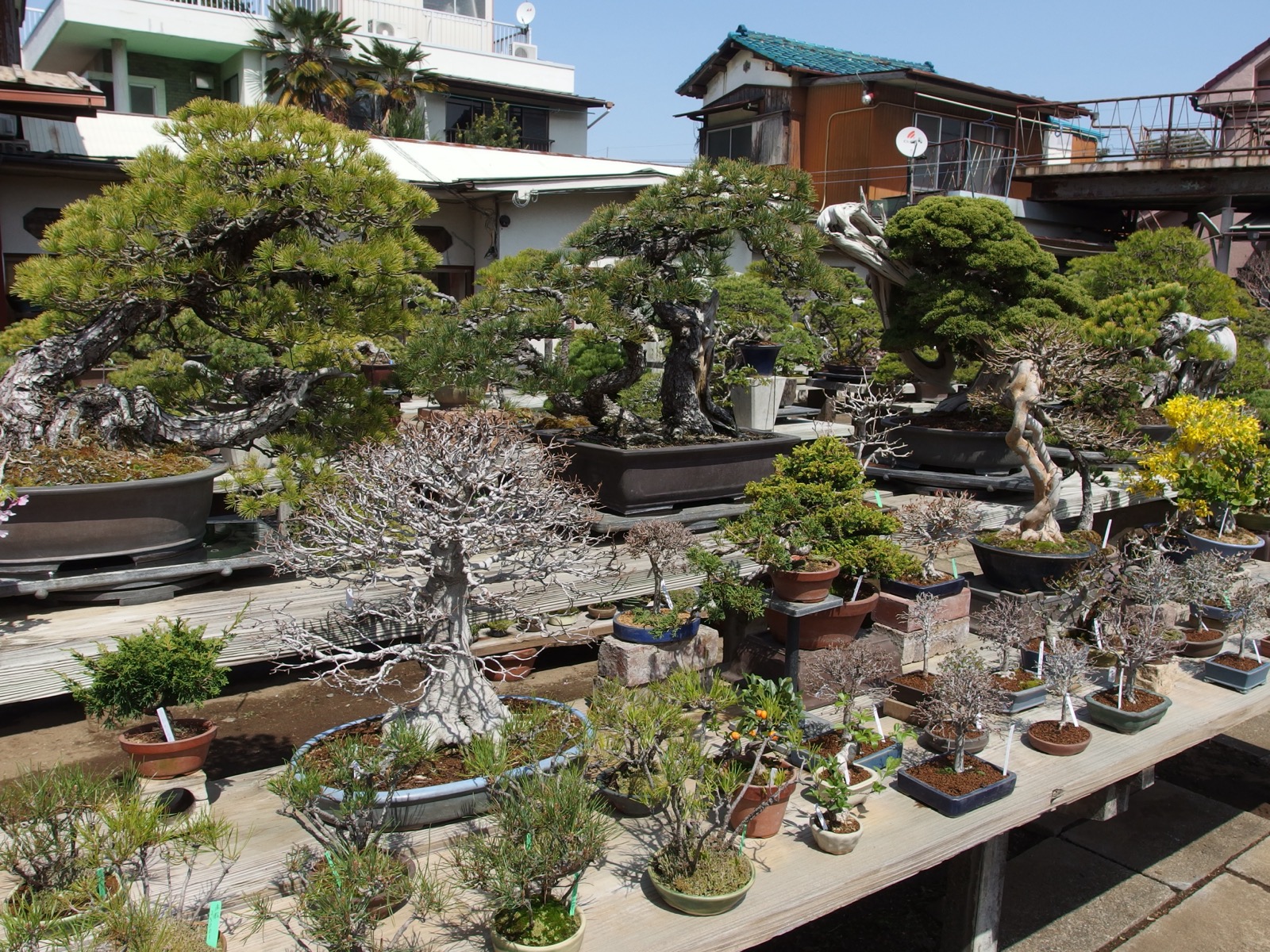
A working nursery inside Omiya Bonsai Village, Saitama. Photo by Guilhem Vellut, CC BY 2.0, via Wikimedia Commons — Source

Buy from a nursery you can ask questions to — in person if one is near you, or a specialist online seller with a real, checkable history if it isn't — and treat a supermarket display or an anonymous marketplace listing as a starting point at best, not a finished tree worth paying real money for. Where you buy matters more than what you buy, because almost everything that goes wrong with a first bonsai traces back to a seller who couldn't, or wouldn't, tell the buyer what they were actually getting.
Start at a nursery, not a display shelf
A dedicated bonsai nursery — someone growing and training trees as their actual business, not a garden center with a seasonal bonsai shelf — is the safest default. Bonsai Empire's own directory lists hundreds of specialist nurseries across the US, UK, Canada, and Australia, from small backyard operations to growers like Brussel's Bonsai, which runs over 175,000 square feet of greenhouse space devoted entirely to bonsai. A nursery like this has a reputation staked on every tree it sells, staff who can answer a direct question about a specific tree's history, and — usually — a return policy if something arrives or turns out unhealthy.
That doesn't rule out a supermarket or home-improvement-store tree, often called a mallsai (a portmanteau of "mall" and "bonsai" describing the mass-produced trees sold outside any bonsai tradition). We cover whether a mallsai is worth buying in detail elsewhere — short version: fine as a cheap first plant to practice on, not something to expect real bonsai quality from.
What a trustworthy seller actually tells you
A good seller answers questions a bad one dodges. Growers who write buying guides for beginners tend to boil it down to the same three checks: is the tree healthy, is it honestly priced for what it is, and — the one most beginners skip — what is it actually planted in. Proper free-draining bonsai soil is a sign the tree has been maintained the way bonsai practice expects; loose garden dirt with a few decorative rocks pressed on top is a sign it hasn't, however good the shape looks from a distance. A seller worth buying from will show you the roots, or at least describe them, without being asked twice.
Buying online: what to check before you pay
The same questions apply online, but the red flags are easier to hide behind a photograph. One recurring warning from buyers' guides: a seller whose entire inventory is labeled with suspiciously round, uniform ages — "all thirty years old" — when almost no seller actually knows the exact age of every tree they carry, unless they grew each one from seed themselves. A trunk with smooth, young bark rarely belongs to the decades-old tree the listing claims. Watch, too, for a nice-looking artisan pot on a tree that was clearly grown in a cheap production container until days before the photo was taken — the pot is sometimes doing the selling that the tree itself hasn't earned.
If the seller is overseas, ordinary shipping adds its own layer of caution. A tree bought from a Japanese nursery, in particular, is not a package that simply gets mailed home — most bonsai cannot legally leave Japan at all, and the ones that can typically pass through registered-nursery quarantine procedures lasting years, a process we go through in Can Bonsai Be Exported? Any online seller who promises fast, simple shipment of a mature tree out of Japan is a claim worth double-checking before money changes hands.
The person comes before the tree
Inside Japan, this whole question tends to answer itself, because a Japanese bonsai-en (盆栽園, "a bonsai nursery") rarely separates the tree from the relationship in the first place. Most don't post a price without seeing the tree or a real set of photographs first, and a first-time visitor is usually building a rapport with the owner before any figure is ever named. That is not a formality unique to Japan — it is close to the actual rule for buying anything living and one-of-a-kind, anywhere. A seller willing to talk you through a tree's condition, its soil, its history, and what it will need from you next year is worth more than the lowest price on the page.
That is also, in the end, the standard worth carrying past the purchase itself. A bonsai bought well is the start of a relationship with someone who already knows the tree — a nursery down the road, or, for a tree that stays in Japan under a grower's ongoing care, an arrangement like Azukari, where the person tending the tree and the person who owns it stay in touch season by season rather than parting ways at the register.
References
- Bonsai Empire — "Where to find Bonsai trees for sale" — directory of specialist bonsai nurseries and online retailers across the US, UK, Canada, and Australia, including Brussel's Bonsai's greenhouse scale.
- Love My Bonsai — "What To Look For When Shopping For A Bonsai Tree" — buyer's checklist on tree health, soil quality, and root condition before purchase.
- Bonsai-En (Australia) — "Don't Fall For This Bonsai Scam" — warning signs in online bonsai listings, including implausible uniform age claims and mismatched pots.
- Fujikawa Kouka-en — Overseas Buyers — description of how a Japanese nursery handles inquiries from overseas buyers by email and photographs rather than a listed catalogue price.
- Wikimedia Commons — File: Bonsai nursery @ Omiya Bonsai Village (13593836174).jpg — source and license (CC BY 2.0, photo by Guilhem Vellut) for the header image.