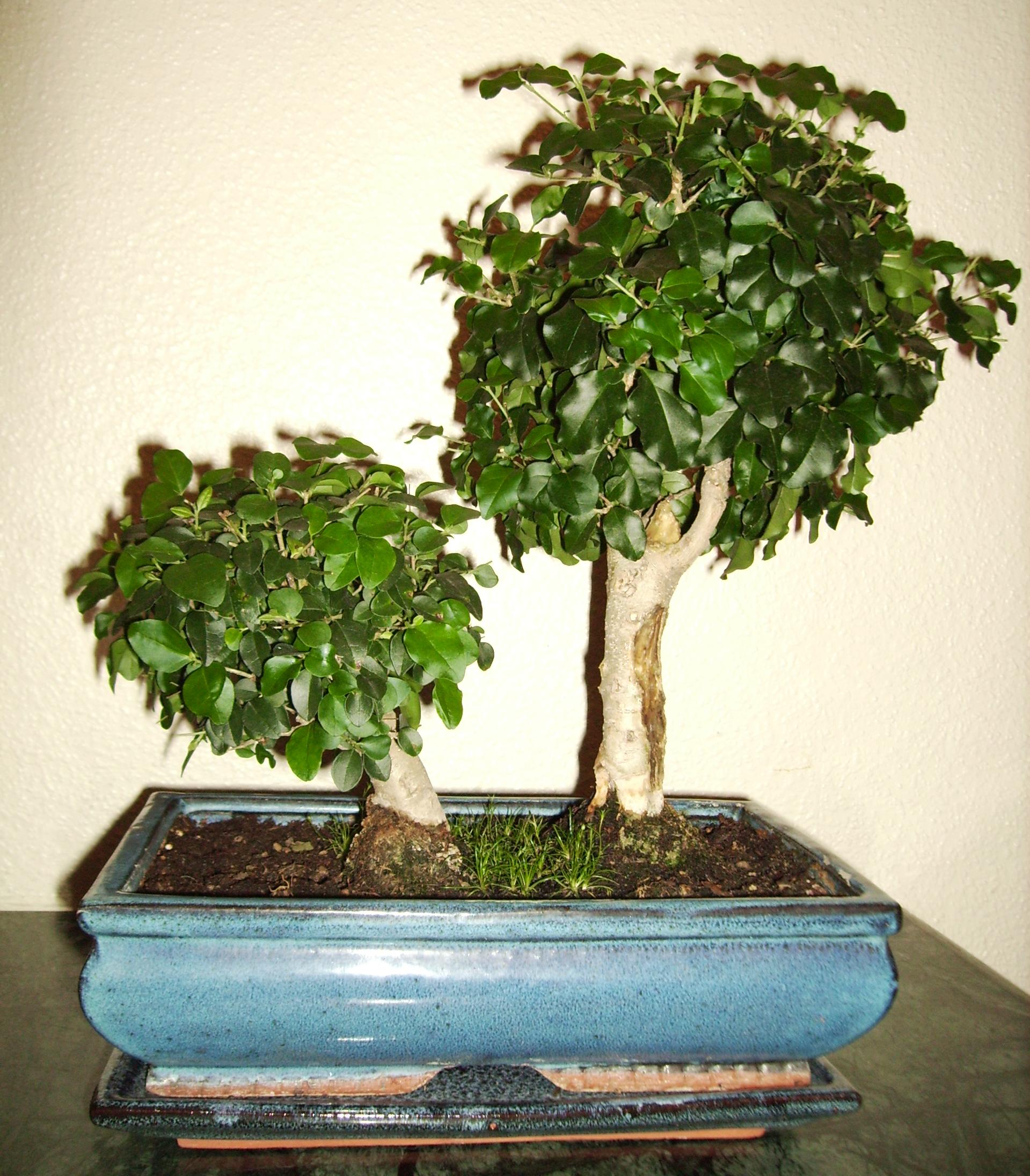
Photo by Edward Cwik, CC BY-SA 3.0, via Wikimedia Commons — Source

Walk past the seasonal aisle of a large supermarket, a home-improvement store, or a shopping mall kiosk almost anywhere outside Japan, and there is a decent chance a shelf of small potted trees is sitting under the label "bonsai." Growers have a word for these: mallsai, a portmanteau of "mall" and "bonsai" that describes mass-produced trees sold outside any bonsai tradition — grown by the thousand, potted young, and shipped to wherever shelf space is available.
Yes, a mallsai is worth buying as a starting point — just not as a finished bonsai. The tree itself is usually a real, living, small-leaved species capable of becoming an actual bonsai over years of work. What you are paying for is not artistry. It is a cheap, available first plant to practice on.
What "mallsai" actually means
The word has murky origins depending on who is telling it. American growers generally took the "mall-" prefix at face value — the shopping mall, where kiosks sell inexpensive goods of uneven quality. Some European growers spelled it malsai instead, reading "mal-" as the Latin root for "bad." Either reading points at the same thing: a tree grown for volume, not for the eye of an artist.
Growers describe a recognizable look. A trunk bent into a strong, exaggerated S-curve rather than a trunk that tapers and thickens the way an older, trained tree's does. A "crew-cut" canopy, clipped flat and even rather than shaped with any sense of a tree's natural silhouette. Small decorative stones are often glued to the soil surface, mainly to keep the growing medium from spilling in transit. Most originate from large-scale nurseries in China, Israel, and similar growing regions, using species that tolerate mass propagation and indoor retail conditions well — Ficus, Chinese elm, privet, jade, and a handful of others.
Why the condition is usually poor
The bigger problem sits below the soil line, not above it. Many mallsai are grown in dense field clay rather than the free-draining mix bonsai practice calls for. Once that clay is packed into a small pot, it compacts into something close to an airless block, which makes it hard for water to reach the roots evenly and easy for the roots to sit wet and begin to rot. A layer of nicer-looking decorative soil, or the glued stones, often sits on top and hides the clay underneath. None of this is visible from a glance at the display shelf, and none of it is a defect specific to one unlucky tree — it is closer to how the entire category is grown.
Is it still worth buying
For a first tree, yes — with the expectation reset. Several well-known bonsai practitioners have said openly that their own first tree was exactly this kind of mass-produced plant, not a nursery-trained one. A Ficus mallsai in particular tolerates the mistakes a beginner is likely to make: uneven watering, low humidity, an apartment with mediocre light. It survives long enough to teach the basics — how to read a leaf, when to prune, what root-bound looks like — before a beginner has spent real money on a better tree. We go through what an indoor-friendly Ficus actually needs in our companion piece on starting with ficus, and a fuller checklist for a first purchase of any species is in choosing your first bonsai.
What to check before taking one home
Look past the shape and check the tree itself. The trunk and branches should be firm and green or brown under a light scratch with a fingernail, not dry and grey. New growth at the tips is a good sign; a canopy that is uniformly bare or brittle is not. Once home, most experienced growers recommend removing any glued stones immediately, since they block water from reaching the soil evenly, and, within the first season, bare-rooting the clay away and repotting into a proper bonsai soil mix — the single change most likely to keep the tree alive.
What the shelf doesn't sell
A mallsai on a supermarket shelf has no keireki (経歴, "a traceable record of who has grown and cared for a tree") — no nursery owner behind it, no relationship to inherit along with the plant. That is the real difference between a shelf purchase and the way a tree is chosen at a Japanese nursery, where the person selling it is often the same person who has spent years training it and can speak to every year of its life. A mallsai is not a shortcut around that difference; it is simply a different starting point — a way to spend a first, low-stakes year learning to keep a small tree alive before deciding whether to go further. Some growers stop there. Others, a few years and a few dead branches later, go looking for a tree with an actual person and a real season-by-season history behind it — which is closer to how bonsai has always changed hands in Japan.
References
- Growing Bonsai — "Mallsai" — on the definition, characteristics (S-curved trunk, crew-cut canopy, glued stones, clay soil), and the two competing explanations for the term's origin.
- Bonsai4me — "Improving Mallsai" — on compacted clay soil as the main underlying problem, glued transport stones, and the bare-root-and-repot fix.
- Bonsai Empire — "From 'Mallsai' to Bonsai" — on mass-produced Ficus mallsai sold at supermarkets and general retailers, and documented progressions from mallsai into more developed bonsai.
- Wikimedia Commons — File: Kaufhausbonsai.JPG — department-store bonsai display, Chinese privet (Ligustrum sinensis), photo by Edward Cwik, CC BY-SA 3.0.