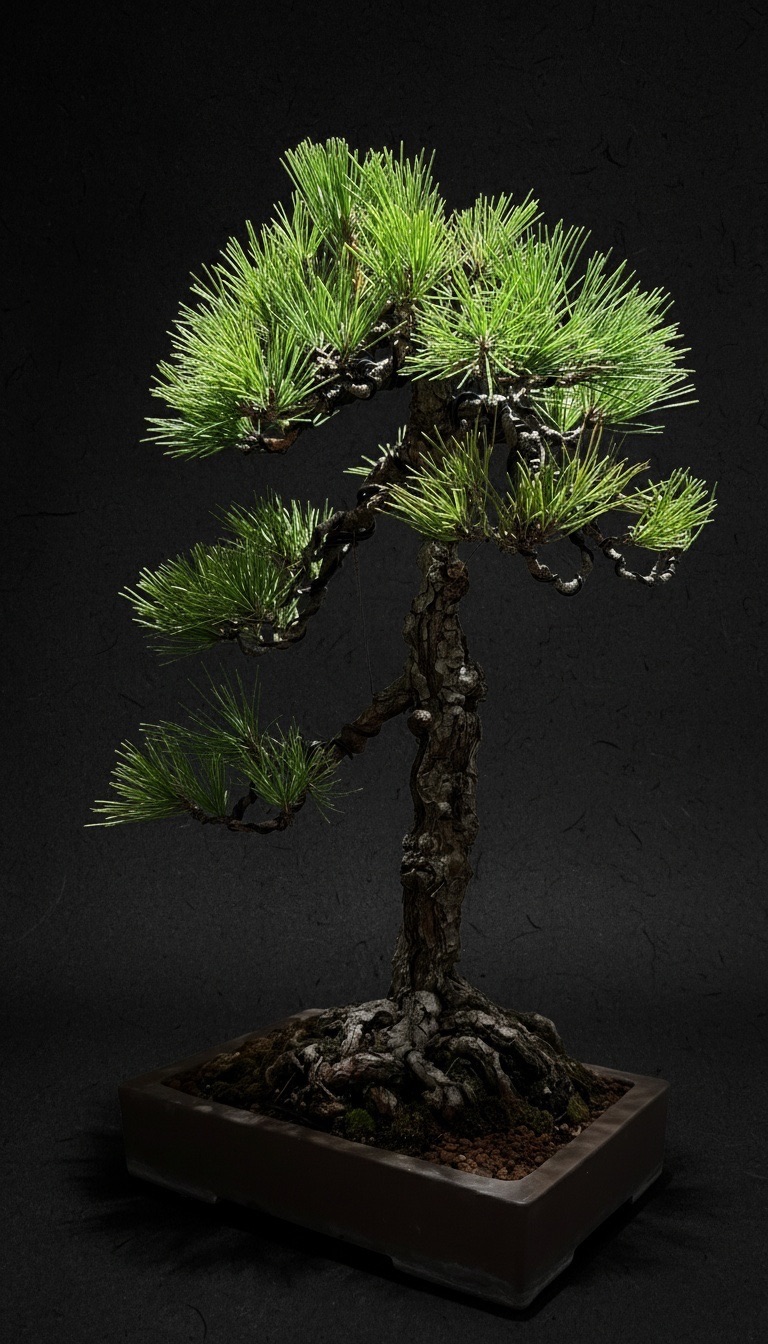
A tree kept a little hungry, at the right moments, tends to look like this: dense, closely held foliage rather than long, soft growth.
A bonsai confined to a container cannot feed itself the way a tree in open ground can, reaching a little further out each year into soil no root has yet touched. Whatever nutrients it receives, it receives because a grower put them there. That single fact makes it tempting to think of fertilizer as something to give generously, and this article's answer runs against that instinct.
More fertilizer does not make a better bonsai — past the amount a tree actually needs, it starts to unmake one, which is why the real skill behind hiryo (肥料, "fertilizer") lies almost as much in withholding it as in giving it.
Why more is not better
Left unfed for too long, a containerized tree thins out and stalls. Fed too generously, it does something less obviously wrong but just as damaging to a bonsai's form: it throws long, soft internodes and oversized leaves, because excess nitrogen — the nutrient most responsible for leafy, above-ground growth — pushes a shoot to keep extending before it has any reason to stop. None of that extra growth is refined growth. It is simply bulk, and bulk is exactly what years of pinching and pruning are spent taking back out of a tree. Pushed further, overfeeding turns into a more direct injury: fertilizer salts build up in the soil faster than routine watering can flush them out, and roots already confined to a shallow volume of soil can scorch, showing up as browned or dropped leaves. A grower aiming for a compact, densely branched tree is, in effect, choosing to withhold food about as often as they choose to give it.
Feeding for flowers and fruit, not only leaves
Fertilizer is not one substance with one job. Of the three nutrients printed on any bag as an N-P-K ratio, nitrogen drives leaf and shoot growth, phosphorus supports root development and the formation of flowers and fruit, and potassium supports the tree's general health and hardiness. A pine or a juniper grown mainly for its silhouette can generally be kept on a fairly even mix through the growing season. A tree grown for its blossom or its fruit is fed differently, and often on a different schedule: nitrogen is deliberately held back, particularly as flower buds are forming, because too much of it pushes the tree toward vegetative growth at exactly the moment its energy needs to go into wood maturation and bud formation instead, while phosphorus and potassium are raised to support the flowers or fruit the grower is actually after. Japanese nurseries raising flowering and fruiting stock commonly work from an organic base of aburakasu (油かす, "rapeseed cake") mixed with bone meal, and adjust the proportion of the two so that fruiting varieties in particular carry a noticeably higher share of phosphorus and potassium than an ordinary foliage tree would ever need.
Timing and amount, not habit
Hiryo is applied on a rhythm tied to the growing season, not to the calendar as a whole. A solid organic fertilizer, tucked onto the soil surface and left to break down slowly with each watering, is generally renewed roughly every four to six weeks; a diluted liquid feed, where one is used, is applied on a shorter cycle, closer to every one to two weeks. Both are withheld outright, not just reduced, at several points where a tree cannot make good use of them. A newly repotted tree, its cut roots not yet healed, is commonly left unfed for a month or more, since fertilizer offered to damaged roots does more harm than good; a tree recovering from hard pruning is treated the same way. Feeding is also eased off or paused through the hottest, most humid stretch of summer, when growth itself slows and any unused nutrient simply accumulates in the soil, and again as the tree moves toward winter dormancy, when there is no active growth left to feed at all. None of these pauses are exceptions carved out of a feeding schedule. They are the schedule.
Restraint is also a form of cultivation
Put those three points together and a fourth, quieter one follows from them: in bonsai, choosing not to feed a tree is treated with as much seriousness as choosing to feed it. A tree kept a little hungry, at the right moments, tends to hold smaller leaves, tighter internodes, and a finer branch structure than the same tree fed without discipline — much the same compactness that years of pinching and pruning are also spent building, arrived at here simply by giving a tree a little less than it could technically use. That is not neglect. Judging when a tree has had enough takes as much attention as judging when it needs more, and it sits alongside daily watering and the periodic renewal of soil at the roots as one more ordinary, repeated task that turns out to carry most of a bonsai's real technique.
At Azukari, that same seasonal judgment governs how each tree is fed under an artist's care in Japan — never as much as a tree could take, but as much as it actually needs, at the moment it needs it.
References
- Bonsai Empire — Fertilizing Bonsai — on the roles of nitrogen, phosphorus, and potassium, overfeeding producing long internodes and oversized leaves, salt buildup and root burn from excess fertilizer, and pausing feeding through winter dormancy.
- Bonsai4Me — Fertilising Your Bonsai / Bonsai Feeds — on avoiding high-nitrogen feed late in the growing season to prevent overly lush growth with long internodes, and on leaving newly repotted trees unfed for at least six weeks.
- Bonsai Myo (Japanese) — "Seven Effects of Fertilizer on Bonsai" — on overfeeding producing leggy branches and oversized leaves, the periods to avoid feeding (rainy season, bud formation, right after repotting), and the differing rapeseed-cake-and-bone-meal ratios used for flowering versus fruiting stock.
- Kimiko's Mini-Bonsai Days (Japanese) — "Bonsai Fertilizer" — on solid versus liquid fertilizer types, the light-spring/heavier-autumn feeding rhythm, and withholding fertilizer through midsummer and for about a month after repotting.