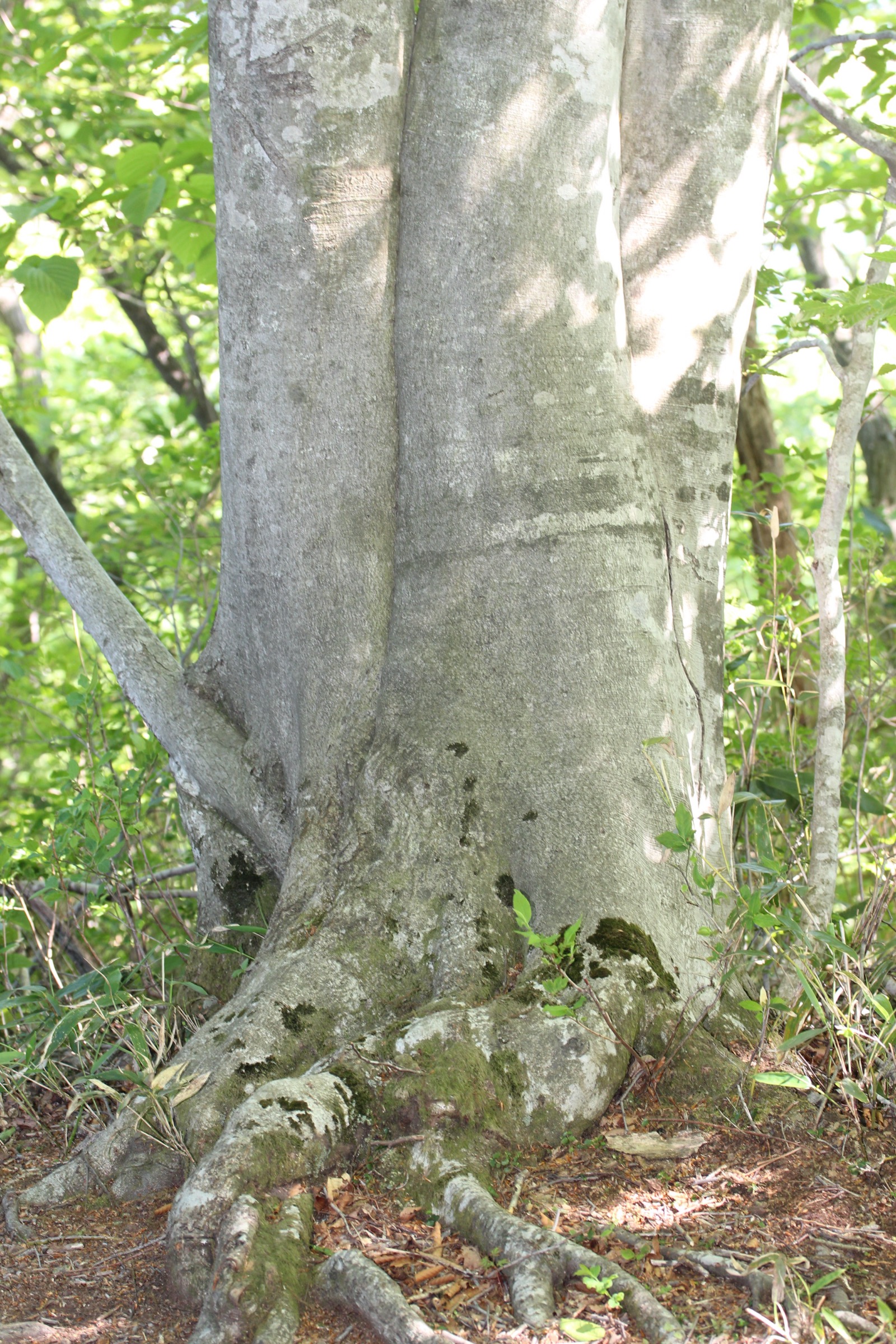
The trunk of a Japanese beech (Fagus crenata), photographed in Gifu Prefecture — bark that stays smooth and pale even on an old tree, in place of the plates and fissures conifers develop with age. Photo by Alpsdake, CC BY-SA 3.0, via Wikimedia Commons — Source

We wrote earlier about the five lineages of bonsai, and named beech, alongside maple and zelkova, among the zoki (雑木, "deciduous trees") that wear four different faces across a year. Most of what makes a zoki bonsai worth growing is change — the color, the bloom, the bare winter branch. Buna (ブナ, "Japanese beech," Fagus crenata) plays a stranger game. It changes least of all of them, and growers who take it up tend to prize it for exactly that.
A buna bonsai keeps last year's dead leaves through the coldest months and carries one of the palest, cleanest trunks in bonsai — a tree deciduous-bonsai growers tend to reach for only after they have grown tired of everything louder.
A leaf that will not let go
Most deciduous trees drop their leaves cleanly. A layer of specialized cells, the abscission zone, forms at the base of each leaf stalk in autumn and severs it outright, and within weeks the branch is bare. Beech is one of a small group of trees — oak and hornbeam are the other familiar examples — where that process often stalls. On young trees, and on the lower and inner branches of older ones, the abscission layer never quite completes its work. The leaf dies, fades from green through tan to a dry, papery reddish brown, and stays fastened to the twig through the entire winter. Foresters call the habit marcescence, and it is well documented in Fagus crenata specifically. Growers and botanists offer a few explanations for why the tree bothers — that the dry leaves may shield the following year's buds from frost and drying wind, or that a branch of brittle, unpalatable foliage is less inviting to browsing animals in the coldest months. Neither theory is fully settled. What is not in question is the effect: a mature buna bonsai trained to hold the habit keeps a whole canopy of rust-brown leaves through winter, and only lets them go in spring, pushed off one by one as the new buds finally swell.
A trunk kept clean of everything but time
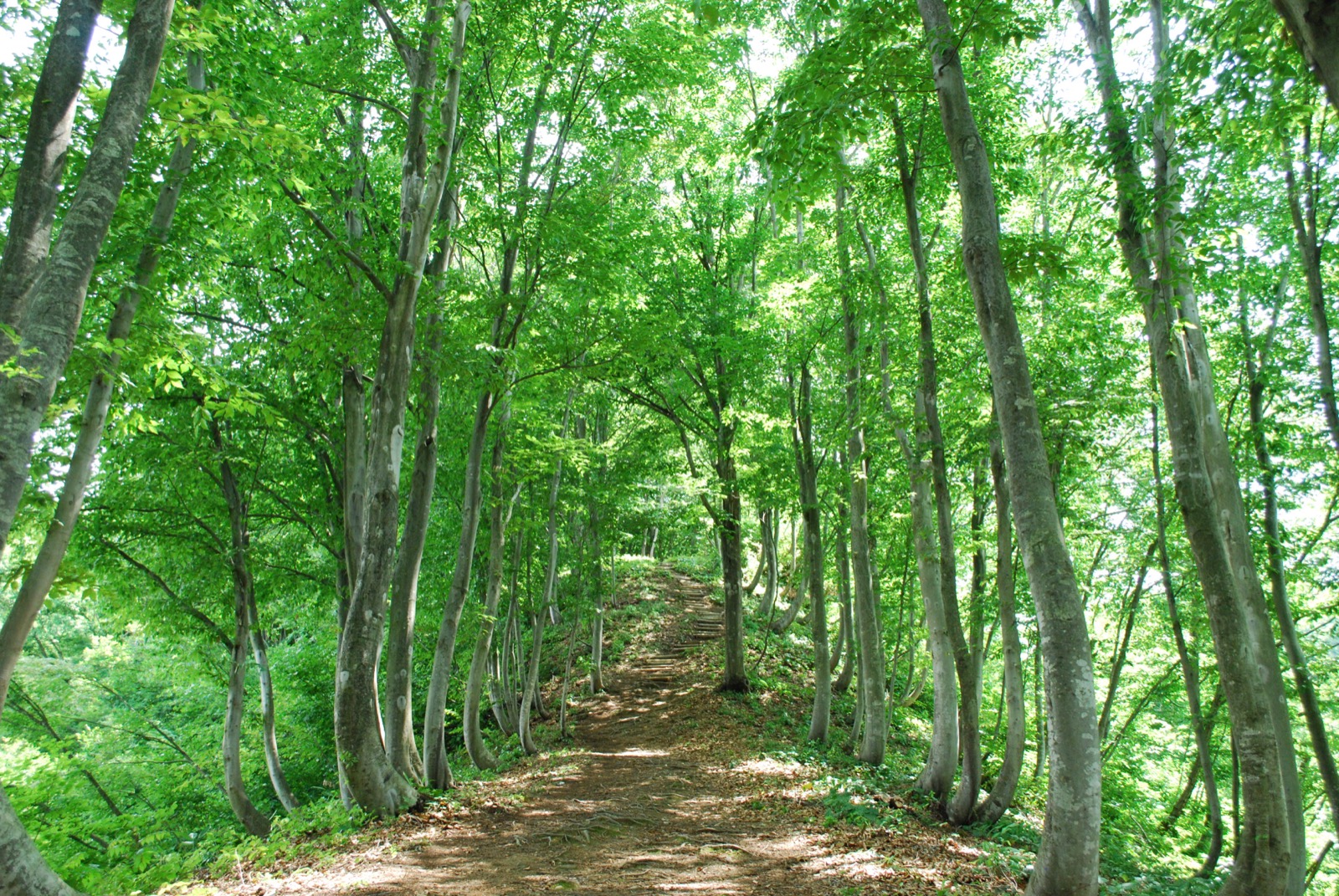
A beech forest in fresh spring leaf on Mount Gongendo in the Uonuma mountains of Niigata Prefecture — the kind of cool, high, deciduous forest buna belongs to in the wild. Photo by Uonuma City Tourism Association (魚沼市観光協会), CC BY 4.0, via Wikimedia Commons — Source

Where pines and junipers earn their age in plates, fissures, and bare jin (神) and shari (舎利) deadwood — a different kind of record we've written about elsewhere — a beech trunk stays smooth for its entire life. Buna bark is light gray to nearly white, sometimes mottled with faint patches of green or darker gray, and it keeps that clean, unbroken surface even on trees many decades old. That cleanliness is also a liability the grower has to manage: on a beech, a careless pruning cut or a wire mark can leave a dark scar that does not fade or heal over the way it would on a rougher-barked species, so wiring and cutting are done with more restraint than on a pine or a maple. The result, handled well, is a trunk that reads less like a record of injuries survived and more like an argument for having survived without many at all.
A tree that carries mountain air onto the bench
Buna is not a garden species. In the wild it dominates the cool, moist mountain forests of Honshu, Shikoku, Kyushu, and southwestern Hokkaido, typically above the warmer lowlands where pine and oak take over. In Japanese forestry writing it is sometimes called the mori no joo (森の女王, "queen of the forest") for how its canopy shapes an entire ecosystem beneath it: a beech forest's soil holds water like a natural reservoir, filtering it slowly into the streams that start there, which is why old beech stands are prized as watershed forests as much as scenery. The best-known of these is Shirakami-Sanchi, spanning Aomori and Akita Prefectures, inscribed as a UNESCO World Heritage Site in 1993 and described by UNESCO as the largest remaining old-growth beech forest in East Asia and the last true virgin stand of Fagus crenata left in Japan. A bonsai buna does not grow at that altitude or in that company, but the association travels with the species anyway — a tree whose native habitat is mist and elevation carries something of that quiet onto a bench at sea level.
The species deciduous growers grow into
If buna were as forgiving as it is beautiful, every zoki collection would be built around it. It is not. Beech does not reliably back-bud the way maple or zelkova does, and older trees can refuse to push new growth from bare wood at all. Where a grower pinches or defoliates a maple and gets a dense second flush of small, evenly spaced leaves in return, the same technique on a buna often produces buds set on long, uneven internodes that resist becoming the fine, twiggy branch structure the species is prized for. Vigor also tends to pool in the upper branches, so keeping a buna's silhouette balanced takes closer, more constant attention than it does on a more cooperative deciduous species. And because the tree comes from shaded, elevated forest, strong summer sun and heat weaken it and scorch its leaves, so it needs the kind of dappled, moderated placement a lowland maple can shrug off. None of this is disqualifying — we've looked separately at the fine winter branching a well-grown zoki bonsai can achieve — but it does mean buna rewards patience more than technique. Among growers who have already worked through the more forgiving deciduous species, it is often the tree they arrive at last, not first.
Closing
A buna bonsai does not compete for attention the way a maple does in October. What it offers instead is quieter and, for exactly that reason, slower to notice: a pale trunk that stays clean rather than dramatic, a canopy of dead leaves that refuses a tidy ending until spring insists on one, and a general unwillingness to be hurried into the shapes other species accept more easily. It asks a grower to sit with very little change for a very long time, and to trust that the little change occurring is enough.
That same trust runs through how Azukari structures the relationship between a tree, the artist who tends it in Japan, and the owner who is entrusted with one stretch of its seasons. A buna rewards no one who checks in only for the dramatic weeks. It rewards whoever is still watching in February, when the leaves are still there, brown and quiet, waiting for a spring the tree is in no hurry to reach.
References
- Wikipedia — Fagus crenata — bark description (smooth, light gray to whitish), native range across Japan, and the Shirakami-Sanchi old-growth forest.
- Bonsai Empire — Hornbeam and Beech (Carpinus and Fagus) care guide — on beech's smooth, silvery-white bark and its marcescent, dry winter leaves as a valued ornamental trait.
- Wikipedia — Shirakami-Sanchi — 1993 UNESCO World Heritage inscription and description as the largest remaining virgin beech forest in East Asia.
- きみのミニ盆栽びより — 「ブナ(山毛欅)の育て方」 — on buna's unpredictable back-budding, long internodes after pinching, vigor concentrating in upper branches, bark scarring, and sensitivity to strong summer light.
- 森林・林業学習館 — 「ブナ」 — on the mori no joo ("queen of the forest") name, beech forests' water-retention role, and the species' distribution from Hokkaido to Kyushu.