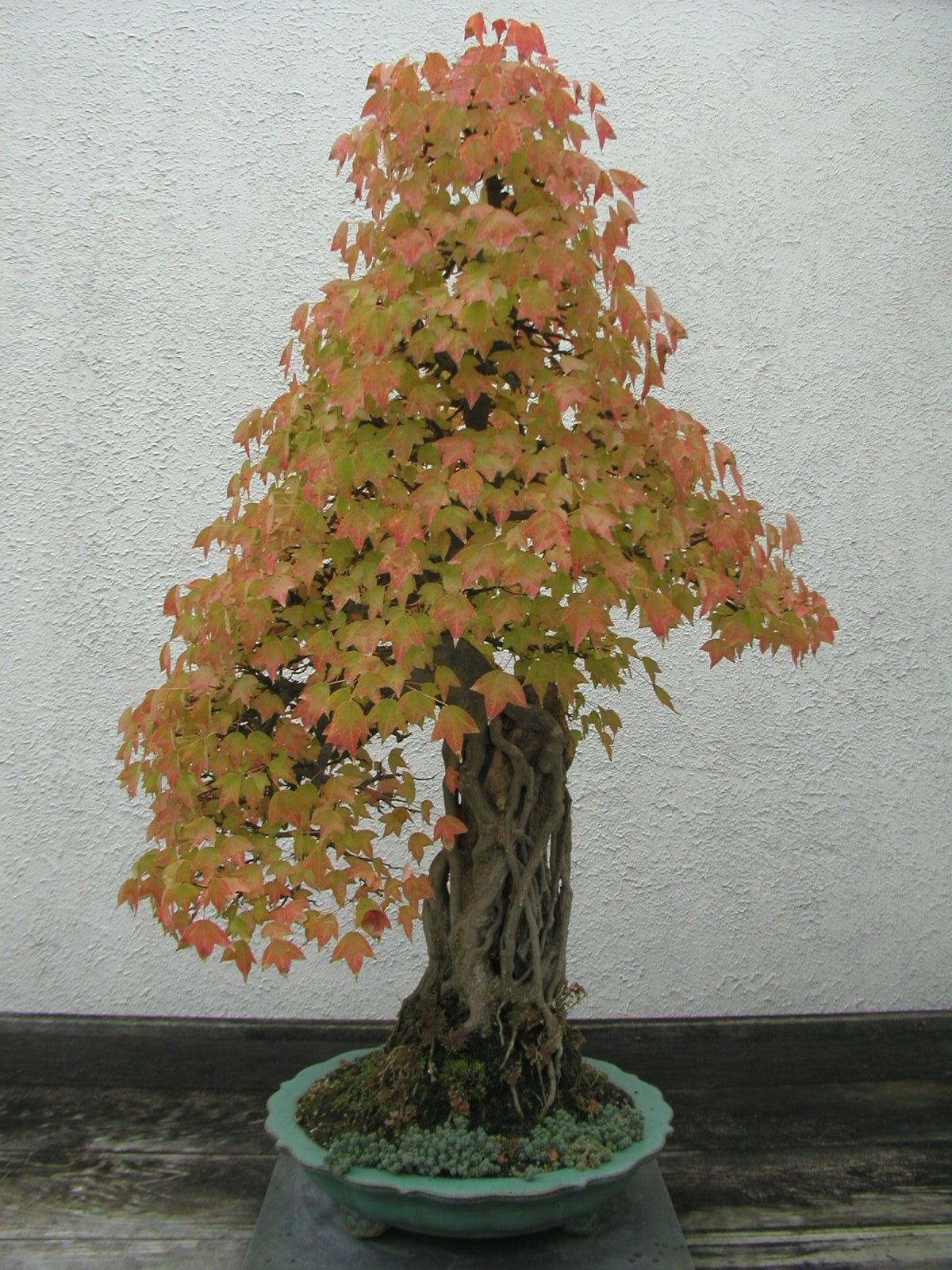
A maple bonsai turning through the early stages of autumn color, leaf by leaf, from green to orange and red. Photo by Neal Ziring, public domain, via Wikimedia Commons — Source

A mature momiji bonsai rarely stands taller than thirty or forty centimeters — small enough to turn in one hand, small enough to keep on a single shelf indoors. For most of the year, that scale barely matters. Then the nights turn cold, and the same modest canopy that looked unremarkable in July starts changing color leaf by leaf, close enough to watch at a resolution that would normally require standing under a hillside a kilometer wide. Momiji (紅葉, literally "crimson leaves," and also the everyday Japanese name for the maple tree itself) is the word behind one of the most watched events on the Japanese calendar: whole hillsides turning red and orange each autumn, with people traveling specifically to stand under them. A bonsai grower keeps that same event on a bench indoors, close enough to see it leaf by leaf without leaving the house.
A momiji bonsai is graded on a color it holds for only a few weeks a year, and on leaves so small that most of that color happens in miniature.
The red is made new, only as the leaf is dying
Autumn color is chemically a kind of unmasking — except for the part that isn't. Through spring and summer a maple leaf reads green because chlorophyll, the pigment used for photosynthesis, dominates. As nights turn cold, the tree breaks that chlorophyll down and stops replacing it, and pigments that were already present in the leaf — yellow and orange carotenoids — become visible for the first time that year. The red is different. Rather than being uncovered, it is built fresh: cold weather triggers the leaf to synthesize a pigment called anthocyanin that it did not previously contain. Researchers at the University of Tokyo note two competing explanations for why a tree would spend energy making a new pigment in leaves it is about to drop — one, that the red works like a parasol, shielding a leaf whose photosynthesis is already winding down while nutrients are pulled back into the trunk; the other, that the color signals to aphids and other insects that the leaf is a poor place to lay eggs for the winter. Neither theory is fully settled. What is certain is the result: a tree green in September can be a gradient of yellow, orange, and red by November, and at bonsai scale that gradient plays out leaf by leaf rather than hillside by hillside.
The smaller the leaf, the harder it is to earn
Leaf size is not incidental to how a momiji is judged. Bonsai growers use the word hasho (葉性, "leaf character") for a tree's inherent leaf size, density, and color — a quality we've looked at elsewhere — and among maples, small and densely set leaves are consistently the more sought-after trait, both because they read as more convincingly tree-like at bonsai scale and because they are harder to obtain. Some of that smallness starts with the tree itself: yamamomiji (山紅葉, "mountain maple," a wild-type Japanese maple) is noted for naturally short internodes and small foliage that make it compact and easy to keep dense. The rest is technique. Growers shorten maple leaves through defoliation — cutting away a flush of leaves in early summer, once the spring growth has hardened, so the tree pushes a second flush that emerges smaller and lets more light reach the branches beneath, deepening ramification at the same time. Defoliation is used across most vigorous deciduous species, but on a maple, where fine branch structure and autumn color both depend on how small and densely the foliage sits, the payoff is unusually direct.
Red before it is even green
Autumn is not the only season a momiji turns color. Several of the cultivars grown specifically for bonsai — Deshojo (出猩々) and Seigen (青幻) among the most common — unfurl their spring growth in a bright carmine red, driven by the same anthocyanin pigment involved in the autumn change, before the leaves settle into green for summer and then shift again toward yellow, orange, or red as the weather turns. A single tree can offer two distinct red seasons in one year, separated by a long green interval between them: spring's brief, intense flush of new red growth, and autumn's slower, more complete change across the whole canopy. Between those two events sit the branches themselves, whose bare winter structure and fine ramification are their own subject, worth a closer look on their own terms.
No other bonsai keeps a fuller calendar
An evergreen conifer — a black pine, a shimpaku (真柏, "Japanese juniper") — offers the same steady green through most of the year, its interest concentrated in trunk and branch rather than in change. Deciduous bonsai are prized precisely because they don't hold still, and among them, momiji sits near the far end: a red spring flush, a green summer canopy, an autumn turn that can run through yellow and orange before settling into red, and bare branches through winter. No single week tells the whole story of the tree. That is close to the idea behind momijigari (紅葉狩り, "leaf hunting," the Japanese custom of traveling out to view autumn color), a practice historians trace back through the Heian court's autumn excursions and, before that, to Nara-period poetry that first set colored leaves into verse. The word itself is thought to descend from momiizu (揉み出づ), a term from the old technique of rubbing dye out of safflower petals, since dyers so associated with autumn leaves. For centuries, the custom was a matter of active seeking, not passive noticing: nobles rode out to where the color was, watched it, and let the season move on without them once they left.
Judge the tree by its whole year
A maple that only turns color in November is being judged on one week of the year; one that also carries a red spring flush, a full summer canopy, and bare winter branches worth looking at is being judged on all of it. That is the plainest way to separate a momiji worth keeping from one that only photographs well in autumn.
Azukari is organized around that whole calendar. An artist in Japan tends the tree through every stage of it — the spring flush, the summer green, the turn, the bare winter structure — and folds what happened into the seasonal record its owner receives, so the year travels to wherever the owner is, the way a momijigari excursion once traveled only as far as the nearest hillside.
References
- The University of Tokyo — "Why do maple trees turn red in autumn?" — the chlorophyll-breakdown and anthocyanin-synthesis mechanism behind autumn color, cold weather as the trigger, and the two leading hypotheses for anthocyanin's function.
- Wikipedia — Acer palmatum — Japanese common names momiji and irohamomiji, native range, leaf lobe count, and the species' long history as a subject of Japanese art and bonsai.
- Seattle Japanese Garden — "Momiji-gari" — the Nara- and Heian-period history of autumn leaf viewing, the shift from admiring yellow leaves to admiring red ones, and the momiizu (揉み出づ) etymology of the word momiji.
- Bonsai Empire — Japanese Maple (Acer palmatum) care guide — spring foliage color varying by cultivar, the Deshojo and Seigen red-leaved cultivars, and defoliation as a maple-specific technique.
- Bonsai Empire — Defoliation — how defoliation reduces leaf size and increases ramification, and the June timing used on most deciduous species.
- Bonsai Prelude — "Species Profile: Acer buergerianum (Trident Maple)" — trident maple's Japanese name kaede, cited here for the naming distinction from momiji (Acer palmatum) referenced above.