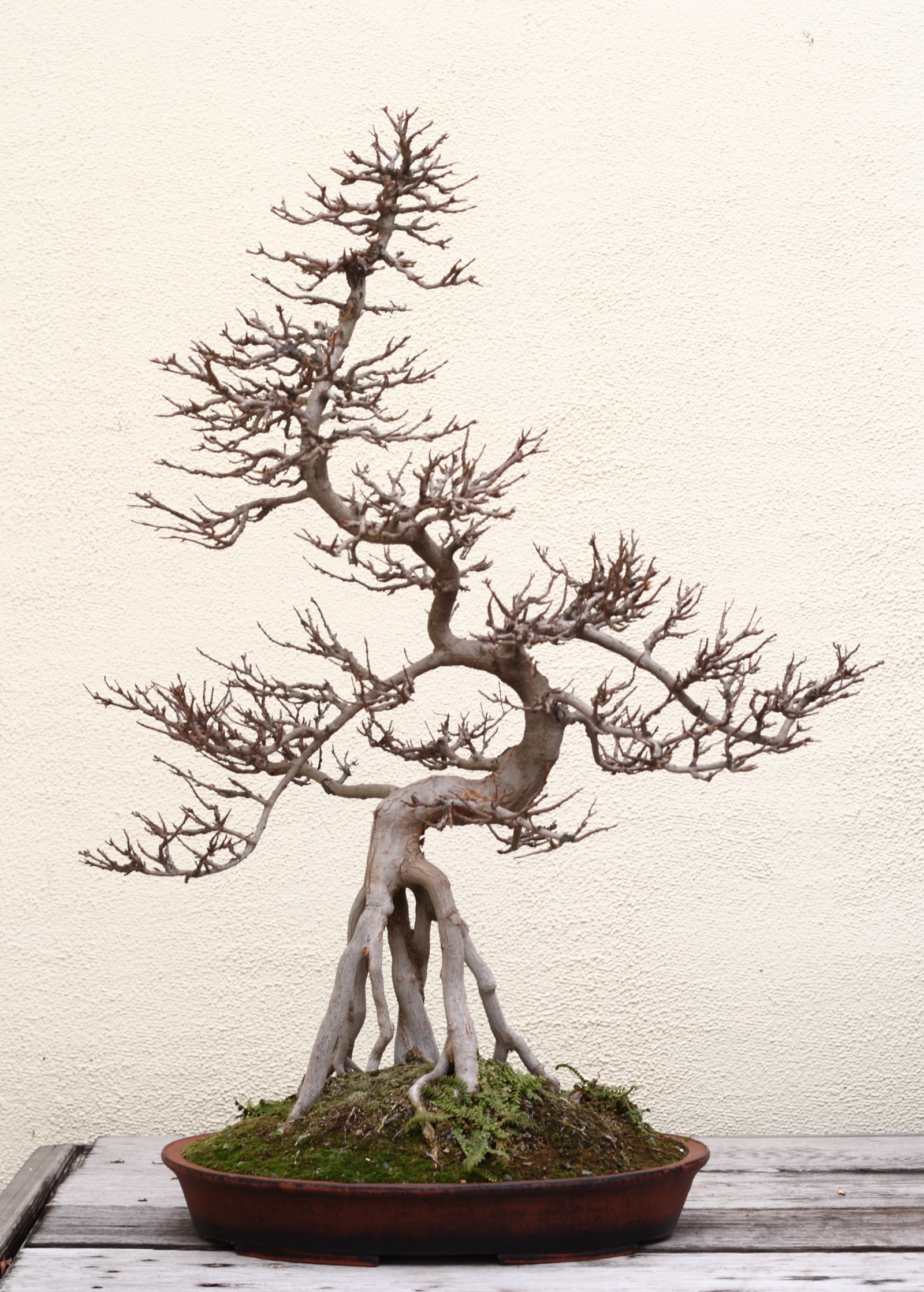
Trident maple (Acer buergerianum), exposed-root style, National Bonsai & Penjing Museum, U.S. National Arboretum, in its bare winter branch structure. Photo by Sage Ross, CC BY-SA 3.0, via Wikimedia Commons — Source

The tree above was photographed on December 24, at the National Arboretum in Washington: every leaf gone, every twig of a trident maple's winter branch structure standing out against open air. That bare state is the one Japanese growers wait all year to see arrive. Strip a kaede (楓, "maple") of its leaves and there is nothing left to look at but the branches themselves — how many there are, how finely they divide, how honestly the years of pruning behind them have been spent. Color is what a maple offers in October. Structure is what it offers in January, and among growers, judgment falls more heavily on the second.
A maple bonsai's real test comes after the leaves are gone: in the bare winter branch structure — the fine, repeatedly divided twigwork Japanese growers spend years building, and call, in that leafless state, kanju (寒樹, "cold tree," the winter silhouette of a deciduous bonsai) — an artist's work stops hiding behind foliage and simply has to hold up.
Maple branches are built to keep dividing
Maples are, among the deciduous species grown as bonsai, unusually cooperative about producing fine branching, a quality growers generally call ramification. The reason is structural: a maple's buds sit in opposite pairs along a shoot, so a single cut made just above a pair of buds does not produce one new shoot but two, each growing outward at its own angle. Repeat that cut through several growing seasons and a branch that started as a single line forks into a lattice, each generation of twigs a little finer than the one before it.
Growers push the process along with the tools they reach for through the year. In spring and summer, new growth is pinched back to one or two leaf pairs before it can harden and thicken, keeping the tree's energy pushing outward into more divisions rather than into a few coarse extensions. On a strong, well-rooted tree, growers may go further and defoliate — strip some or all of a healthy tree's leaves in early summer — which forces a second, smaller flush of growth and, with it, finer branches and smaller leaves than the first flush produced. None of it happens in a single season. A maple's ramification builds gradually rather than all at once: each year's small cuts set the shape the next year's cuts go on to refine.
Kaede and its close relative momiji (紅葉, the maple varieties prized above all for autumn color) are often used almost interchangeably in everyday Japanese, and both simply mean "maple." Growers draw a rougher, more practical line between the two: trees with shallow-cut leaves are usually the ones called kaede, while the deeply lobed, star-shaped leaf associated with the classic Japanese maple is usually called momiji — a customary distinction rather than a strict botanical one, but a useful one for a grower picturing what a given branch will look like once it leafs out.
Foliage hides flaws that winter exposes
For most of the year, foliage does a great deal of a bonsai's work for it. A canopy in leaf reads as a mass of green, and a branch structure with a flaw in it — a crossing twig, an uneven fork, a section left too coarse — can sit unnoticed under that cover for years. Winter removes the cover entirely. Once a maple drops its leaves, every twig down to the smallest is visible against open air, and there is, quite literally, nowhere left for a mistake to hide.
That is precisely why growers treat the bare season as the honest one. A tree that looked accomplished in August can look thin or lopsided in December, and a tree whose summer canopy looked ordinary can turn out, once undressed, to carry a branch structure built with real patience. The bark's texture and color, the taper running from a branch's base to its tip, the spacing an artist has kept between one twig and the next — all of it is legible in a way leaf cover never allows.
Kanju is the season growers wait for
Japanese practice has a specific word for a deciduous bonsai in this leafless state: kanju (寒樹, literally "cold tree"), also called hadaka-gi (裸木, "naked tree") or fuyugi (冬木, "winter tree"). Far from being an off-season to get through, it is treated as a viewing season in its own right — one prized precisely because bark texture, root spread, and the fine unraveling of the twigs are on full display in a way spring and summer growth never permits. Maples, in both their momiji and kaede forms, are counted among the deciduous species most closely associated with good kanju, since their branching divides finely enough to reward the close look a bare tree invites.
One longtime enthusiast, writing about the season in a regional newspaper's bonsai column, put the appeal simply: a good kanju lets the viewer imagine the harsher nature a tree has weathered — pictured standing in snow, or bent under a hard wind — even indoors, months from either. It is a way of looking built entirely on restraint: nothing added, nothing hidden, only what years of pruning actually produced.
A bare branch cannot fake the years behind it
Fine ramification is not something a grower achieves once and keeps. New shoots at the branch tips grow more vigorously than the older wood behind them, and left unchecked they thicken past the taper the rest of the branch is meant to hold, so the same small decisions — pinch this, shorten that, remove the one growing where it crowds its neighbor — repeat every season for as long as the tree is cultivated. A branch structure that reads as effortless in a January photograph is, in practice, a record of that repetition: years of an artist choosing, shoot by shoot, what the tree would be allowed to keep.
This is also, in its way, why a maple's bare branches reward a patient viewer more than almost any other part of a bonsai does. Reading a tree's branches at all is a skill built through close looking, and a kaede in winter is where that skill is tested most plainly — there is no autumn color left to soften a weak structure, and no leaf left to explain away a season's worth of neglect.
Judge a maple in the season it cannot hide
A maple's leaves fall every year regardless of who is watching. What is left afterward — dense, finely forked, honestly built or not — is the one part of the tree an artist cannot dress up for the season. If you are judging a maple bonsai's quality, judge it in winter: autumn color forgives a weak structure that January cannot. At Azukari, the pruning that shapes a kaede's branch structure continues through the winter work months as much as through the growing season, and the seasonal record an owner receives does not stop at the tree's bare months either. If anything, a January record is the clearest one a maple ever offers: nothing left standing between the viewer and the years of work that built it.
References
- Bonsai Empire — Trident Maple Bonsai Care Guide — leaf shape and lobing, and how defoliation increases ramification and reduces leaf size.
- Bonsai4Me — Acer Buergerianum / Trident Maple Bonsai — pruning new growth back to one or two leaf pairs through the growing season, and hard pruning timed to after leaf-fall or late winter.
- Bonsai Myo — Glossary: Kanju (寒樹) — definition of kanju as the bare winter form of a deciduous bonsai, also called hadaka-gi or fuyugi.
- Shikoku Shimbun Bonsai — "The Beauty of Kanju" — on kanju as a season that "cannot hide" flaws in bark and twig structure, with grower commentary on its appeal.
- Kimiko Shinto's Mini-Bonsai Glossary — か行 (Kanju) — kanju defined, with momiji and kaede named as representative deciduous species for the form.
- TEPCO Kurashi to Hikari — "The Difference Between Momiji and Kaede" — the customary distinction between kaede and momiji by leaf-lobe depth.