
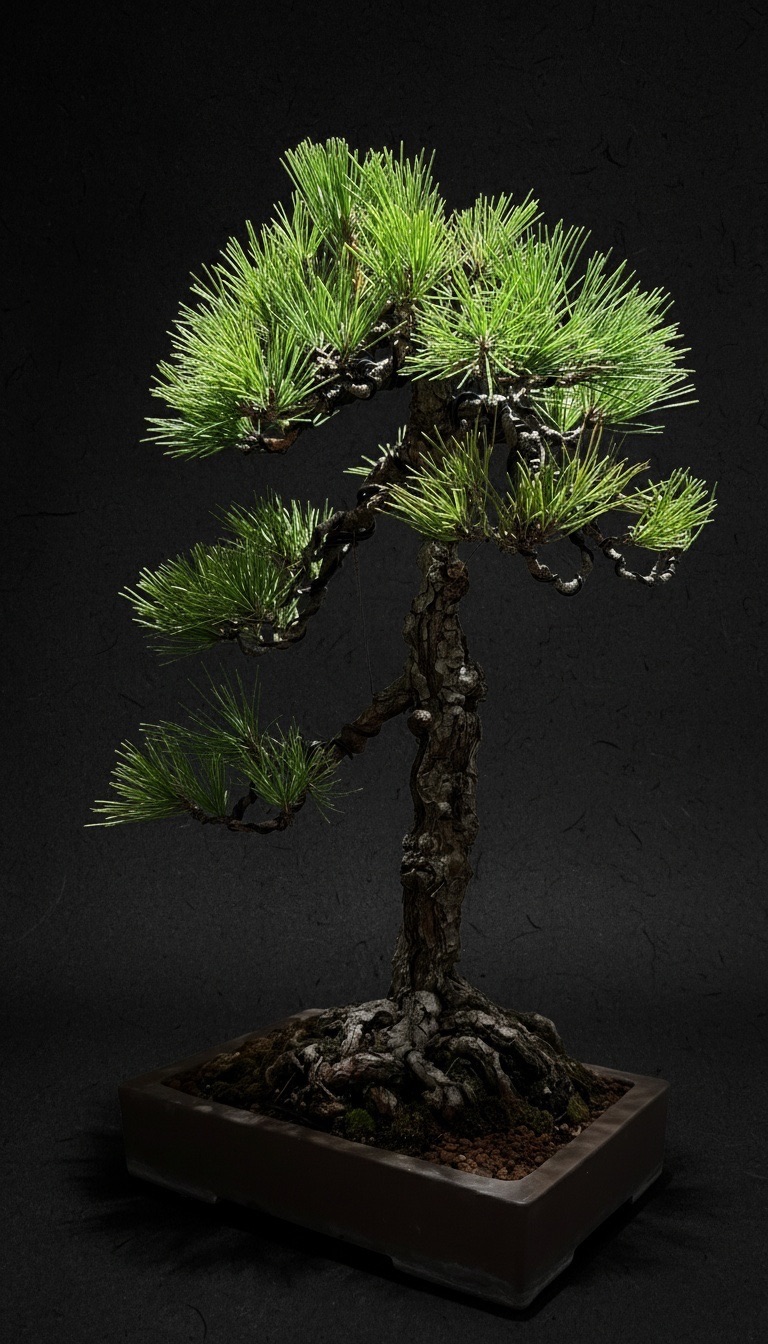
Most of a bonsai's year is visible from across the room — the flush of spring growth, the density of summer foliage, the color of autumn. Winter works differently. It takes a deciduous tree down to almost nothing, and it asks the roots, the pruning shears, and a grower's judgment to do work that rarely shows up in a photograph taken from a distance.
Winter is not a pause in bonsai practice. It is the season when a deciduous tree's structure is most exposed, when its roots are most at risk from cold, and when a grower does some of the year's most consequential pruning, wiring, and planning — all of it in service of a spring the tree has not yet reached.
What the bare season shows
Once a deciduous bonsai drops its leaves, Japanese practice has a name for what remains: kanju (寒樹, literally "cold tree"), the leafless winter form of a maple, zelkova, or beech, also called hadaka-gi (裸木, "naked tree") or fuyugi (冬木, "winter tree"). Far from being treated as a season to get through, kanju is regarded as a viewing season in its own right, valued precisely because bark, root spread, and the fine divisions of the branches are visible in a way no leaf cover ever allows. Kaede maples are among the species most closely tied to this idea, since a lifetime of careful pruning is most honestly on display once nothing is left to soften it.
Not every tree in the garden goes bare. Pines, junipers, and other conifers keep their needles through the cold months, standing green beside their leafless neighbors — a reminder that "winter work" covers two very different kinds of trees at once, one resting in plain sight and one resting invisibly, underground.
Protecting the roots, not just the branches
The part of a bonsai most at risk in winter is rarely the part a visitor would guess. A tree growing in open soil rarely feels a hard freeze at root level — the ground itself is a poor conductor of cold, and even a modest depth of earth is usually enough insulation. A bonsai's roots have no such protection. Confined to a shallow pot with soil exposed on every side, including underneath, they are affected by air temperature almost as directly as the branches above them.
Growers respond with a familiar set of measures: moving pots into an unheated shed, garage, or cold frame; mulching or wrapping pots with straw, bark chips, or bubble wrap; grouping pots together on the ground for shared insulation; or, for the hardiest trees, heeling the pot itself into garden soil until the coldest weeks pass. None of it is about warmth in the way a house is warm — the goal is to soften temperature swings, not remove cold altogether, since the tree still needs real winter cold to complete its dormancy properly. Watering is scaled back to match: a dormant tree drinks little, and soil left wet through a cold winter can do a tree's roots more harm than the cold itself. Species vary in how much protection they need — a trident maple or a magnolia is generally more frost-sensitive than a hardy pine, and a grower's winter routine tends to be built around the most delicate tree on the bench, not the toughest.
Pruning and wiring while the tree is still
Winter's stillness is also when a grower does some of the year's most structural work. Deciduous species are generally cut back hardest in the dormant season, once the leaves are down and before the buds begin to swell — a cut made while a tree is fully dormant heals without the sap flow that can weaken a wound made once growth is underway, and the tree spends its stored energy pushing out new growth rather than recovering from a badly timed cut. Reading a bare tree's branches is also simply easier without foliage in the way, which is part of why the coldest months are favored for the heaviest structural decisions of the year.
The same stillness helps with wiring. A juniper's thick branches carry more sap during the growing season, which stiffens them and raises the risk of tearing bark as they bend; once sap levels drop in the cold months, the same branches move more willingly. Deciduous trees offer the opposite advantage — an open view of every branch, with nothing hidden behind a canopy — which is part of why late-winter wiring sessions are common for maples and zelkova alike.
Winter is not only a season for shears and copper wire, though. It is also a season for looking at a tree without touching it — studying where a branch traveled last year, deciding what the next cut should remove, picturing the shape a tree might hold five years from now. Growers often describe this quiet study as being as much a part of the year's real design work as the cutting itself.
A season the tree and the grower share
Dormancy is not decorative. A deciduous tree in winter has genuinely slowed its biology, drawing resources back into the roots and trunk and holding visible growth in check until temperatures and daylight return. A grower's own pace slows to match it. The twice-a-day watering of summer gives way to a once-a-week check. The urgency of a shoot that needs pinching before it hardens gives way to longer, quieter sessions of pruning, wiring, and planning. It is, in its way, the one season when a bonsai and the person tending it move at roughly the same speed — both storing up what the coming season will need.
That rest is also preparation. The cuts made in January are the branches spring will fill back out. The design decided on a cold afternoon becomes the shape a tree wears once repotting and budding begin in earnest a few months later. Little about winter is wasted time — it is simply work that does not announce itself the way a flowering branch does.
Closing
A bonsai's record does not pause for winter. The frost protection, the carefully timed cuts, the wire applied while sap runs low, the plans sketched in front of a bare tree — all of it belongs to the same continuous care a tree receives the rest of the year, even though little of it can be seen from across a room. At Azukari, the seasonal record an owner receives reflects that continuity: a tree entrusted to an artist's care is watched and worked on through its quietest months as closely as its most visibly active ones, because a bonsai's winter is not an absence of work. It is where the following year is quietly decided.
References
- Bonsai Empire — Overwintering Bonsai trees — on why potted roots are more exposed to frost than roots in open ground, and protection methods including cold frames and insulation.
- Bonsai4Me — Winter Care For Bonsai — on sheltered storage, mulching, watering restraint during dormancy, and species-specific frost sensitivity (trident maple, magnolia).
- Bonsai Empire — Pruning — on structural pruning timed to the dormant season for more predictable recovery.
- Bonsai Empire — Wiring — on late-winter wiring for deciduous trees once leaves have dropped.
- Plant Paladin — Can You Wire Bonsai In Winter? — on reduced sap levels in juniper and pine branches during winter easing the wiring of thick wood.
- Bonsai Myo — Glossary: Kanju (寒樹) — definition of kanju as the bare winter form of a deciduous bonsai, also called hadaka-gi or fuyugi.