
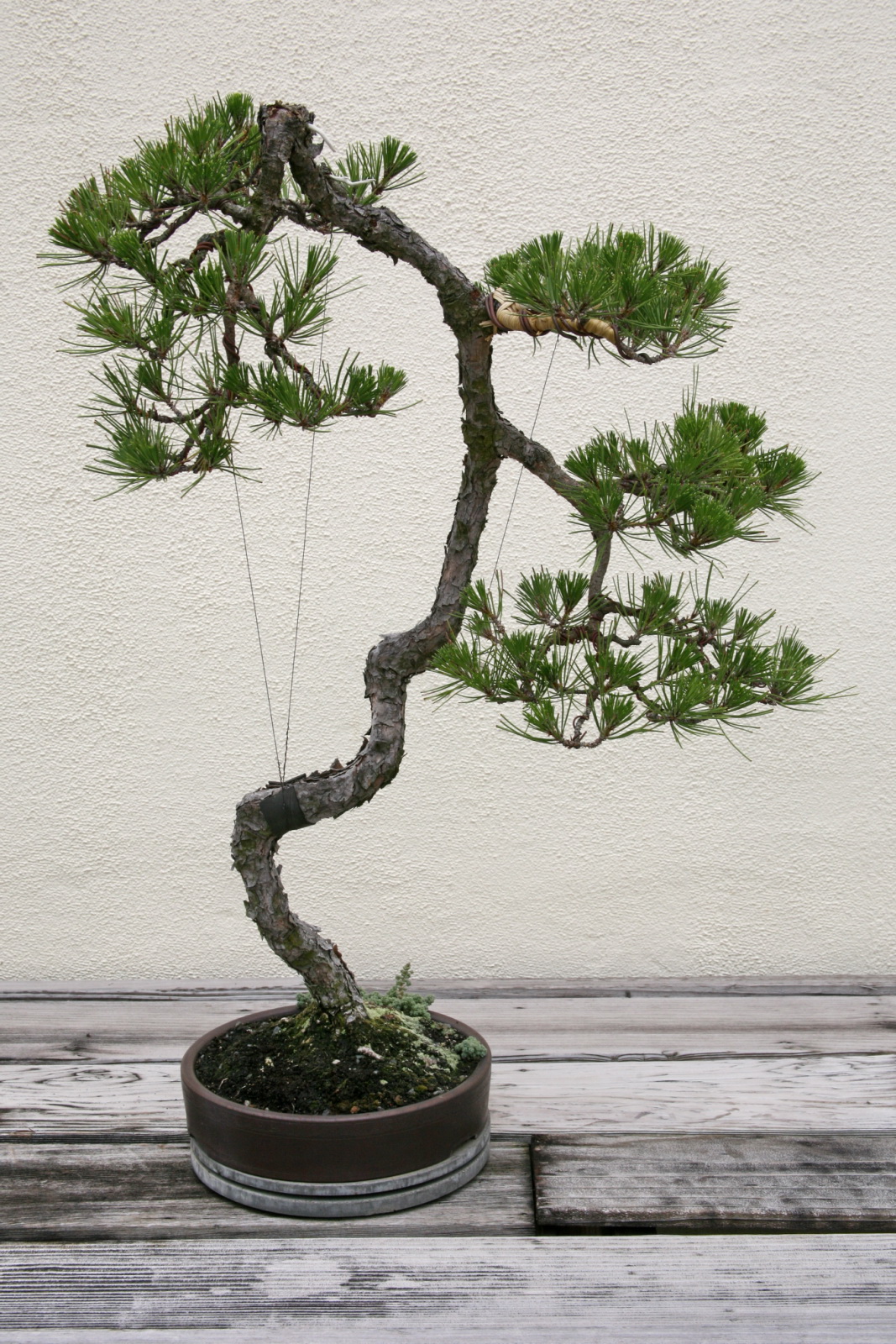
Photo by Cliff (Arlington, Virginia), CC BY 2.0, via Wikimedia Commons — Source
_(3562971279).jpg)
A coil of wire wound around a branch at close to 45 degrees, at roughly a third of that branch's own diameter, aluminum or copper depending on the wood underneath: that short list is the entire physical vocabulary of bonsai wiring, and nearly every question a beginner asks about the technique traces back to it. Seen from outside, the result still reads as force — metal wound tight around living wood, or a thin line pulled taut down to the rim of a pot, a shape that looks imposed on a tree with no vote in the matter. Growers who do this for years read the same coil differently: not as a cage, but as a proposal a branch is given a season, sometimes several, to accept.
Wiring holds a branch, briefly, in a shape it can be persuaded to keep — then the wire comes off again.
The angle and the gauge decide whether the wire helps or hurts
Harigane (針金, "wire") is wound around a branch — conventionally aluminum or copper — at roughly a 45-degree angle, a pitch that lets the branch keep thickening naturally inside the coil rather than fighting it. The wire's thickness is chosen at around a third of the branch's own diameter: thin enough not to swamp a delicate shoot, thick enough to actually hold a bend once one is made. Aluminum is soft and forgiving, the standard choice for deciduous species and for anyone still learning the technique. Copper is stiffer and holds a heavier, resinous conifer branch with less bulk of wire, but it punishes a mistake more readily, which is why it tends to stay in more experienced hands.
Once a branch is wound, it is bent by hand — decisively, in a single motion. Growers are consistent on this point: returning again and again to reposition the same section fractures wood fibers that one confident movement would have left intact. Hariganekake (針金かけ, "wire application," the act of wiring) is, in this sense, less a continuous adjustment than a single, considered decision, made once the wire is already in place to support it.
A healthy tree, the right season, and old bark change the plan
Only a healthy, actively growing tree is wired; one that is weak or recently repotted is left alone until it has recovered enough to tolerate the stress. Some growers let the soil dry slightly beforehand, since a branch that is a little less turgid bends with less risk of splitting than one swollen with water.
Timing follows the calendar of the species. Conifers are commonly wired from around the start of spring, while deciduous trees are usually wired a little later, once the coldest months have passed — cold, dormant wood is the most brittle wood a tree has, and the deep winter is avoided across most species for that reason. For an old pine or juniper, whose bark has gone rough and inflexible with age, wire on its own is not always enough: raffia, plant fiber softened in water and bound around the branch before the wire goes on, spreads the strain of a sharp bend across a wider surface so the bark holds together rather than tearing. And for a branch too thick, too old, or too brittle to accept a coil at all, growers reach for a different tool — a fine guy-wire, anchored to the pot, to a root, or to another branch, drawing the branch into position by tension from a distance rather than wrapping it directly. In the photograph above, both approaches are at work on the same tree: raffia wrapped around one branch to protect it through a hard bend, and thin guy-wires anchoring others down toward the pot.
The bark sets the wire's deadline, not the calendar
No wire stays on forever; that would defeat its purpose. A fast-growing deciduous branch can set into a new position within a few months. A slow, heavy conifer branch, especially on an older pine or juniper whose wood thickens gradually, may need the wire left on for the better part of a year, and a stubborn old line in the trunk or a major branch can take several separate rounds of wiring, removal, and rewiring, spread across more than one growing season, before it finally holds unaided. There is no single correct number of months for any of this — only one reliable checkpoint. Growers check every few weeks once growth resumes, watching for the first sign that a coil has begun to disappear into the bark, and cut the wire away — rather than unwind it — before that happens, since a coil left too long leaves a permanent scar. If the coil is visibly biting into the bark, the check came too late; that single sign, more than any date on a calendar, is what decides when a piece of wire has to come off.
The wire is evidence of an exchange, not a command
Handled this way, wiring reads less like an order given to a passive tree and more like an exchange. The artist proposes a direction; the wood answers back, in the resistance it offers or the ease with which it gives, how far tonight's bend can safely go. The wire holds that proposal in place; the tree, over the following season, answers again — by keeping the position, by pushing faintly against it, by thickening exactly along the new curve or refusing to. Sometimes the branch's answer is a partial one, and the artist rewires it a little differently the following year: a small correction rather than a fresh demand. It is the same discipline that shapes a bonsai's overall silhouette, the kata (型, "form") an artist commits a tree to and then works within for years — and it sits close to the patient, cumulative judgment behind pruning and reading a tree's branch structure. None of these techniques finish a tree in a single sitting. Each one is a position taken, and then watched.
The metal itself is never the point — it is simply removed, quietly, once its job is done. What stays behind is the branch's own answer, written into wood that will go on thickening along that line for the rest of its life. That sequence — a coil applied, checked every few weeks, cut off the moment it starts to bite — is exactly what an Azukari owner sees recorded season by season from Japan: not a finished shape delivered once, but the log of a branch being asked, answered, and asked again until the shape holds on its own.
References
- Bonsai Empire — Wiring Bonsai Trees — wire gauge at roughly one-third branch thickness, the 45-degree wrapping angle, aluminum versus copper wire, and typical wire-removal timing.
- Bonsai4Me — Wiring Bonsai — the principle of bending decisively in one motion rather than repeatedly, and letting soil dry slightly to increase branch pliability before wiring.
- Bonsai Outlet — Raffia: Essential Protection When Training and Shaping Your Bonsai — raffia's role in protecting bark and spreading strain during sharp bends, particularly on conifers.
- Growing Bonsai — Guy Wires for Bonsai — guy-wiring as an alternative to coiled wire for branches too thick, old, or brittle to bend directly, and typical anchor points.
- Kindai Shuppan — Bonsai Beginner's Course: Wiring — seasonal timing of wiring by species (conifers from early spring, deciduous trees somewhat later, deep winter avoided), and copper versus aluminum wire characteristics.