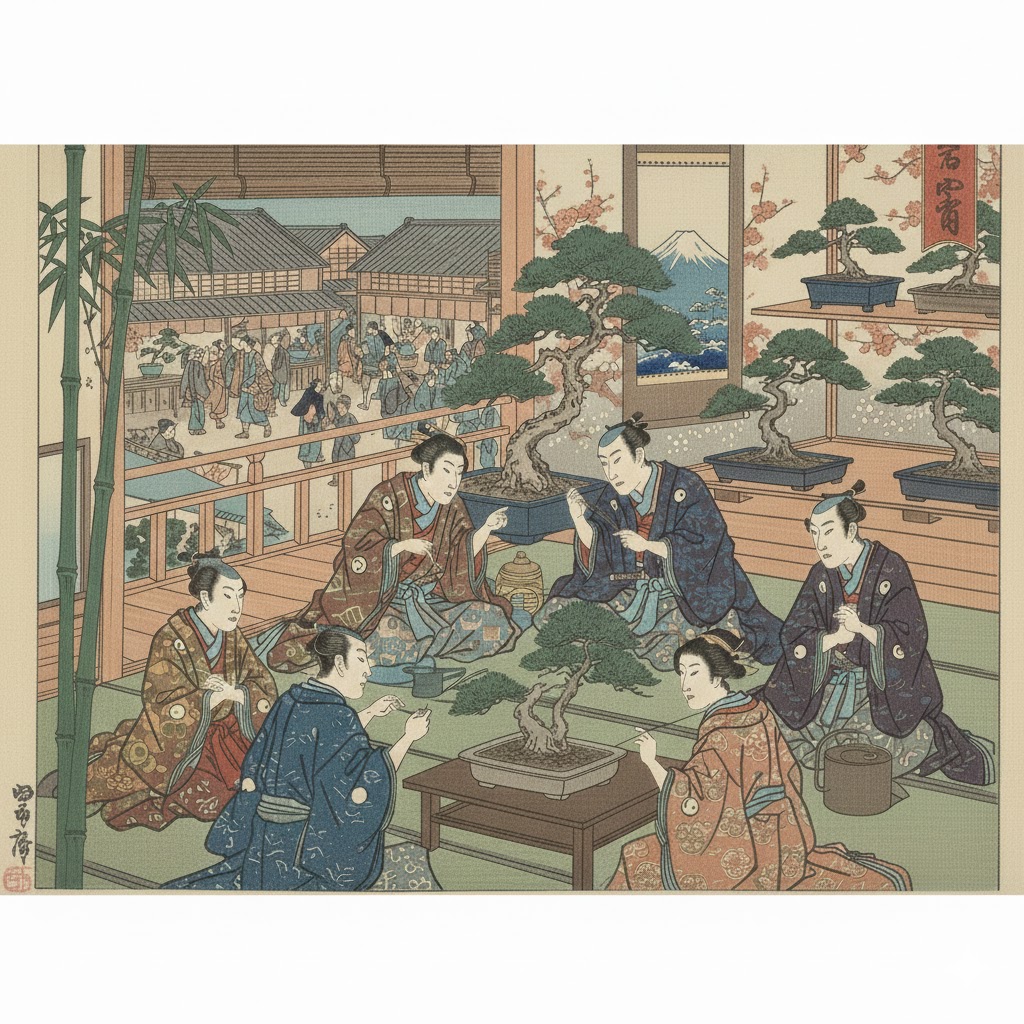
In November 1899, a Boston auction catalogue listed 450 lots of Japanese plants. More than a hundred were dwarfed hiba cypress. Only about 139, across that sale and two companion auctions held the same year, were entered under the name the trees actually carried in Japan: "Bon Sai." Everything else went out under a botanical genus, or simply as a "dwarf tree." The trees had already been crossing oceans to world's fairs for more than two decades by then. The word did not keep pace.
Bonsai reached the West through the world's fairs that Meiji Japan used to present itself as a modern nation, and for most of that history the trees moved faster than the word for them — exhibited for four decades as "dwarf," "stunted," or "pigmy" trees before English settled on "bonsai."
Japan picked the exposition, not the tea ceremony, to introduce itself
After the Meiji Restoration of 1868, Japan set out to present itself to the world as a modern nation, and one of the stages it chose was the hakurankai (博覧会, "a world's fair, or international exposition"). Japan's first appearance at one came at the 1873 Vienna World Exposition, where its delegation built a full Japanese garden — gate, shrine, arched bridge, trees, and stones shipped from Japan. The look of it was so unfamiliar that the British designer Christopher Dresser reportedly bought the entire installation for around £600 and had it re-erected at Alexandra Palace in London two years later, giving British visitors their first close look at Japanese garden design. Whether that particular garden included true potted dwarf trees is less clear than what came next: within a few years, small trees in shallow pots became a fixture of Japan's exhibition halls in their own right, not an accessory to the garden around them.
The trees earned their own display, fair by fair
At the 1876 Centennial Exposition in Philadelphia, America's first world's fair, the Japanese pavilion held a single specimen: what visitors' accounts described simply as a "stunted cedar tree," reportedly around sixty years old. Two years later, the 1878 Exposition Universelle in Paris went further — the Japanese pavilion displayed a group of small potted trees, closely enough observed that France's leading horticultural journal, Revue Horticole, wrote them up in detail. One reporter called the exhibit "one of the wonders of the Exhibition." Garden historians often point to Paris in 1878, rather than Philadelphia two years earlier, as the point where dwarfed potted trees became a recognized display in their own right, rather than a curiosity attached to a garden.
Paris hosted a second Japanese garden, with bonsai again on view, at the 1889 Exposition Universelle, this time at the Trocadéro. Then in 1893, Chicago's World's Columbian Exposition brought the trees to American ground for the first time at real scale: a Japanese garden with dwarfed potted plants, some reportedly sent by the Japanese Emperor's household, supplied in part by the nursery house that would soon reorganize into the Yokohama Nursery Company. St. Louis followed in 1904, where the fair's own guidebook to the Japanese exhibit made a point of describing its bonsai as "many centuries old" — placing the trees deliberately alongside the pavilion's buildings, each modeled on structures at least two hundred years old, as evidence of a cultural depth to match Japan's new industrial ambitions.
The largest single showing came in London, at the 1910 Japan-British Exhibition — an event so large it drew more than eight million visitors over its run from May to October. The Yokohama Nursery Company exhibited around 2,000 potted trees, ranging from 25 to 300 years old, and a golden-leaved dwarf hinoki cypress said to be about 125 years old won a silver cup as the finest specimen in the show. A newspaper writer covering the exhibition predicted that Japanese-style gardens would soon become fashionable across England — and, in the years that followed, they largely did.
Visitors kept returning to the same mismatch of size and age
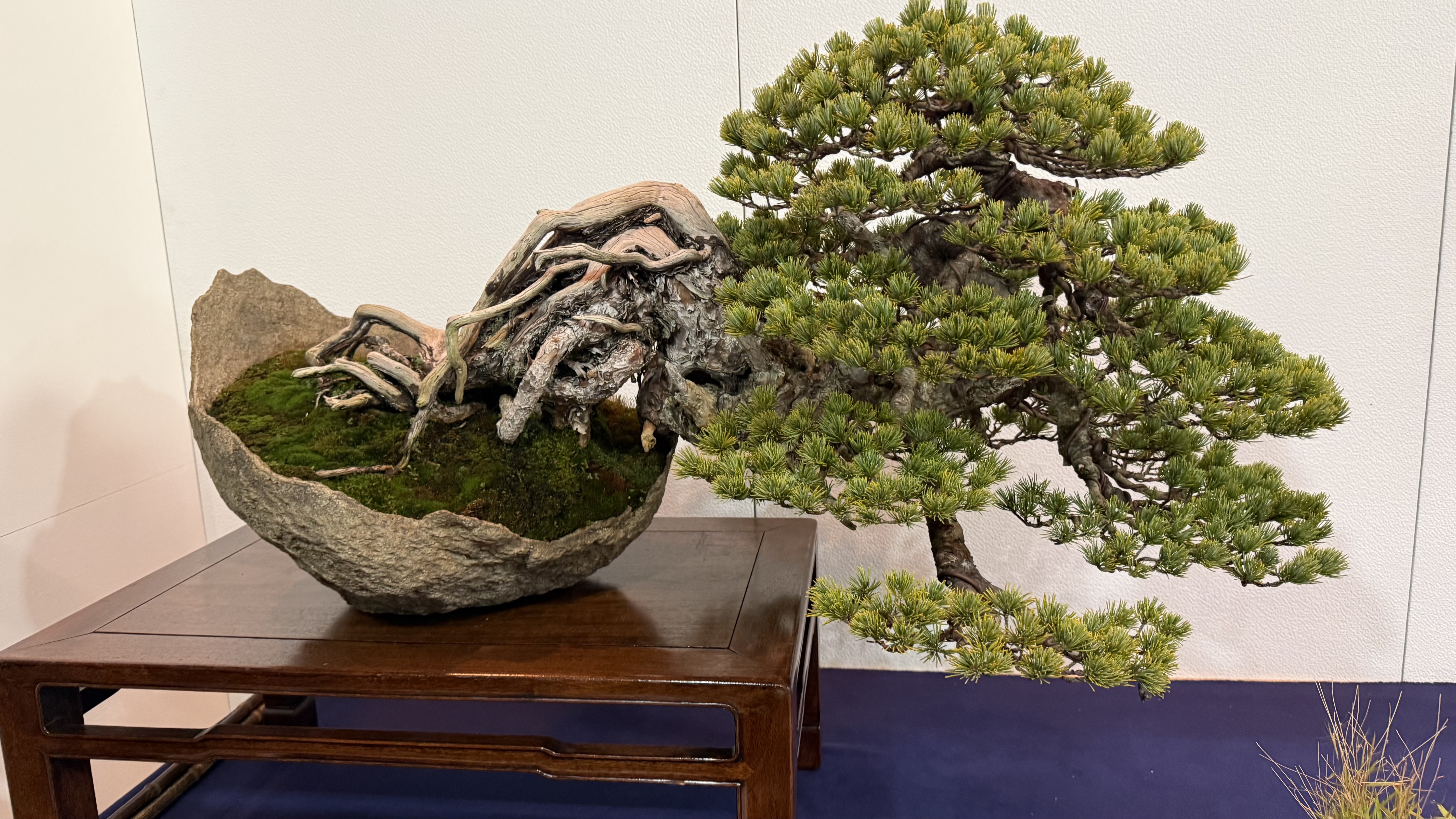
A Japanese white pine — a species not unlike the specimens that filled exhibition halls in Paris, Chicago, and London a century earlier.
Reactions ranged from delight to bafflement, often in the same sentence. The American horticulturist Liberty Hyde Bailey, writing on the Chicago fair's Japanese garden, called it something Americans would not consider conventionally beautiful, but "curious and grotesque" — a backhanded compliment that captured how little the aesthetic of an aged, deliberately shaped tree matched Western gardening taste of the day. Across four decades of fairs, what Western visitors kept circling back to was age: a tree small enough to lift with two hands, yet older than the person looking at it. For a long stretch, no single word held that mismatch. English-language accounts from Philadelphia, from Chicago, even from London in 1910, mostly called the trees "dwarf trees," "stunted trees," or "pigmy trees" — descriptive, slightly diminishing terms that treated the trees as an oddity of size rather than a distinct art form with a name of its own.
The word arrived by a slower route than the trees
The Japanese word itself entered English commerce gradually, and one of its earliest documented footholds was not at a fair at all, but at the auction described at the start of this piece. The dealership behind it, Yamanaka & Co., had roots in Osaka and held the Boston sale in November 1899 as one of three such auctions it ran in the United States that year. Even there, "Bon Sai" was the exception in the catalogue, not the rule — most of the plants on offer went out under a botanical name, or as a generic "dwarf tree." It is nonetheless among the earliest points at which the Japanese term itself, not a Western paraphrase of it, appears attached to trees for sale on American soil.
The changeover stayed slow for years afterward. As late as the 1910 London exhibition, the Yokohama Nursery Company's prize-winning specimens were still being written up in the English press as "pigmy trees." It took further decades — trade catalogues, horticultural societies, and eventually postwar teachers and translated books — before "bonsai" fully displaced "dwarf tree" as the standard English term. The word's path into English, like the trees' path into Western exhibition halls, started here, in the Meiji era, not later.
What crossed the ocean was never just the tree
By the time the Meiji era ended in 1912, Japan had shown potted trees at five major international expositions across three countries, watched Western critics struggle to name what they were looking at, and seen its own word for the practice begin to take hold in a foreign language. Western regard for bonsai is, by any reasonable measure, well over a century old — as old as Japan's own effort to present itself as more than an exotic backdrop.
What has changed since then is less the fact of that regard than what has to travel to sustain it. A tree bought at the 1899 Boston auction usually left its maker, its garden, and its record behind the moment it left Japan; whatever history it carried arrived, if it arrived at all, as a line in a sale catalogue — a number, not a record. That is still the question worth asking of any old tree today: is its age a figure attached to it, or a record that travels with it? Azukari exists on the second answer. A tree stays in Japan, under the hand that has shaped it for years, while its record — the seasonal photographs, the notes on what was pruned and when — travels instead. The tree still has to cross the same distance it always did. What moves differently now is the record.
For more on this history, see our reports on why bonsai is not a small tree and from the 100th Kokufu Bonsai Exhibition, and our related pieces on the samurai and the bonsai and Omiya, the bonsai village.
References
- The Garden History Blog — "Japan Goes On Show" — Japanese gardens and bonsai at the 1873 Vienna, 1878 and 1889 Paris, and 1893 Chicago expositions, including the Christopher Dresser and Revue Horticole accounts and the Liberty Hyde Bailey quote.
- Arnold Arboretum (Harvard University) — "From Temple to Terrace: The Remarkable Journey of the Oldest Bonsai in America" — the 1876 Philadelphia Centennial Exposition's "stunted cedar," the 1899 Yamanaka & Co. Boston auction and its "Bon Sai"-labeled lots, and the early history of the Yokohama Nursery Company.
- "Emulating Imperialism: Japan at the 1904 World's Fair" — the Japanese exhibit's guidebook description of centuries-old bonsai at the St. Louis World's Fair.
- Magiminiland — "Horticulture in Britain and The Japan-British Exhibition of 1910" — the Yokohama Nursery Company's approximately 2,000 pigmy trees, their age range, and the award-winning dwarf hinoki cypress.
- Wikipedia — "Japan–British Exhibition" — dates and attendance figures for the 1910 London exhibition.