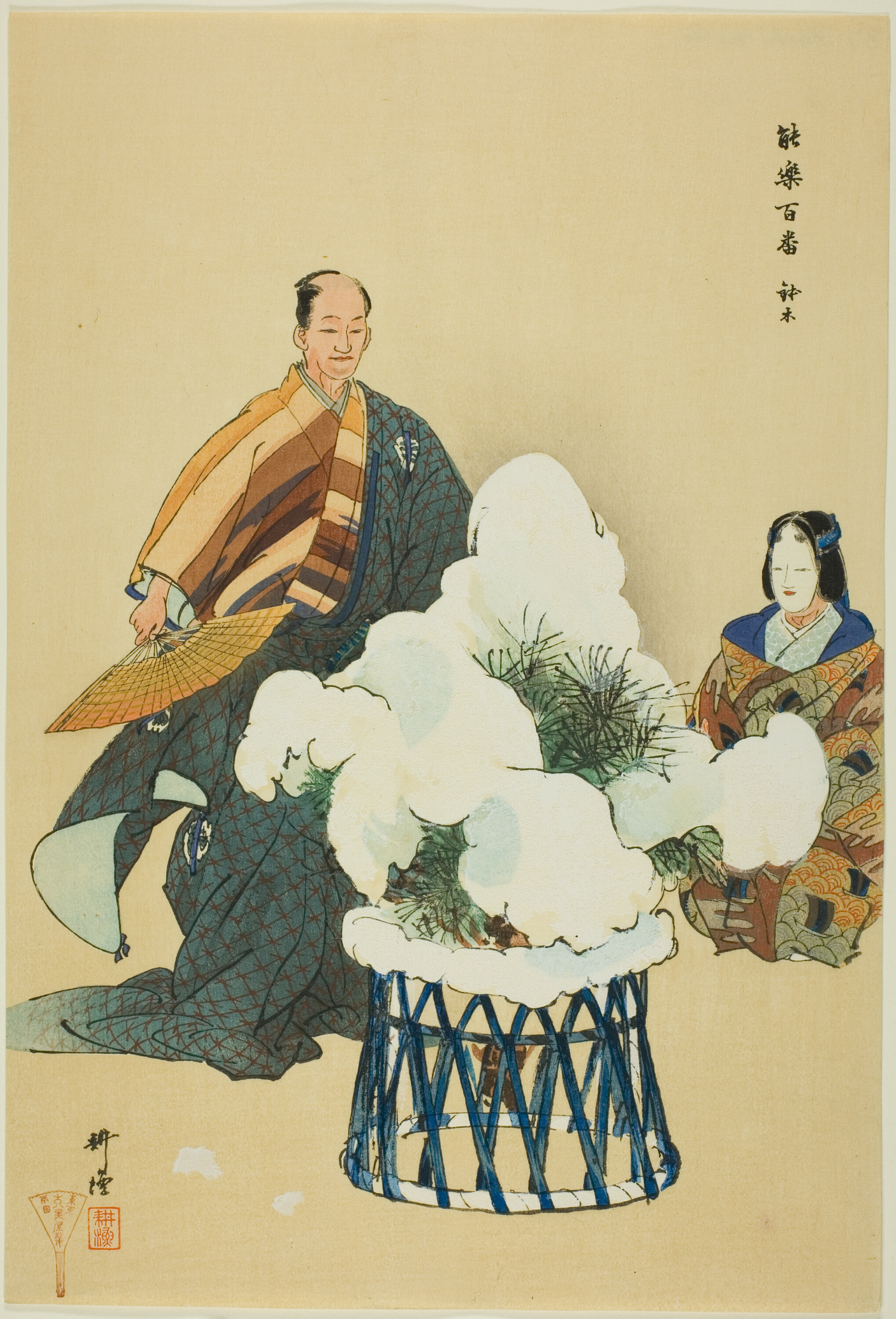
Tsukioka Kogyo, "Hachi no Ki" (鉢木), from the series Nogaku Hyakuban (能楽百番, "One Hundred No Dramas"), c. 1898–1903. Public domain, via Wikimedia Commons — Source
In a Noh play of uncertain authorship, an impoverished samurai named Sano Genzaemon Tsuneyo runs out of firewood on a snowbound night. To warm the stranger who has come begging shelter, he cuts down and burns the three trees he treasures most — potted plum, cherry, and pine. The stranger turns out to be Hojo Tokiyori, the retired fifth regent of the Kamakura shogunate, traveling in disguise to test the loyalty of his vassals; when he later summons the region's warriors to Kamakura, the ruined Tsuneyo is the first to answer the call, and is rewarded with his lands restored and three new fiefs named after the trees he burned. The play, built on episodes from classical sources such as the Taiheiki, is called Hachinoki (鉢木, "The Potted Trees"), and hachi no ki — literally "potted tree" — is the old word for what is now called bonsai, attached in the literature from the start to the warrior class rather than to court aristocrats or Zen monks alone.
The story only works if an audience of samurai already accepted that a well-kept hachi no ki was worth grieving — proof that potted trees carried real weight in warrior culture centuries before bonsai became a global art form.
The sacrifice had to be real for the story to work
Hachinoki dates from the thirteenth century, but it did not become widely loved until centuries later — mainly from the Edo period on, when playhouses added it to puppet theater and Kabuki alongside the Noh stage. Audiences kept returning to it not for the trees themselves but for what burning them proved: that Tsuneyo's hospitality and loyalty outranked even his last prized possessions. That argument only lands on an audience that already treats a well-tended hachi no ki as something worth mourning — a small fact about the culture, carried inside a play about a much larger one.
The shoguns kept coming back to potted trees
The attachment did not stay on stage. The official synopsis maintained by Japan's Noh theater association records Hachinoki as a favorite play of Tokugawa Ieyasu (1543–1616), the shogunate's founder — whether or not it was truly his single favorite, the claim places the story inside the ruling military house's taste from the opening of the Edo period.
His grandson carried the attachment past the theater and into the garden. Tokugawa Iemitsu (r. 1623–1651), the third shogun, was by most accounts a genuine hachi no ki devotee, enough that his attention to the trees is said to have drawn him away from governmental duties. In one account, his blunt-spoken councilor Okubo Hikozaemon (1560–1639) threw one of Iemitsu's favorite trees into the garden in full view of the shogun, hoping to shame him into spending less time on the hobby; Iemitsu, the story goes, never gave it up. A darker account from the same era describes a samurai's gardener who is said to have taken his own life after his master insulted a hachi no ki he had been especially proud of tending — true in its details or not, a record of how much status a household could rest on the condition of one tree. One pine linked to Iemitsu's own collection, later connected to a residence inside Edo Castle, has its fuller record in "Meiboku: Japan's Historic Bonsai."
Bonsai trained character the way swordsmanship did
None of this reads as simple decoration. Samurai society already had, in swordsmanship and in the tea ceremony, disciplines built to train character rather than only produce a result, where visible skill served as evidence of an invisible composure. Bonsai fit the same category naturally. A tree cannot be rushed: a branch wired too early snaps, a trunk cut on impulse cannot be uncut, and the shape a grower wants this year may only be reachable a decade from now. Cultivating one is a private argument with one's own impatience, repeated for years, with no opponent to defeat and no audience required to witness the discipline being kept.
That quality — a test with no observer, held over a span longer than most projects a person takes on — sits close to what we explored in "Zen Is Practice," where Zen training values the repetition of an ordinary act over any single flash of insight. A samurai tending a potted pine through a decade of Edo-period peace was doing a small version of the same work: proving something to himself on a schedule no swordsmanship could offer once there was no more war left to fight.
Restraint is the grammar bonsai shares with the sword
Bushido (武士道, the samurai code) never treated aesthetics as ornament. What it prized was economy — a single cut that lands correctly, a gesture in the tea room performed exactly, with nothing added for effect. That same grammar runs through bonsai. A branch comes off because the tree's kata (型, "form," a fixed pattern passed down and trained into — the same discipline examined in "What Is Kata?") calls for exactly that cut, and the artist's skill shows in how little else gets touched. If you want a quick way to judge whether a piece of work — a tree, a sword cut, a tea gesture — carries real mastery, look past what was added and count what was left alone. A form earns trust only once it has been repeated long enough to go quiet.
The discipline survives; the rank does not
Almost nothing of the Sengoku-to-Edo warrior class survives in any literal sense — no shogunate, no fiefs to lose or win back by answering a summons. What survives is the habit of mind it attached to potted trees: an object judged by character before taste, that rewards nothing so much as years of patience no single season can rush. Azukari carries that same habit forward, minus the rank and the war. A tree keeps doing its slow work under a Japanese artist's care in Japan, and its owner receives, season by season, not a title or a fief, but a record of the discipline itself — the same discipline a samurai household once used to measure a man, now handed in shares to anyone willing to keep watching a tree that isn't finished yet.
References
- History of bonsai — Wikipedia — on Tokugawa Iemitsu's devotion to hachi no ki, the Okubo Hikozaemon anecdote, and the account of a samurai's gardener.
- Hachinoki (Potted Trees) — Noh Plays Database, the-noh.com — official synopsis of the play, including its status as a favorite of Tokugawa Ieyasu and its basis in bushido themes.
- 鉢木 — Wikipedia (Japanese) — on the play's uncertain authorship, its material drawn from the Taiheiki, and its Edo-period adaptations into puppet theater and Kabuki.
- Hachi no Ki, from the series One Hundred No Dramas — Art Institute of Chicago — museum record for Tsukioka Kogyo's print reproduced above.