
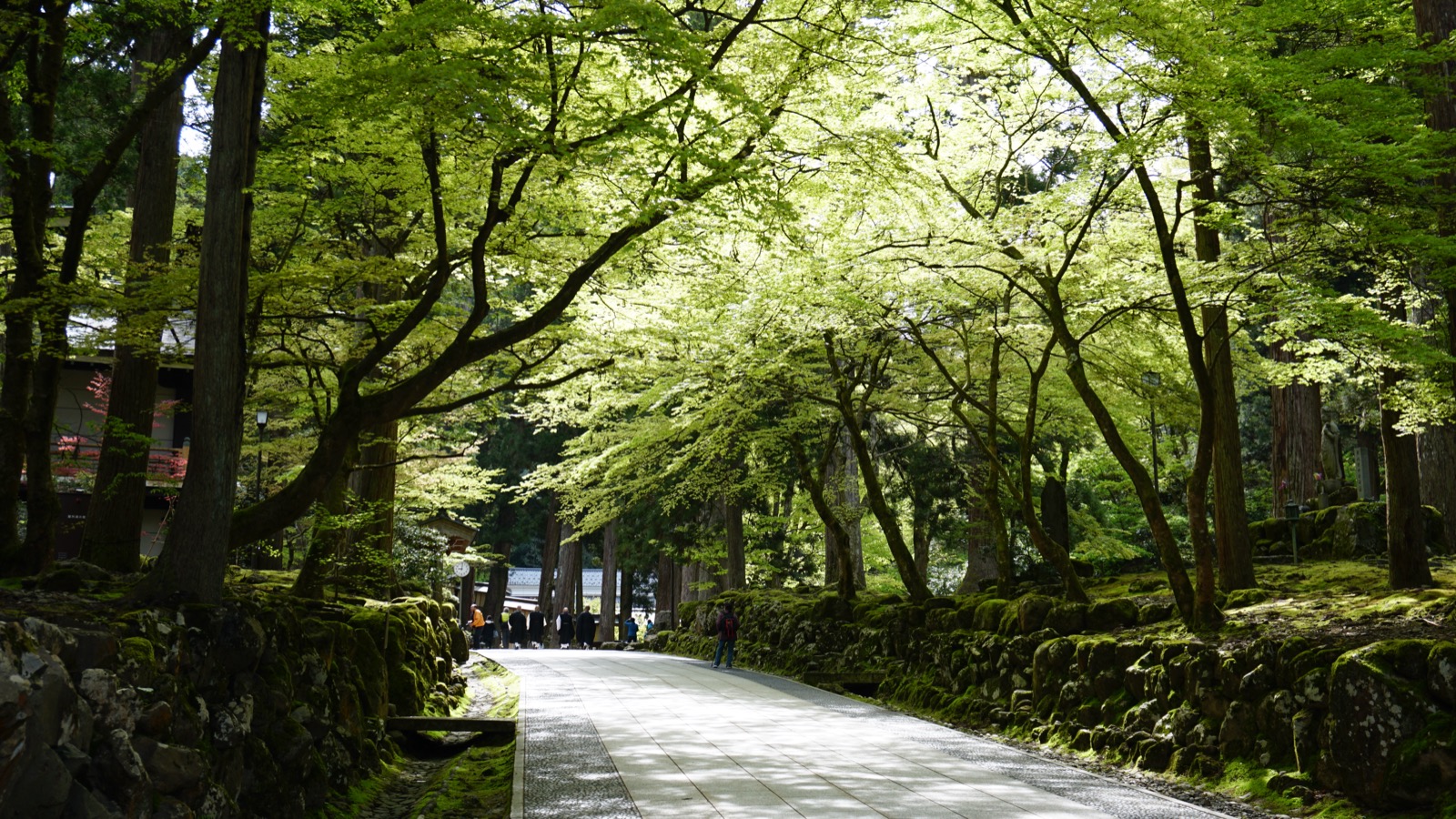
In 1237, a monk named Dogen sat down to write instructions for the person who cooks a monastery's rice. He did not write about doctrine. He wrote that a single leaf of a vegetable should be handled with the same care given to a buddha, and that the job of cook — elsewhere treated as a lesser task, handed down to whoever is free — should instead go to one of the monastery's most senior, most practiced monks. The text became known as the Tenzo Kyokun (典座教訓), "Instructions for the Cook." Eight centuries later, it still says something true about how this tradition treats an ordinary task: not as a chore to clear on the way to enlightenment, but as the material enlightenment is made from.
Zen is not a set of ideas to understand. It is a set of actions to repeat, with the body, until the repetition itself becomes the understanding.
Outside Japan, "Zen" has drifted into shorthand for a mood — clean rooms, quiet minds, a word borrowed for candles and phone apps. Inside the tradition, the emphasis runs the other way. Zen is a training school built around sitting, sweeping, and cooking, and its central claim is that none of the three can be learned by reading about it.
Sitting is the whole instruction
The clearest statement of this comes from zazen (座禅, seated meditation), and specifically a form of it called shikantaza (只管打坐), "just sitting." Dogen — who carried this lineage from China and founded Eihei-ji temple in what is now Fukui Prefecture — treated zazen as the direct enactment of an awakened state a person is already part of, rather than a technique for reaching one. It asks for no concentration on the breath, no image held in mind, and, strictly speaking, no enlightenment pursued as a future event. Soto Zen's own teaching materials put it plainly: the practitioner "just sits," letting thoughts arise and pass without chasing or pushing them, doing, as one text puts it, "nothing but sit."
This connects to an old Zen slogan, furyu monji (不立文字), "not standing on words and letters." The phrase does not mean Zen has no texts — the tradition produced a large body of writing, commentary, and poetry. It means a text can point at the experience of practice but cannot replace it, the way a menu describes a meal without feeding anyone. Zen's founding legend builds the same idea into its own origin story: a transmission from teacher to student that passed "mind to mind," without words, alongside the sutras rather than instead of them. What survives into daily training is a plain instruction: sit, and sitting will teach what talking about sitting cannot.
Sweeping and cooking carry the same weight as sitting
If sitting is the most visible face of Zen training, it is not the only one. Japanese monasteries organize daily chores — sweeping the garden, scrubbing the hall floor, washing the pots — into a formal practice called samu (作務), work. Samu is not a task squeezed in around meditation. It is meditation performed with a broom, done with the same unhurried attention as sitting on the cushion, and treated as no less capable of carrying a person toward realization.
The Tenzo Kyokun extends the same logic to the kitchen. Writing after his own years of training in China, Dogen described cooking rice and vegetables as inseparable from the pursuit of the way. Nothing here is metaphor. It is a literal claim about where practice lives — not only on the cushion, but in the pot, the ladle, and the hands doing the washing.
The hand learns what arguing about it cannot
Why treat a broom or a soup ladle as equal to formal meditation? Because Zen holds that understanding gained purely as an idea stays thin and forgettable, while understanding built into a repeated motion becomes something closer to knowledge lodged in the hands. A monk does not sweep the garden once and grasp attention. A monk sweeps it every morning for years, and somewhere inside that accumulation — without one dramatic moment — the quality of attention sweeping asks for starts showing up elsewhere: at the table, in conversation, on the cushion.
This is why Zen training resists shortcuts. There is no version of the practice where reading enough, or reasoning carefully enough, lets a person skip the sitting and the sweeping. The body has to be the one that learns, because it is the body — not a set of correct opinions about Zen — that carries the practice into the next ordinary moment.
A watering can obeys the same rule
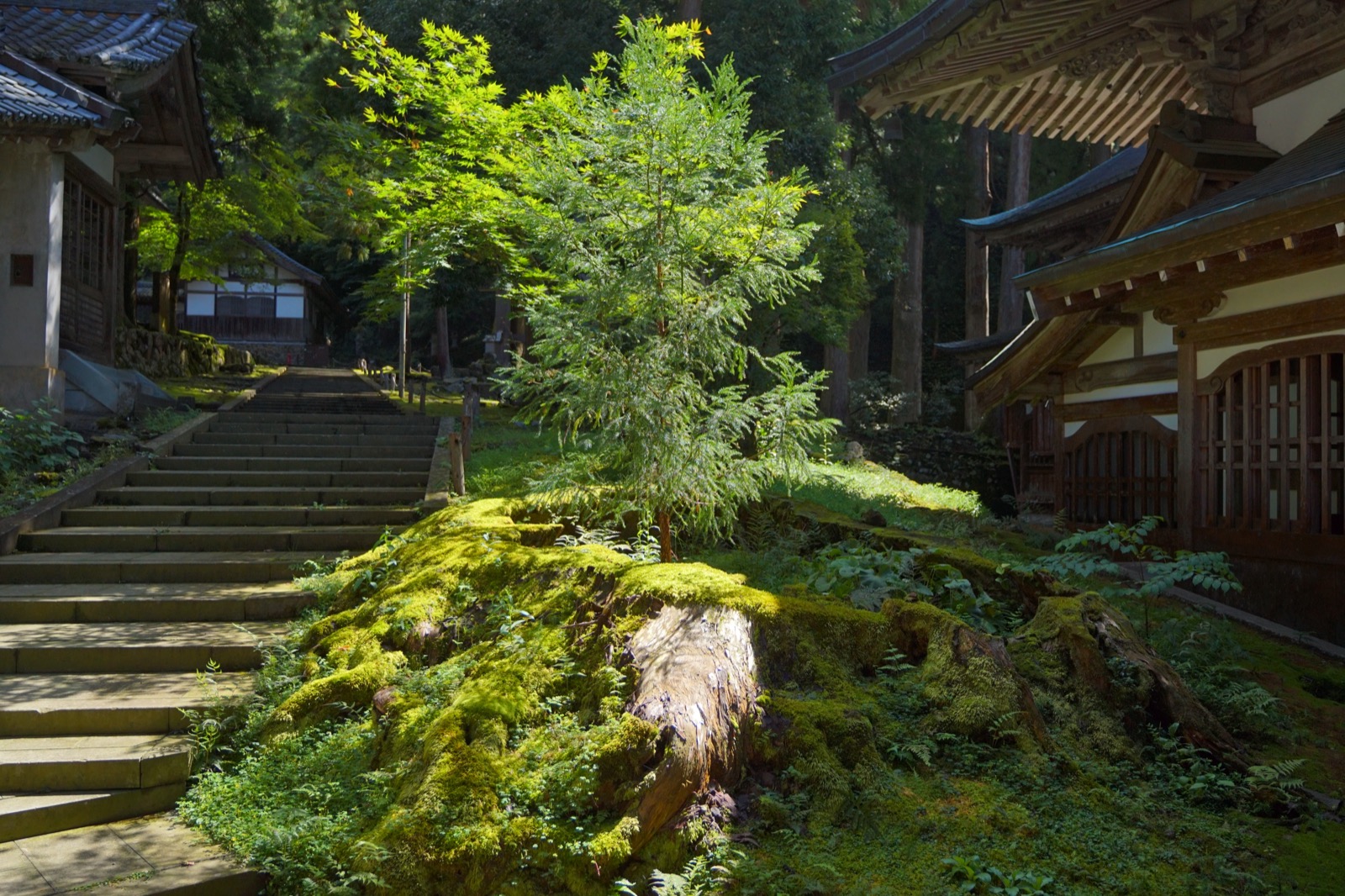
An old cedar stump beside a young cedar growing on, inside the grounds of Eihei-ji. Neither the temple's daily sweeping nor a tree's daily watering asks to be finished — only repeated.
The same structure turns up in an ordinary household chore: the daily watering of a bonsai. As we wrote in "Bonsai and Watering," growers have an old saying, mizuyari sannen (水やり三年), "three years for watering" — the claim that giving a tree water, done well, takes about three years of daily practice to learn. Tipping a watering can is trivial. What takes years is exactly what samu and shikantaza also ask for: showing up in front of the same tree at the same hour, day after day, until reading the soil, the leaves, and the season becomes something the hands and eyes do before the mind finishes thinking about it.
The honest test for a practice like this is whether it survives the day it stops feeling meaningful. That is the test a monk sweeping for the ten-thousandth morning passes without noticing, and it is the same test a bonsai owner's watering schedule has to pass if the tree is going to make it through the owner's busiest weeks, not only the calm ones.
No one would call watering a bonsai a religious rite, and this piece does not argue that it is. But the shape of the discipline matches what Zen has organized into a formal school for eight centuries: an ordinary, repeated act of care, performed without expecting to finish it, that quietly becomes the place where attention gets trained. A tree cared for this way is never "done," any more than a monk who has swept the garden ten thousand times has finished sweeping.
What continues, season after season, in the version of this practice Azukari keeps in Japan on an owner's behalf, is the same plain motion — kept going by someone whose hand does not skip the difficult weeks. Not insight. Not discipline. Just continuation.
For more on that daily discipline, see "Bonsai and Watering," and on the idea that a tree, like a practice, is never finished, "Bonsai Is Never Finished."
References
- Shikantaza (Just Sitting) — Rev. Kenshu Sugawara, Center for Soto Zen Studies — official Soto Zen doctrinal explanation of shikantaza as "just sitting," with no object or goal.
- Glossary — SOTOZEN.COM — official Soto Zen glossary of core terms including zazen and related practice concepts.
- Daihonzan Eiheiji — Soto Zen Temples — official Soto Zen page on Eihei-ji, the training temple founded by Dogen.
- Tenzo Kyokun: Instructions for the Cook — Terebess Asia Online — full English translation of Dogen's 1237 text on the practice of the monastery cook.
- "Furyu monji" — Encyclopedia.com — reference entry on the Zen principle of "not standing on words and letters."
- Work Practice (Samu) — Mountain Cloud Zen Center — practitioner explanation of samu as work done with the same attention as zazen.
Photo credits: "Approach to the Eiheiji" by 掬茶, and "Huge stump and young cedar tree in Eiheiji" by 掬茶, both via Wikimedia Commons, licensed under CC BY-SA 4.0. Resized from the originals.

