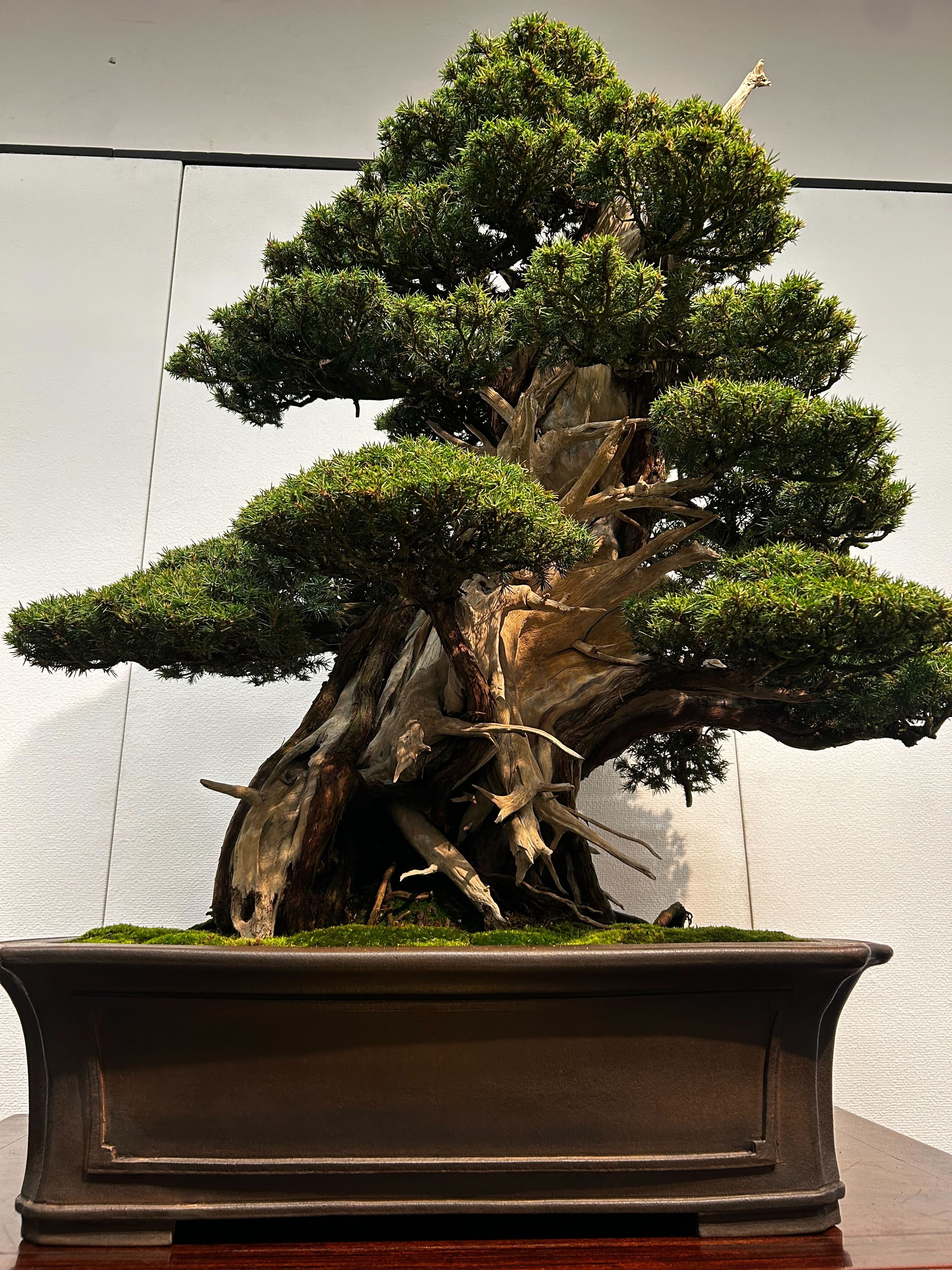
Run a hand across most bonsai foliage and it gives a little — soft, faintly resinous, cool to the touch. Run it across a tosho (杜松, "needle juniper"), and it does not give. The needles hold their point, three to a whorl, each one aimed in its own direction, and a careless hand comes away marked. Japanese farmers once put that trait to practical use, wedging cut branches into the gaps of a wall or roofline to keep mice out — a habit remembered in one of the tree's older names, nezu (ネズ, shortened from nezumi-sashi, 鼠刺し, "mouse-piercer").
Among the junipers grown as bonsai, tosho is the one that never quite lost its wild edge — in its needles, in the rough-hewn deadwood it forms, and in a popularity that trails only shimpaku juniper's.
A tree raised on ground nothing else wants
In the wild, Juniperus rigida is not a plant that goes looking for shelter. Within Japan it grows from Honshu south of Iwate Prefecture down through Shikoku and Kyushu, favoring exposed mountain ridges, sunlit granite slopes, and the rocky coastline of the Seto Inland Sea — ground too dry and too poor in soil for most other trees to bother with. Beyond Japan the same species reaches into the Korean peninsula, northern China, and the far southeast of Russia, growing at altitudes anywhere from near sea level to roughly 2,200 meters. What it will not tolerate is a wet root: built for drought and thin, fast-draining ground, it struggles wherever moisture collects. It is also planted as an ornamental in Japanese temple gardens, valued there for the same rugged bearing that makes it a bonsai subject today.
That harsh native ground matters for more than botany. The same forces that carve jin and shari onto an old shimpaku juniper holding on to an exposed ridge work just as readily on a tosho rooted in a granite outcrop above the sea — wind, drought, and a dead branch left standing rather than falling. A tosho collected from that kind of ground can already look decades older than its years in the pot, an inheritance no amount of later styling can shortcut.
Needles that still sting, deadwood that still looks rough
A tosho's foliage is the clearest way to tell it from its more famous relative. Where shimpaku (真柏, "sacred juniper") carries soft, flattened scale leaves a hand can run through without complaint, tosho holds true needles — roughly one to two centimeters long, awl-shaped and triangular in cross-section, growing in whorls of three with each one pointing its own way, a single pale stomatal band along the inner face and a sharp tip that gives the whole tree its bite. It is no accident that later cultivation prized shimpaku's softer foliage for the formal tokonoma alcove and left tosho's harder edge more or less alone; the two trees ask to be handled differently from the moment a visitor reaches out to touch one.
The deadwood follows the same logic. Growers who work both species describe tosho's jin (神) and shari (舎利) — the bleached, stripped wood bonsai prizes on old conifers — as coarser and more jagged than shimpaku's: less the polished, sinuous white of a refined exhibition trunk, more the raw, torn look of wood that has genuinely been killed by weather rather than only carved to resemble it. We have written elsewhere about how jin and shari are read on a bonsai's trunk; on tosho, that reading tends to come out rougher than on almost any other species regularly worked this way.
Named in the same breath as shimpaku
Ask which conifers are prized above all for jin and shari, and tosho and shimpaku are usually named together — the two species most growers reach for when the goal is a trunk that reads as old, weathered wood carrying a narrow ribbon of living green. The kinship runs deeper than reputation: both belong to the genus Juniperus within the cypress family, both propagate readily from cuttings, and both reward the same patient, decades-long carving of the trunk.
Where the two part ways is rank. Shimpaku is usually treated as the finished master of the pair — the species most associated with the most refined exhibition trees, its foliage softer, its shari smoothed by generations of technique. Tosho is spoken of as its wilder cousin: named in the same sentence for what it can do with dead wood, but rarely mistaken for it. Among growers who want that jin-and-shari character without shimpaku's more cultivated finish, tosho is very often the tree chosen instead.
A tree that resists being fully tamed
Tosho's wildness is not only visual. The species is genuinely difficult to keep, and most of the reasons trace back to the same harsh, well-drained ground it grows on in nature. Its roots want to stay lightly moist and heavily oxygenated; hold water around them the way a more forgiving species might tolerate, and rot sets in quickly. It does not reliably bud from bare, leafless wood, so a grower who lets a branch go bald has effectively lost that branch for good — there is no coaxing new growth back into an old, needle-free limb the way some other conifers allow. Repotting is its own hazard: growers who work regularly with tosho describe losing specimens to a badly timed root disturbance, and recovery afterward tends to be slower than in the species it is most often compared to. Wiring asks for extra care too, since tosho's wood is more prone to snapping under the same twisting technique a shimpaku trunk will usually tolerate.
None of this makes tosho harder to admire — if anything, the opposite. A tree this unwilling to be rushed or mishandled is, in its own way, still living by the rules of the mountain ridge it came from, whether or not it has spent the last thirty years in a pot.
Closing
A tosho does not soften with cultivation the way some bonsai species do. Decades of careful work will refine its shape, deepen its shari, and thicken its trunk — but the needle stays sharp, the deadwood stays rough, and the tree still, in a small way, keeps something of the ridge it came from. Caring for one well means working with that edge rather than trying to file it away.
In Japan, that kind of exacting, season-by-season attention is what an artist gives a tosho as a matter of course — watching root moisture through a wet summer, judging exactly when a branch can be wired and when it cannot, deciding which limb to sacrifice rather than risk losing outright. Azukari lets an owner join that same unhurried record from wherever they live, receiving the seasonal account of a tree that, wild as it looks, is being watched as closely as any other.
References
- Bonsai Empire — Needle Juniper (Juniperus rigida) Care Guide — sharp, stinging needle foliage, the risk of overwatering rigida's roots, its inability to bud reliably from bare branches, and wiring notes.
- Wikipedia — Juniperus rigida — botanical description: needles in whorls of three with a white stomatal band, native range across Japan, Korea, northern China and the far southeast of Russia at altitudes of 10–2,200 m, and its use as a temple-garden ornamental.
- 植木ペディア(庭木図鑑)「ネズミサシ」 — origin of the name nezumi-sashi ("mouse-piercer") from its use warding off mice, its distribution on Japanese mountain ridges and the Seto Inland Sea coast, and its preference for dry, poor soil.
- 盆栽エンパイア「杜松」 — tosho's jin and shari described as an expression of the species' wild character, and a note that its wood is more prone to breaking under twisting than shimpaku's.
- 盆栽日本「杜松 Needle Juniper」 — native habitat on sunlit mountain and hillside granite ground in Japan, and how readily the species forms jin and shari in cultivation.
- 盆栽Q「杜松(トショウ)盆栽の育て方まとめ」 — comparison of tosho's rougher shari carving to shimpaku's, the two species' shared genus and propagation by cuttings, and the risk of losing a tosho to a badly timed repotting.