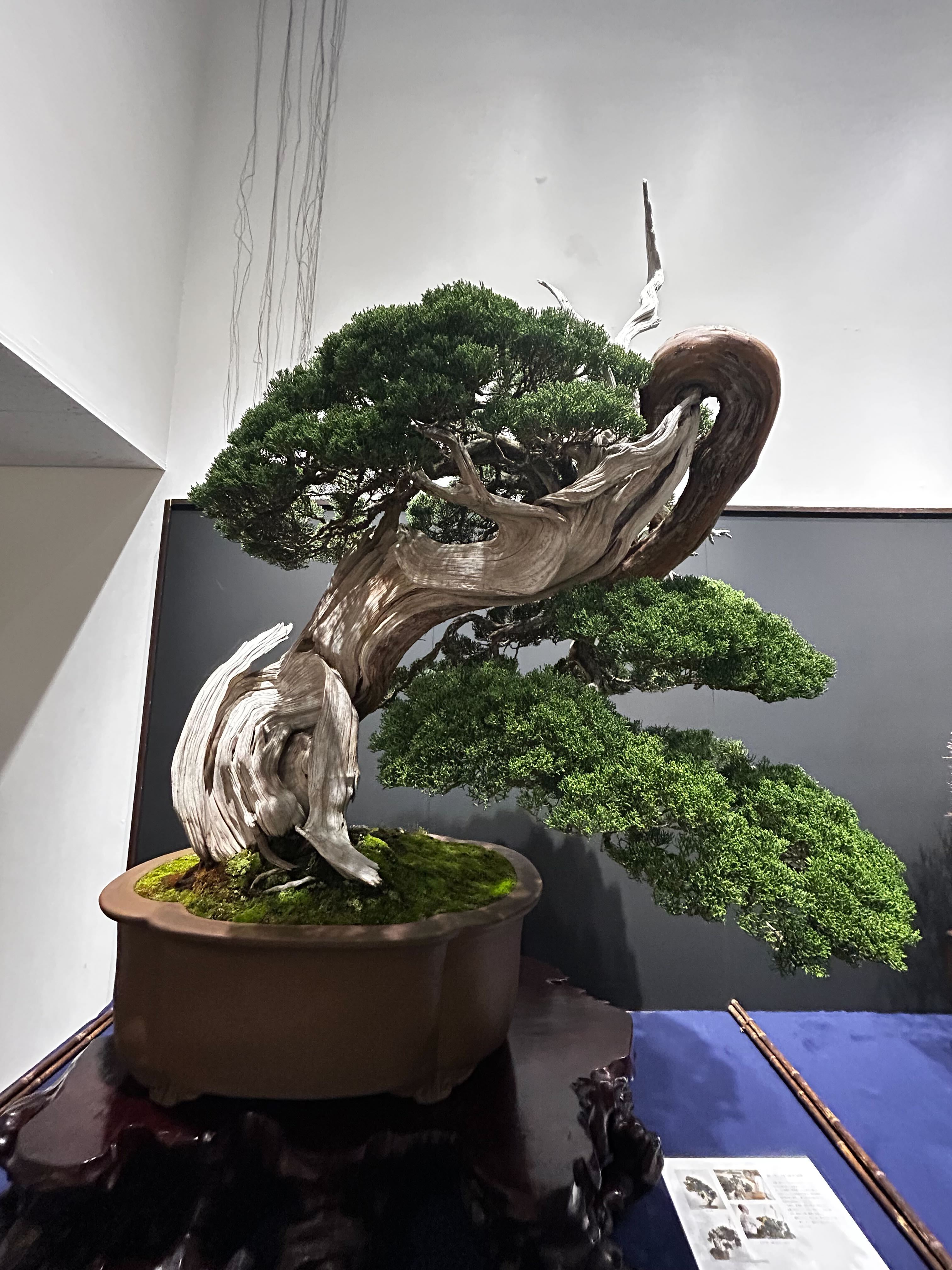
A shimpaku juniper's coiling deadwood, carved and bleached over decades. Photo: Azukari
At the Omiya Bonsai Art Museum, more than a hundred cataloged bonsai and suiseki stand under running labels of species and age — and in front of the oldest named trees, conversation reliably drops to a murmur. No docent asks visitors to lower their voices; nothing about an old pine issues an instruction. Walk on to the younger material nearby — the freshly wired trunks, the bright foliage pads still finding their shape — and the same visitors talk more, linger less, and reach for the placard first.
A well-kept old bonsai carries no caption for what it has lived through, and needs none — its bark, its bends, and its scars already say more than a placard could, which is why the oldest tree in a room is so often the quietest one to stand in front of.
The reaction is worth taking seriously, because nothing about it is staged. It happens the same way in front of far larger things, and it happens for a traceable reason.
An old tree is legible before anyone explains it
An old bonsai is mono iwanu (物言わぬ, "that does not speak") in the most literal sense — no language, no memoir, no interview to give. And yet almost nobody who stands in front of a genuinely old tree reads it as blank. A trunk that has thickened over eighty or a hundred years, a line that bends the way a branch bends only after decades of being trained and left to set, carries information whether or not a visitor goes looking for it — the way an old hand or an old face does, to anyone willing to stand still and look. The tree is not performing eloquence. It simply cannot help being legible.
This is not only a bonsai phenomenon. On Yakushima, a small island off Kagoshima, a Japanese cedar known as Jomon Sugi (縄文杉) stands with a trunk some 16.4 meters around — direct measurement and dendrochronology put a confirmed portion of its age in the low thousands of years, while broader estimates, hedged even by the researchers who cite them, run as high as 7,200. Since Yakushima's 1993 UNESCO World Heritage listing, visitors have been kept to a viewing platform roughly 15 meters from the trunk. Nobody built a wall of explanatory text at that platform. The distance and the silence around it do that work instead. A bonsai produces the same effect at a scale small enough to sit on a bench — the same wordless authority, compressed into a pot.
A scar records what a tree survived
None of this comes from decoration. It comes from what the tree was made to survive. Growers name a stripped, bleached branch jin (神) and a stripped vein of dead wood running down the trunk shari (舎利) — terms traced in more technical detail elsewhere — but the plain fact under both words is that they mark where the tree lost part of itself and kept growing anyway. In nature this happens to a branch broken by snow load or a strip of bark killed by drought or lightning; in cultivation, an artist studies exactly that pattern and, over months or years, carves and bleaches a matching scar with lime sulphur, never inventing a wound the tree could not plausibly have earned. A trunk that bends sharply low down and straightens higher up is rarely an aesthetic flourish either — more often it is a record of years spent leaning toward a stronger light source, or the point where an earlier owner chose not to prune it back to straight.
Japanese and Chinese painting has treated old, twisted trees this way for centuries, favoring them precisely because a gnarled trunk reads as biography rather than simple botany. Kano Sansetsu's Old Plum (老梅図, 1646) — four sliding-door panels painted for a subtemple of Kyoto's Myoshin-ji, now held at New York's Metropolitan Museum of Art — gives an ancient, black, sharply bent plum trunk the full width of the composition; its new blossoms read almost as an afterthought beside the age of the wood carrying them. A young, straight tree offers a painter, or a bonsai artist, very little to say. A bent, scarred one arrives already carrying its own plot.
That gives a plain way to place any mark on a tree without knowing its specific history: notice which direction it points. A branch still short of its final shape points forward — it invites the eye toward what the tree might yet become. A scar points the other way. It marks something the tree has already been through and no longer needs to finish.
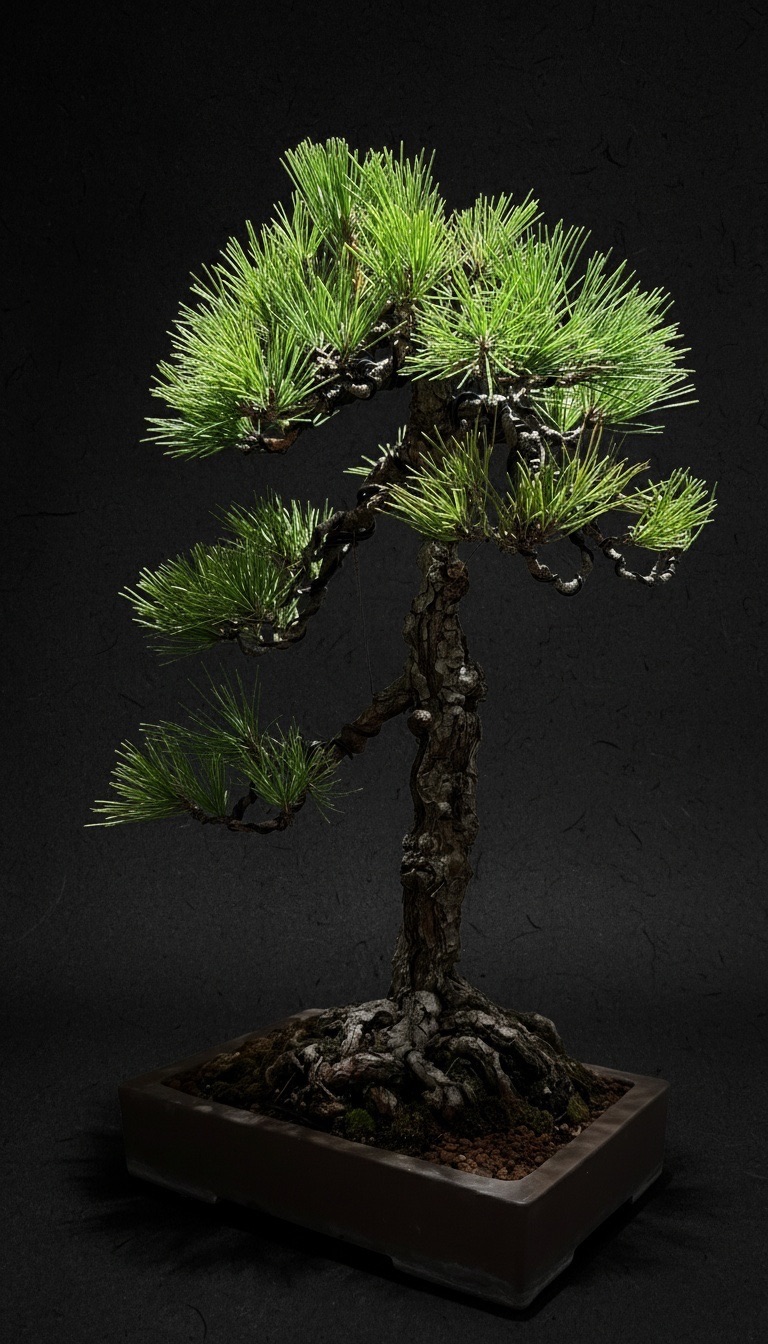
Old bark on a Japanese black pine reads, at a glance, as a record no younger tree could fake.
The blank space in the story is where a viewer has to work
No label at a bonsai exhibition explains which winter caused which scar, and that is not an oversight. A tree's bark and bends function the way Japanese readers describe gyokan o yomu (行間を読む, literally "reading between the lines") — the habit of drawing a meaning out of a text that never states it outright. Nobody hands a visitor the specific cause of a given jin, so the visitor supplies one: a storm, a hard winter, a branch an earlier artist chose to sacrifice for the sake of the whole. That guess is rarely provable and does not need to be. As with a documented meiboku, some old trees do carry a written record of exactly whose hands shaped them and when — but even a tree with no paperwork at all gets read this way by strangers who will never learn its actual history. The silence is not a gap the tree failed to fill. It is the space the viewer is invited to work in, much as reading a bonsai's overall form always asks something of the person looking.
Old age is measured against the viewer's own scale
It is worth returning to that murmur at Omiya, because it was never really about the tree asking for quiet. What changes is the visitor's own sense of scale: a hundred years, worn visibly into bark and line, outlasts any one life in the room, and standing next to a span of time that size tends to quiet a person — the same way it does at the foot of the Jomon Sugi, or in front of a nearly four-century-old painted trunk at the Met. The tree's tatazumai (佇まい, "the way something quietly holds itself, its bearing") does the work no placard, docent, or plaque ever could.
The record needs no translator
An old bonsai's silence is not a void waiting to be explained. It is the finished record of every year the tree was not cut back to something simpler — every scar left rather than smoothed away, every bend kept rather than straightened, all of it left legible on purpose by generations of hands that chose not to interrupt it.
That is the record Azukari is built to extend rather than edit down. A tree keeps aging in Japan under an artist's care, gaining exactly this kind of bark and line, season after season, while its owner joins one stretch of that unhurried record from wherever they live. Nobody needs to speak for the tree. It has never needed translating — only continuing.
References
- Wikipedia — Jomon Sugi — the cedar's estimated age range (roughly 2,170 to 7,200 years, by different dating methods), its 16.4-meter trunk circumference, its location on Yakushima, its 1993 UNESCO World Heritage listing, and the 15-meter viewing platform installed to protect it.
- Canon Global — Tsuzuri Project, "The Old Plum" — description of Kano Sansetsu's 1646 Old Plum sliding-door panels, their gnarled ancient trunk and blossoming branches, and their present home at the Metropolitan Museum of Art via the Packard Collection.
- Bonsai Empire — Deadwood on Bonsai (Jin, Shari and Uro) — definitions of jin and shari, how each forms in nature from storm and drought damage, and how growers carve and bleach matching deadwood with lime sulphur.
- Omiya Bonsai Art Museum — Collection — the museum's catalog of more than a hundred historic bonsai and suiseki, including long-cultivated named trees.