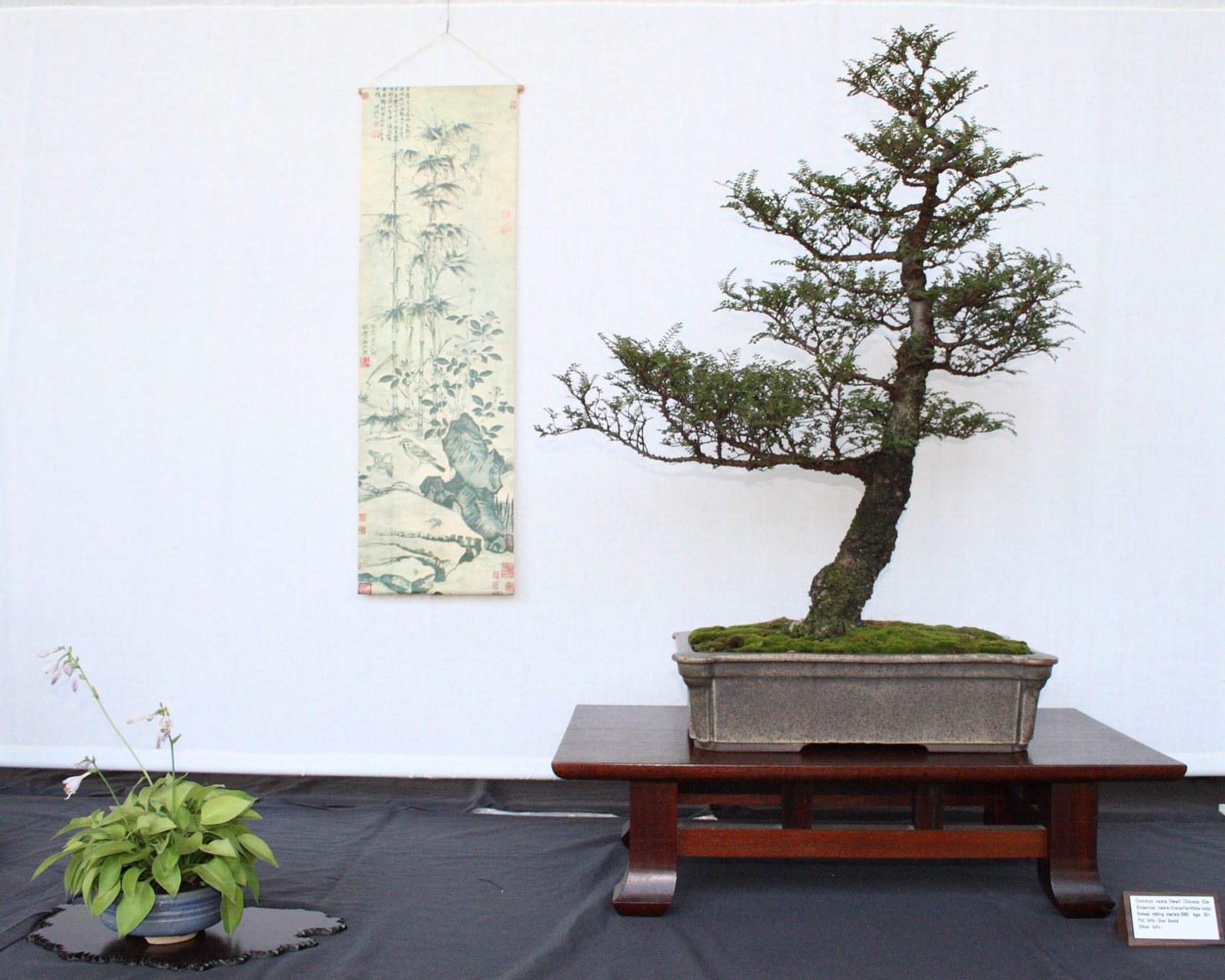
A Seiju elm bonsai shown with its ceramic pot, a wooden stand, a miniature hosta as accent planting, and a hanging scroll, at the 2009 exhibition of the Bonsai Society of Greater Hartford. / Photo by Sage Ross, CC BY-SA 3.0, via Wikimedia Commons — Source

A bonsai is not finished when the last branch is cut. It is finished the moment it is set beside the right pot, on the right stand, next to the right scroll — when a single tree stops reading as a specimen and starts reading as a composed scene.
Four objects, one arrangement
Japanese has a word for a composed presentation of this kind: kazari (飾り, "an arrangement," "a formal display"). The term covers more than the tree. A fully built kazari draws together at minimum four things — the tree itself, its pot, the stand it rests on, and, in the fullest version of the form, a hanging scroll set behind it.
None of the four is neutral. The pairing of tree and pot has its own name, hachi-awase (鉢合わせ, "matching a pot to a tree"): a glazed pot for a flowering or fruiting tree, an unglazed one for a pine or a juniper, a shape and color chosen to argue with the trunk's line rather than simply hold soil in place. What decides that pairing is a subject of its own. The stand beneath the pot, called taku (卓) or dai (台) depending on its formality, does further work most viewers never register consciously — its height lifts the tree to eye level and sets how much air surrounds the trunk, and choosing the right one is a craft in itself. Behind the tree, a kakejiku (掛け軸, "a hanging scroll" of calligraphy or ink painting) supplies a season, a mood, or a literary reference the tree alone cannot state outright. A single line of calligraphy, a painted branch of autumn grasses, a distant mountain in ink — the scroll gives the tree a background, the way a caption gives a photograph a date.
Each piece could stand on its own. A fine pot is a fine pot; a good scroll hangs perfectly well over an empty room. What kazari asks is that none of them be judged alone. The tree remains the reason for the arrangement — every other object in it is chosen to support that one tree's meaning, never to compete with it — but the meaning itself is built collectively, object by object, the way a sentence is built from words that carry little on their own.
Where the pieces meet: the tokonoma
The traditional stage for this arrangement is the tokonoma (床の間, a recessed alcove built into a formal Japanese reception room for the display of a single composition). Its architecture and etiquette are their own story. What matters here is how the kazari elements are laid out once the stage is set. One common convention hangs the scroll at the center of the alcove and sets the tree to one side, balanced on the other by a stone or an accent plant — a basic arrangement Japanese sources on the subject describe as the starting point from which more elaborate versions branch. A composed alcove display of this kind is called toko-kazari (床飾り, "formal alcove display"); the broader term for a composed bonsai presentation in any formal setting, alcove or otherwise, is seki-kazari (席飾り).
Formality itself has degrees. Writers on the tradition describe three recognized registers, the names borrowed from the vocabulary of calligraphy: shin (真, "formal"), the strictest arrangement, suited to a tatami-floored reception room and a tree of correspondingly high standing; gyo (行, "semi-formal"), the register most home displays settle into; and so (草, "informal"), loosest of the three, more often seen in a tea room than a parlor. None of the three is more correct than another — each is simply pitched to its occasion, the way a letter's opening line changes with who is meant to read it.
Turning one tree into a story
The fourth object, when present, is the smallest: a shitakusa (下草, "accent plant," literally "undergrowth"), a low grass, fern, or flowering herb set in its own small pot near the tree. A shitakusa is never meant to draw the eye first. Guides written for exhibitors are specific about this — the accent plant and its stand should not rise above the top of the tree's own stand, and in practice it is usually kept to a fraction of the tree's height. Its purpose is not scale but season and place: a stand of miniature grass hints at an open field the tree itself cannot show, a flowering herb marks a month the bare trunk alone would leave unstated.
One account of the classical tokonoma composition assigns each element a role in a small triad — the tree standing for jin (人, "man"), the scroll for ten (天, "heaven"), the accent plant for chi (地, "earth"). This should be read loosely, as one formulation among several rather than settled doctrine. But the instinct behind it is easy to see in any well-built kazari: a tall vertical element, a low horizontal one, and a mediating form between them, arranged so the eye moves through the composition rather than resting on a single point. That movement is what turns a tree, a pot, a scroll, and a sprig of grass into something closer to a sentence than a shelf of objects — each piece answering the one beside it, together naming a single place at a single moment of the year.
Appreciation completed by display
A tree can be examined on a bare bench and its structure will still be visible — the taper of the trunk, the spread of the branches, the age written into the bark. What a bench cannot supply is context. Writers who have thought carefully about bonsai exhibition draw a real distinction between simply lining trees up for comparison, a practical format still used at large shows, and staging a single tree with care in a quiet setting, where a viewer is asked to slow down and read what the whole arrangement is saying rather than scan a row of specimens. The tree itself does not change between the two settings. What changes is whether it is being read as an object or as a composed statement — and that difference is exactly the work kazari does. What Is Keido treats this same instinct as a wider practice of attention; display is where that practice becomes visible, one arrangement at a time.
A tree finished this way is not simply looked at. It is read — and reading takes a frame.
Closing
None of this changes what the tree needs day to day: water, light, a season's worth of quiet growth on a bench far from any tokonoma. Display is not the tree's daily life; it is the occasional hour in which that daily life is made legible to someone standing in front of it. Azukari works mostly in that daily register — the seasonal record an artist keeps while a tree grows in Japan, not the staged hour of a formal kazari. But the two are related. A record that notes which branch was set this spring, which pot the tree has been moved to, what the artist thought worth writing down, is doing in writing something close to what a scroll and a stand do in a room: giving a tree, otherwise silent, a context an outside eye can read.
References
- Bonsai Empire — "Tokonoma displays" — on the elements of a tokonoma bonsai display (tree, suiseki, scroll, accent plant) and the shin/gyo/so degrees of formality.
- Bonsai Empire — "Kusamono, accent and companion plants" — on shitakusa/kusamono, the classical tree-scroll-accent triad, and the seasonal role of the accent plant.
- Bonsai Mirai — "Bonsai Display pt. I" — on the distinction between chinretsu-kai (row exhibition) and kazari (composed display), and the purpose of formal display in bonsai exhibition.
- East Bay Bonsai Society — "Accent Plants for Bonsai Display" — on placement, scale, and the accent plant's subordinate role relative to the main tree.
- Bonsai Navi — "席飾り" (Seki-kazari) — on the basic tokonoma arrangement of a centered scroll flanked by a bonsai and a suiseki.
- Wikimedia Commons — File: Bonsai display with Seiju elm, miniature hosta and hanging scroll — source and license (CC BY-SA 3.0, photo by Sage Ross) for the header image.