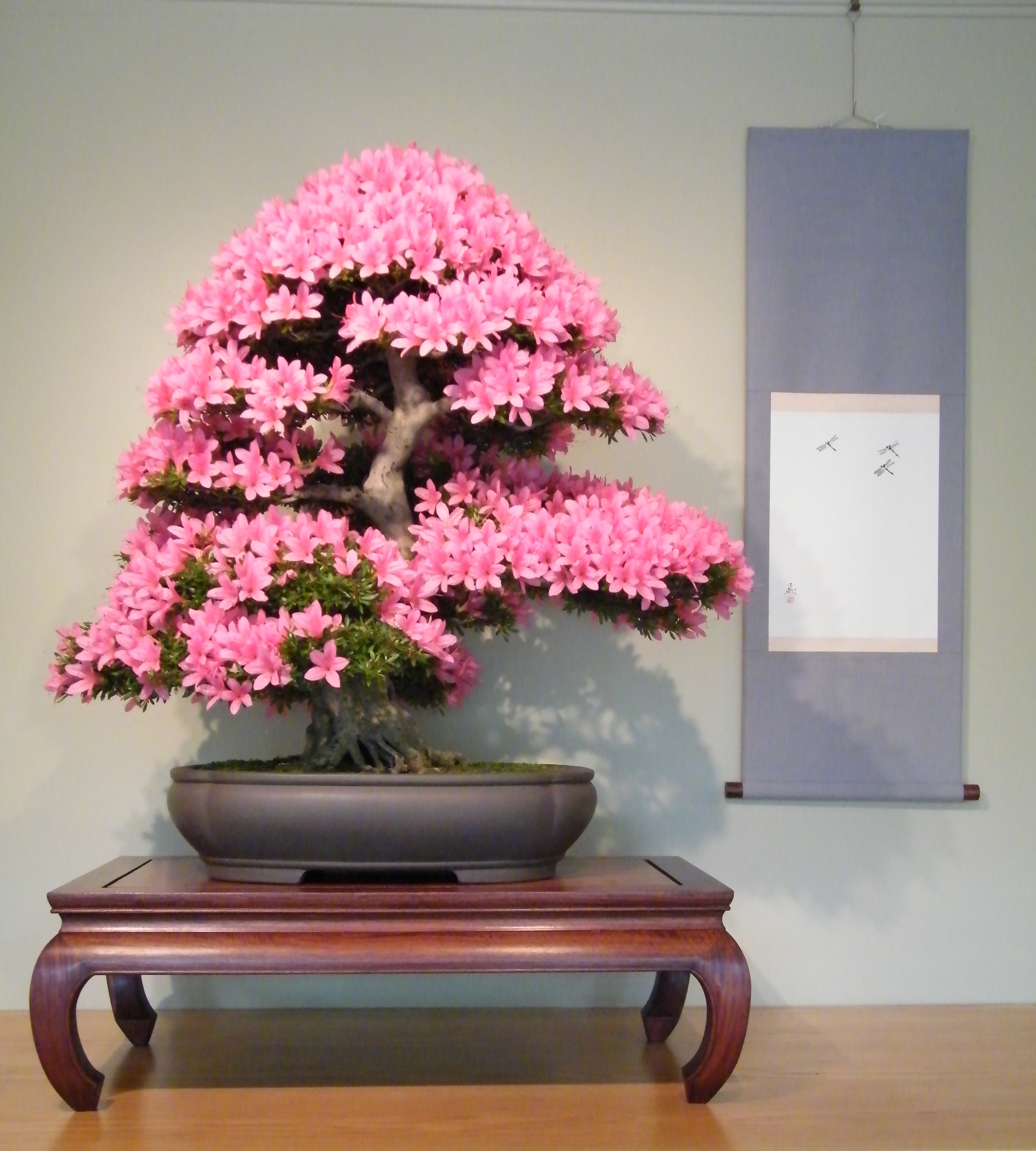
A satsuki azalea in bloom, set on a dark hardwood stand with curved legs, beside a hanging scroll. Photo by Sarah Stierch, CC BY 4.0, via Wikimedia Commons — Source

A bonsai's stand is never neutral furniture — its height, wood, and shape are chosen with nearly as much care as the tree itself, because the wrong stand can quietly undercut a tree that is otherwise excellent.
A supporting piece with its own standing
In Japanese practice, the wooden platform beneath a bonsai's pot is called a taku (卓, "a display stand"), sometimes also written shoku using the same character. A taku is carved or joined from hardwood, its legs, rails, and skirting varying enough in style that growers speak of choosing one the way they speak of choosing a pot. It is easy for a newcomer to see the taku as a shelf — something to keep the pot off the tablecloth — but in Japanese display practice it carries a formal weight of its own. At exhibitions built around the tokonoma (床の間, the alcove reserved for a single art object), a bonsai is judged as part of a full composition: tree, pot, and stand together, with the stand's proportions, wood, and finish read as part of the artist's statement rather than as background. A commonly cited rule of thumb suggests a stand's top should run somewhat larger than the pot it carries, wide enough to keep the composition stable to the eye without swallowing the pot's own presence — a starting point growers adjust as often as they follow.
The tall stand and the flat one
Japanese stands are conventionally sorted by height into a small family of types. A hirajoku (平卓, "a flat stand"), typically some ten to twenty centimeters off the table, keeps a tree close to the ground it appears to grow from. A chujoku (中卓, "a mid-height stand") raises it a little further. A takajoku (高卓, "a tall stand"), often fifty centimeters or taller, lifts the pot well above the surface it sits on. These are not arbitrary preferences. A flat stand reads as level ground, so it suits an upright or slanting trunk that is meant to evoke a tree standing in open country. A tall stand reads as a cliff or a mountain, so it is reserved for a cascading or semi-cascading trunk, whose branches fall below the rim of the pot and need real air beneath them to avoid looking cramped against the tabletop. A fourth option, the jiita (地板, "a legless board"), does away with height altogether — a flat slab of wood, sometimes a slice of a root or trunk, used under group plantings and rock plantings where the display itself sits close to the ground. For a full cascade, growers sometimes reach further still, to a stand carved from a single block of wood and pierced through with hollows, tall enough that the trailing branch clears the table by a wide margin.
Chosen to fit the tree, not the other way around
The same instinct that governs pairing a pot to a tree governs pairing a stand to it. Shape tends to follow shape — a round or oval pot generally sits well on a round, hexagonal, or naturally edged stand, while a rectangular pot generally calls for a rectangular one, the two outlines echoing rather than fighting each other. Weight follows weight: a thick-trunked pine or a heavy, weathered kuromatsu (黒松, "Japanese black pine") is conventionally set on a stand cut from a dense, dark hardwood — shitan (紫檀, rosewood) or kokutan (黒檀, ebony) among the woods most prized for the purpose — sturdy enough in profile to look capable of carrying the tree's visual weight. A lighter, more delicate tree — a maple in its winter silhouette, a flowering quince — is more often set on a stand in a paler or plainer wood, keyaki (欅, zelkova) or paulownia among them, whose lighter presence does not compete with the tree's own restraint. None of this is fixed law; exceptions appear constantly in practice. But it is the working vocabulary a grower reaches for, much as a grower reaches for one when matching a pot to a tree.
The piece no one looks at directly
What makes the taku worth pausing on is exactly how little attention it asks for. No one walks up to a formal display and studies the stand first; the eye goes to the tree, as it should. And yet the stand has already done its work by the time anyone looks — setting the tree at the right height, giving it the right ground to stand on or the right air to fall through, matching its weight in wood and its color in tone. A stand chosen carelessly is rarely blamed by name; it simply makes the tree above it look a little unconvincing, a little unfinished, without anyone quite being able to say why. A stand chosen well disappears into the reading entirely, so that the tree seems to have arrived at exactly the right height on its own.
Closing
This is a small, recurring decision inside bonsai's larger practice: nothing here can be said in words the tree itself would notice, and yet the choice is treated with real seriousness anyway, because it changes how a tree that took decades to shape is finally seen. It is one more example of a habit that runs through much of Japanese aesthetic life — the conviction that a supporting element, handled with enough attention, can carry as much of a composition's meaning as the object it supports.
Azukari sits inside that same habit of attention. An artist in Japan continues to make judgments at exactly this scale — this stand, this season, this pairing of wood and pot — long after a tree has found an owner, and each choice becomes part of the record that owner receives. For more on how a tree's setting is composed once its pot and stand are chosen, see "The Pot Chooses the Tree," "What Is Keido? The Aesthetics of Bonsai and Suiseki," and "The Empty Tokonoma."
References
- Wikipedia — Bonsai display table — on the stand's role in presentation, sizing conventions relative to the pot, and its place in tokonoma and exhibition display.
- Bonsai Tonight — "Bonsai stand conventions" — grower's guidelines for matching stand shape and height to pot shape and tree style, including cascade, literati, and shohin conventions.
- Bonsai Empire — "How to create a Bonsai Rootstand" — on rootstands carved from a single block of wood for cascade and semi-cascade trees, and their construction.
- Bonsai Myo — "The Correct Way to Display Bonsai" (正しい盆栽の飾り方) — on matching flat, mid-height, and tall stands to trunk style, and on woods such as rosewood, ebony, and tagayasan used for stands (Japanese).
- Kimi's Mini Bonsai Days — "How to Display Bonsai" (盆栽の飾り方) — on the height categories of flat, mid, and tall stands and their role within a tokonoma-style display (Japanese).