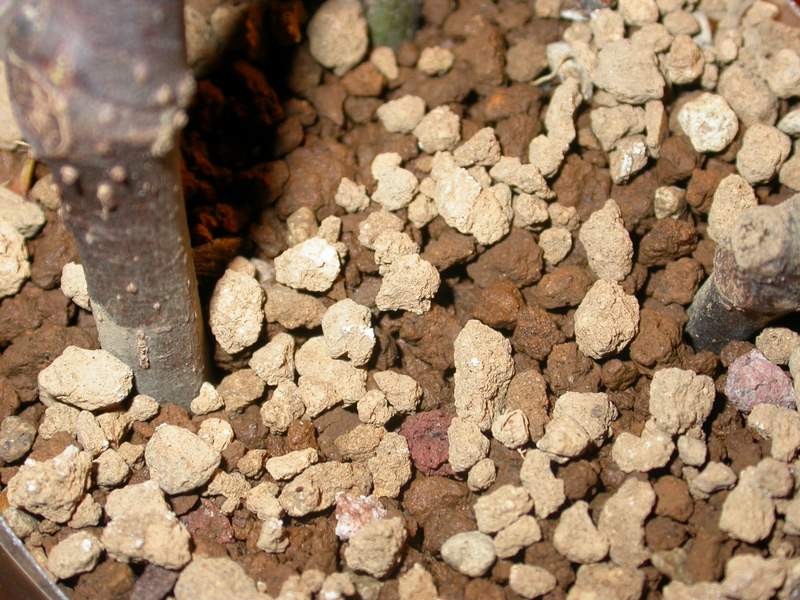
Akadama granules at the base of a bonsai trunk — the paler grains are dry, the darker ones freshly watered. / Photo by Abrahami, CC BY-SA 3.0, via Wikimedia Commons — Source

No. Regular potting soil and ordinary garden soil are built to hold water and nutrients in a way a shallow bonsai pot cannot afford — the fine particles compact, drainage slows, and roots sitting in that trapped water begin to rot. Bonsai are grown instead in coarse, evenly graded substrates, in Japan almost always led by akadama, chosen for the opposite property: they let water pass through quickly and still hold just enough of it between waterings.
Why the bag in the shed doesn't work
Potting soil and garden soil are formulated for the opposite job a bonsai pot needs done. Both are built from fine organic and mineral particles — peat, compost, silt, clay — chosen because those small particles hold water and nutrients close to a plant's roots in a deep bed or a large container, where the extra depth gives surplus water somewhere to go. A bonsai pot has almost none of that depth. Pack the same fine-particled soil into a container a few centimeters deep and a different rule takes over: water clings to the narrow gaps between small particles by capillary action faster than gravity can pull it back out, so a saturated layer forms at the bottom of the pot no matter how well the drainage holes are cut. Horticulturalists call this a perched water table, and the finer the soil particle, the higher into the pot that saturated layer rises — in a shallow bonsai container, it can occupy most of the rootball. Roots sitting in that oxygen-starved layer start to rot within weeks, and a tree can look outwardly healthy right up until the week it isn't. Checking the soil itself, rather than guessing on a schedule, matters just as much once the right substrate is in place — a habit covered in How Often Should You Water a Bonsai?.
The Japanese standard, working in the opposite direction
The soil in nearly every well-kept bonsai pot in Japan solves the same problem by going the other way entirely. Akadama (赤玉土, "red ball soil") is a naturally granular volcanic clay, screened into round, evenly sized grains before it ever reaches a pot. Because the grains are uniform and round rather than fine and irregular, the gaps between them stay large enough for water to drain straight through and air to reach the roots behind it, while each individual granule is porous enough to hold a reserve of moisture inside itself for roots to draw on between waterings. Coarse and uniform, rather than fine and mixed, is the whole difference between a soil that drowns bonsai roots and one that keeps them alive. How the ratios actually change by species, and how the granules break down and get renewed at each repotting, is covered in Akadama: The Foundation Is the Soil.
What a "fast-draining" potting mix still gets wrong
Growers newer to bonsai sometimes reach for a cactus or succulent potting mix instead, reasoning that anything marketed as fast-draining should qualify. It's closer, but usually still not close enough: most of those mixes are graded for pots several times deeper than a bonsai's, and still carry enough fine material to raise a perched water table in a shallow container, just a smaller one. Some growers do use ordinary potting soil deliberately, but only at an earlier stage entirely — for young trees still growing out in deep training pots or open ground to thicken a trunk, where the extra moisture retention helps root growth rather than hurting it. That is a different job from a tree already potted for display, and the two shouldn't be confused.
If akadama isn't available where you live
Akadama is mined in Japan and can be expensive or hard to source abroad, so growers elsewhere have built working substitutes around the same principle rather than the same material: hard, coarse, largely mineral particles that don't collapse under repeated watering. Pumice and volcanic lava rock (also sold as scoria) are the most widely used, sifted to a uniform grain and often mixed together or blended with whatever akadama is available locally. Calcined clay products sold for baseball infields or as oil-absorbent floor granules turn up in bonsai mixes for the same reason, once sifted to size — the material matters less than whether it keeps the same large, stable pore structure akadama does. What shouldn't go into that mix, regardless of what's locally available, is ordinary garden soil or potting compost, which reintroduces the same fine particles and the same perched water table the rest of the mix was built to avoid.
What actually decides whether a tree lives
None of this is really about loyalty to one Japanese mineral. It is about matching the physical scale of the soil to the physical scale of the pot — something a bag labeled for garden beds was never designed to do. Azukari artists mix and renew a tree's soil on exactly this reasoning at each repotting, choosing a coarse, well-drained substrate suited to that species and season rather than whatever potting soil happens to be on the shelf, with the work entered as a dated record for an owner who may never see the soil itself. A tree's roots don't know or care what a bag was marketed for. They only know whether the water around them ever gets to leave.
References
- Bonsai Empire — "Bonsai Soil" — on why compacted, organic potting soils harm bonsai health, and on mixing akadama, pumice, and lava rock (roughly 50/25/25 for deciduous trees) as a well-drained inorganic substrate.
- Michael Hagedorn / Crataegus Bonsai — "Life Without Turface" — a professional grower's assessment of pumice, lava, and perlite as working substitutes for akadama and Turface outside Japan.
- GardenMyths.com — "What Is a Perched Water Table?" — on the physics of the perched, saturated water layer that forms at the bottom of a container, and how smaller soil particles raise that layer higher.
- Bonsai Empire (Japanese edition) — "おすすめの盆栽土" — parallel Japanese-language guidance warning that hardened garden soil harms bonsai growth, and recommending akadama/pumice/lava-rock mixes.
- きみのミニ盆栽びより — "盆栽の用土" — on ordinary garden soils high in peat moss, leaf mold, or black soil retaining water but draining poorly, making them poorly suited to bonsai cultivation.