
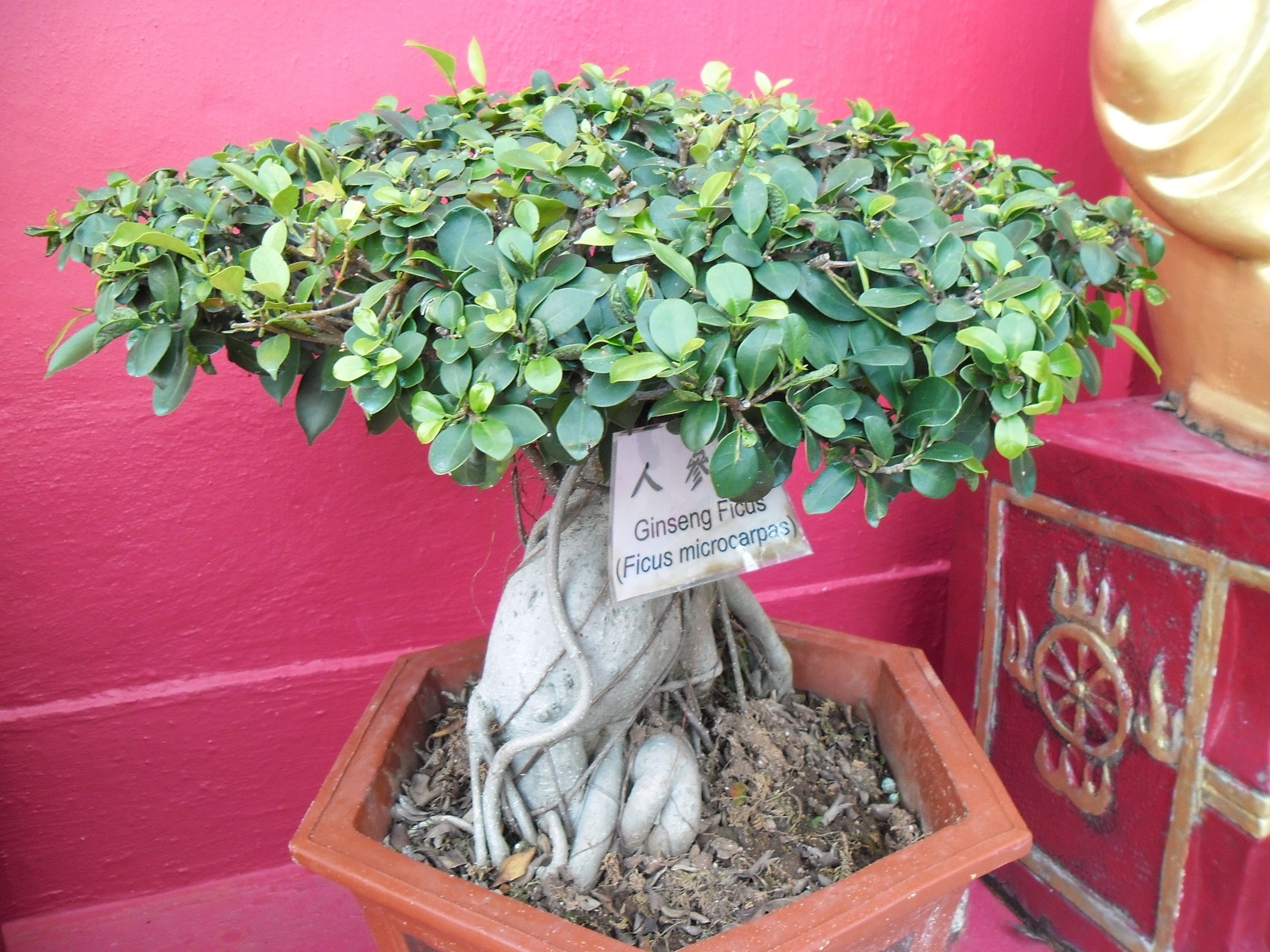
A Ficus microcarpa 'Ginseng' bonsai, its swollen aerial roots rising above the soil, photographed in Hong Kong. Photo by Earth100, CC BY-SA 3.0, via Wikimedia Commons — Source

Walk into a garden center in Amsterdam, a home-improvement store outside Chicago, or a plant stall in Singapore, and the bonsai on offer will rarely be a goyomatsu (五葉松, "Japanese white pine") or a kuromatsu (黒松, "Japanese black pine"). Far more often it will be one of two trees: a low, spreading juniper with wiry blue-green foliage, or a glossy-leafed fig with thick, swollen roots rising above its soil like a bundle of fingers. Almost nowhere outside Japan do these two species dominate a beginner's first purchase by accident.
Two species — Juniperus procumbens and Ficus microcarpa — introduce most of the world to bonsai, not because they rank highest in the tradition, but because they are the trees a local nursery actually has in stock.
Two species carry the introduction
Juniperus procumbens 'Nana', commonly sold as the dwarf Japanese garden juniper, is an outdoor conifer with a naturally low, mat-forming habit that lends itself to cascading and windswept shapes. Ficus microcarpa 'Ginseng', a cultivar of the Chinese banyan grafted for its swollen, ginseng-like roots, is an indoor tropical tree that tolerates the low light and dry air of a living room better than almost anything else sold as bonsai. Between them, these two species account for the overwhelming majority of bonsai sold at general retailers — home-improvement chains, supermarkets, flower markets, even furniture stores — across North America, Europe, and much of Asia.
In hobbyist circles this class of tree has picked up an informal name: mallsai, a blend that English-speakers read as "mall" plus "bonsai" and that European growers sometimes read instead as the Latin malus ("bad"), each version guessing at an origin nobody quite agrees on. The word carries a note of dismissal, and serious growers do sometimes distinguish mass-market stock from material chosen and trained with intent. But the distinction is about the tree's history, not the species — a juniper or a ficus bought at a supermarket is not disqualified from becoming a serious bonsai by where it was purchased, only by how much thought is later given to it.
Availability decides what a beginner meets first
The pattern is simpler than any debate about taste: what a hobby offers a beginner is what a local supply chain can actually deliver. Juniper procumbens propagates easily from cuttings, tolerates the neglect of a garden-center shelf, and survives outdoor winters across most temperate climates. Ficus microcarpa tolerates the opposite conditions — indoor heating, low humidity, inconsistent light — that would kill most other bonsai material within a season. Growers and importers stock what will still be alive, and sellable, months later. Aesthetic rank in the Japanese tradition has little to do with the decision.
This is, in its own way, no different from how a beginner in Japan meets bonsai. A first tree there is as likely to be a satsuki azalea or a young kuromatsu seedling from a neighborhood nursery as it is a meiboku-grade pine — availability shapes the first encounter everywhere, it simply draws from a different regional stock. What changes abroad is which trees the supply chain has decided are hardy and forgiving enough to travel that route.
Different from Japan's classic repertoire — and not lesser for it
The species that anchor the Japanese tradition — Japanese white pine among them — ask for a temperate climate with a real winter dormancy, along with techniques, like grafting fine foliage onto hardier rootstock, refined over centuries specifically for that climate. Reproducing that combination outside Japan is possible, but it takes a grower with the right conditions and the patience to wait years before a tree even begins to show its character.
Juniper procumbens sidesteps the problem by being, technically, itself of Japanese origin — its native range runs along the coasts of southern Japan and Korea — but chosen for global export precisely because it is undemanding rather than because it occupies a high place in Japan's own aesthetic hierarchy. Left in a warm room, however, it fails quickly; understanding why an outdoor juniper cannot be treated as a houseplant is one of the more common lessons a beginner learns the hard way. Ficus microcarpa solves a different problem. Native across tropical and subtropical Asia and northern Australia, it is one of the few trees that can be trained as a genuine bonsai and still thrive as a houseplant in a climate nothing like Japan's — which is exactly why it has become the standard first tree for growers who only have an indoor space to offer.
Neither species displaces the classic repertoire. They simply solve a logistics problem the classic repertoire was never built to solve.
The form stays the same
What does not change, whatever the species, is the discipline applied to it. Wiring a branch into position, choosing which shoots to remove and which to keep, exposing and arranging roots for a more dramatic base — these are the same operations a grower performs on a five-hundred-year-old white pine at the Imperial Palace and on a supermarket ficus on a windowsill. A juniper procumbens trained for ten or fifteen years by a patient owner can be shown seriously; specimens of the species have entered long-term public collections, including North America's national collection in Washington, D.C., after decades of sustained training. The species a grower starts with says less about where the hobby will lead than the years of attention that follow it.
Closing
The trees the world grows first are rarely the trees Japan reveres most, and that gap is not a failure of taste — it is simply what a global supply chain, rather than a centuries-old aesthetic canon, has put within reach. A juniper on a balcony in Lisbon and a ficus on a desk in Toronto are both, in the most literal sense, bonsai: trees kept small and shaped with intention, one growing season at a time. Given enough of those seasons, the species a person started with tends to matter less than whether they kept paying attention.
Azukari works with a different part of that same continuum — trees already further along that road, cultivated in Japan under an artist's ongoing care, with the classic repertoire of species this piece set aside for a moment. But the underlying practice is the same one: attention, applied season after season, to a tree that is never quite finished.
References
- Wikipedia — Juniperus procumbens — native range along the coasts of southern Japan and Korea, and the 'Nana' cultivar's use in bonsai.
- Wikipedia — Ficus microcarpa — native range from India through China, Japan, Southeast Asia, and the western Pacific to Queensland, Australia; common names including Chinese banyan.
- Bonsai Empire — Juniper Bonsai Tree Care Guide — Juniperus procumbens 'Nana' as a widely stocked, beginner-friendly outdoor species that cannot be grown indoors.
- Bonsai Empire — Ficus Bonsai Tree Care Guide — Ficus as the most popular indoor beginner species, its wide retail availability, and its tolerance of indoor conditions.
- Bonsai Empire — "From 'Mallsai' to Bonsai" — mass-produced tropical bonsai sold at general retailers, and their role as many growers' first tree.
- Wikimedia Commons — File: Ginseng Ficus Hong Kong.jpg — source and license (CC BY-SA 3.0, photo by Earth100) for the header image.