Photo by Sailko, CC BY-SA 4.0, via Wikimedia Commons — Source
,_dal_giappone,_circa_50_anni.jpg)
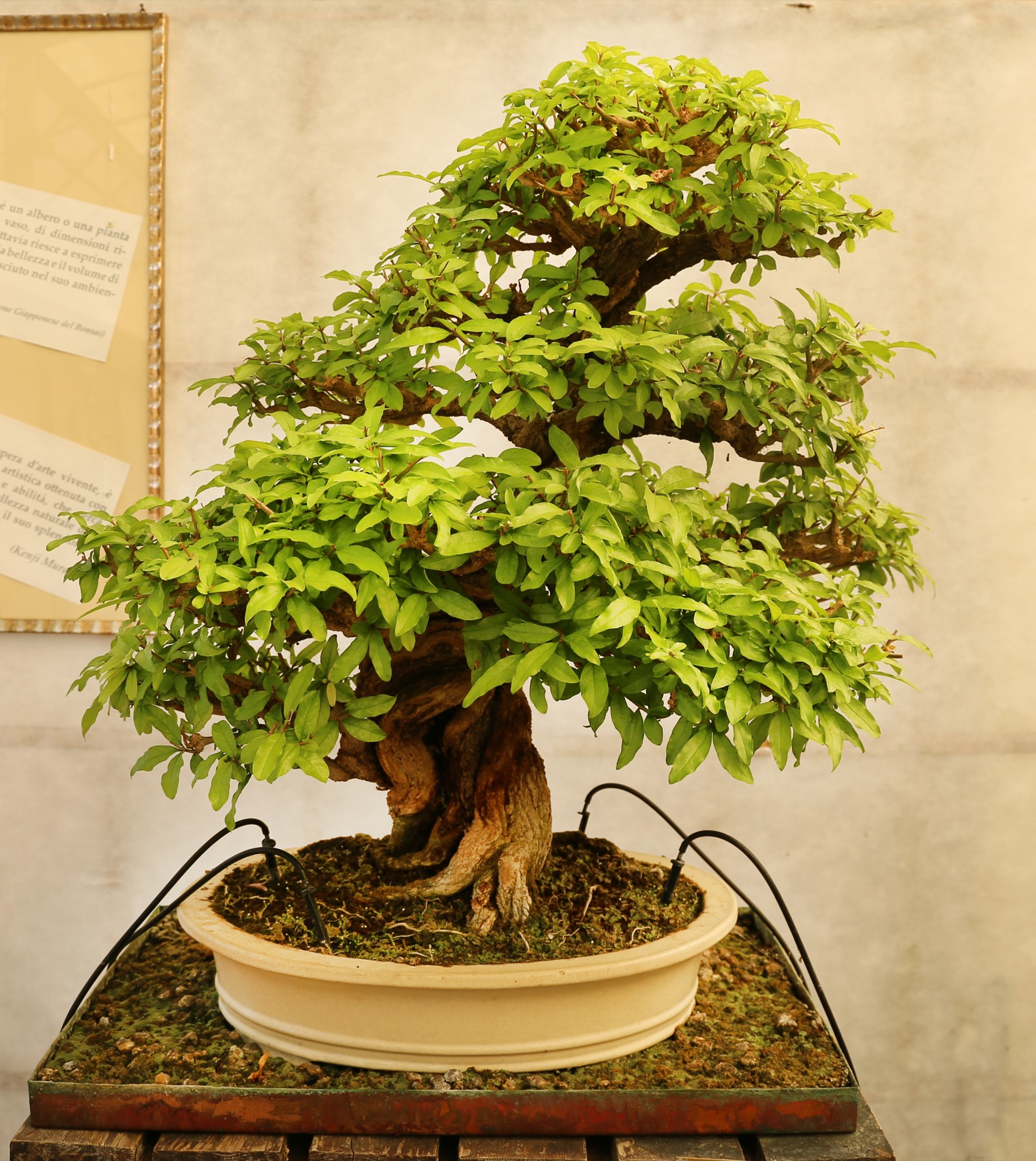
At the Bonsai Museum in Pescia, Italy, a pomegranate bonsai stands with its trunk twisted and furrowed grey — the kind of bark most growers spend a lifetime waiting on a tree to produce. The museum's own record puts this one at roughly fifty years old, a span most pines would need three times over just to look that aged.
A pomegranate earns an old-looking trunk in a fraction of the years most species need, and still spends the rest of the year on something a twisted trunk alone cannot deliver: vermilion flowers that ripen, most years, into fruit heavy enough to split its own skin.
The trunk compresses decades other species need a lifetime for
Most bonsai trunks earn their character slowly. A pine can take the better part of a lifetime to grow bark rough and thick enough to read as old. The pomegranate does not wait that long: even a moderately trained specimen develops grey, furrowed, flaking bark, and the wood beneath tends to twist rather than run straight. One named variety, called nejikan (ねじ幹, "twisted trunk"), spirals conspicuously as it grows — a trait growers prize precisely because it lets a comparatively young tree carry the visual weight of a much older one. It is one reason the species turns up so often in moyogi (模様木, "informal upright") style, where the trunk's own movement is left to do the talking, as in the specimen above. Because the branches stay brittle even as the trunk ages, growers wire only the young, still-flexible shoots during the growing season and leave the older wood alone — the trunk is left to speak for itself.
Flower and fruit are bred as separate outcomes
Japanese growers split the species into two lines. An ornamental flowering line is bred for showy double or parti-coloured blooms in red, white, and yellow, and rarely sets fruit. The line trained for fruit keeps the plant's original single flower, a vivid vermilion-red that opens from early to midsummer, sometimes with a lighter second flush later in the season. What follows the flower is the real event: a round fruit that colours through autumn from green to orange to red, and on a well-set specimen ripens until the skin itself splits, exposing the packed red seed cluster inside. Growers ease off watering as the fruit colours, since a sudden soaking at that stage is one of the more common ways to crack it before its time. Dwarf cultivars bred small for mame (豆, "the smallest bonsai class, palm-sized") and shohin (小品, "small bonsai, up to about a hand's span") sizes flower reliably even as young plants, though they set fruit less consistently than the larger line — a trade familiar to anyone who has grown a species for its blossom and hoped for its fruit as well.
Its history in Japan runs almost as long as bonsai's own
Alongside princess persimmon, the pomegranate is one of the oldest standbys of mimono (実物, "fruiting bonsai") — the branch of Japanese bonsai grown less for a fixed silhouette than for a yearly cycle of bud, bloom, and fruit, as described in Not Only Pine. Native to a stretch of western and central Asia around present-day Iran and the Caucasus, it travelled the Silk Road for millennia before reaching Japan, arriving, by tradition, in the Heian period — one account puts the date as early as 923. It was grown at first mostly for ornament and for the medicinal use of its bark; only later did it become a familiar garden and bonsai subject. Japanese folk tradition also ties the fruit to Kishimojin, a guardian deity said in a well-known Buddhist legend to have been offered a pomegranate in place of a child — one of several threads that keep the species tied to Japanese life well beyond the bonsai bench.
The trunk and the fruit never compete for the same months
What makes the pomegranate worth choosing over another fruiting species is that its two events do not overlap. In winter, once the leaves have dropped, there is nothing left to look at but the bare structure: bark and grain that took only a few decades, rather than a century, to look genuinely old. Through the rest of the year, the same tree carries flower, then green fruit, then colour. Most bonsai ask a grower to pick which kind of patience to practice, an old trunk or a yearly event, because the two rarely finish arriving in the same tree at once. If you are choosing a fruiting species and want both, ask whether a candidate tree's trunk age and its fruiting calendar are competing for the same months or taking turns — with the pomegranate, they take turns, which is the real reason it has kept its place beside the persimmon among Japan's mimono.
One planting can outlast any single owner
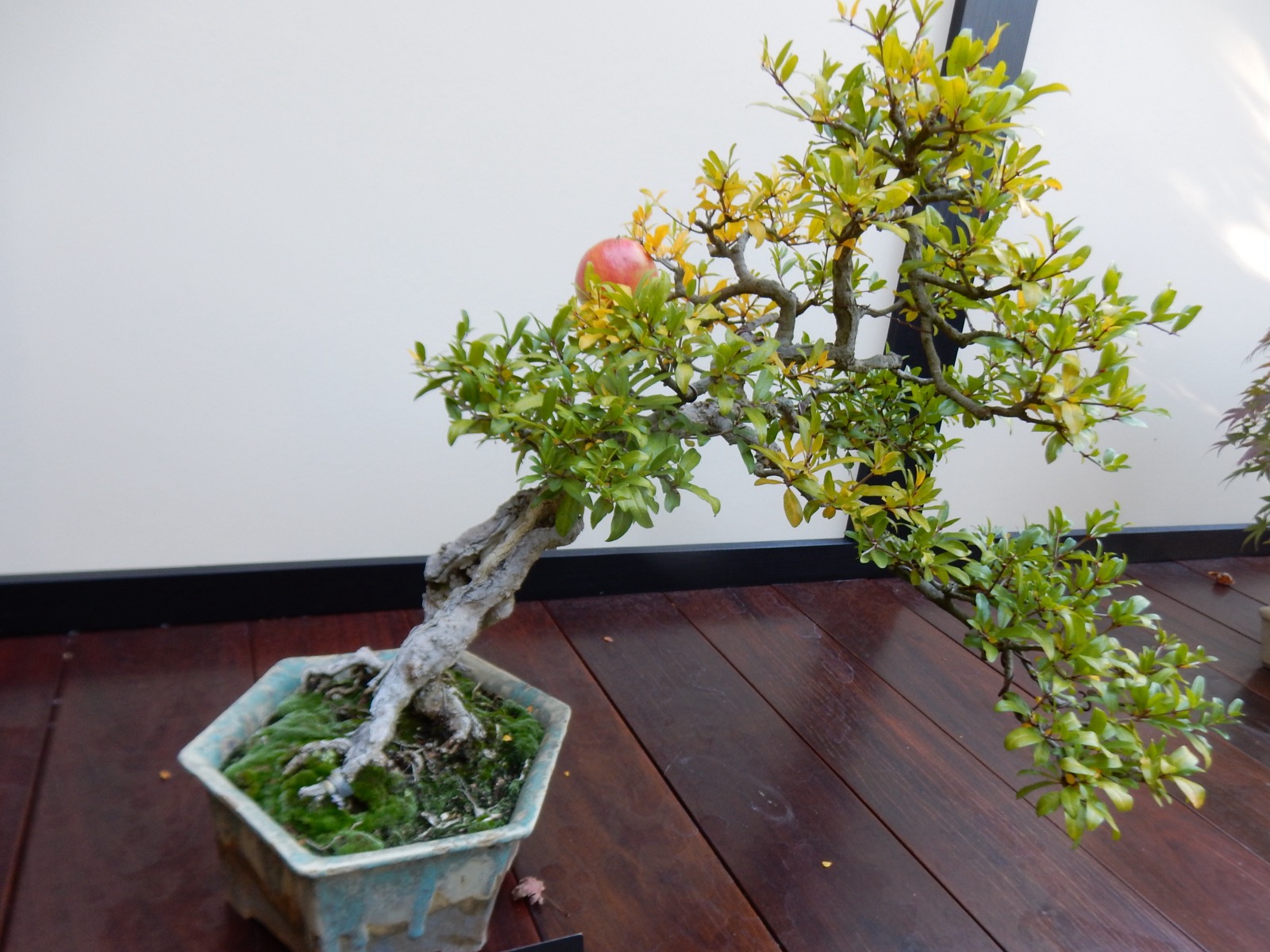
Photo by Shuvaev, CC BY-SA 4.0, via Wikimedia Commons — Source

Above, a fruiting specimen at Longwood Gardens in Pennsylvania has been under training, by the collection's own record, since 1910. That span is less about rarity than about what tending one of these trees actually looks like: the same small decisions, repeated every year on the same trunk — how much water to hold back as the fruit colours, which shoot is soft enough to wire this week and which is not. Azukari exists to carry that rhythm forward for an owner who cannot tend the pot themselves: the tree stays in Japan under an artist's hand, and what reaches its owner each year is the record of that rhythm — the same twisted trunk, taking on its vermilion flowers, and then its fruit. A pomegranate bonsai is not a finished object. It is a season, kept and repeated.
References
- Bonsai Empire — Pomegranate Bonsai (Punica granatum) Care Guide — on the nejikan twisted-trunk cultivar, the dwarf 'Nana' cultivar, and general species care.
- Bonsai4Me — Punica granatum / Pomegranate Bonsai — on the "Neji-kan" variety's spiralling trunk and branches, brittle wood, and styling and wiring notes.
- Bonsai Biyori — "Growing and Managing Pomegranate Bonsai" (盆栽ザクロの育て方と管理方法) — on the twisted trunk developing naturally with age and taking on an aged appearance, and on pruning and wiring practice.
- Wikipedia (Japanese) — Zakuro — on the species' native range in western and central Asia, its botanical name Punica granatum, and its introduction to Japan in the Heian period (one account dating it to the year 923).
- Uekipedia — "Zakuro" — on the name's etymology and the plant's association with the Kishimojin legend.
- Kimiko's Mini Bonsai Days — "The Appeal of Fruiting Pomegranate" (実ザクロの魅力) — on the vermilion-red single flowers of the fruiting line versus the double flowers of the ornamental line, and on fruit size and skin-cracking at ripeness.