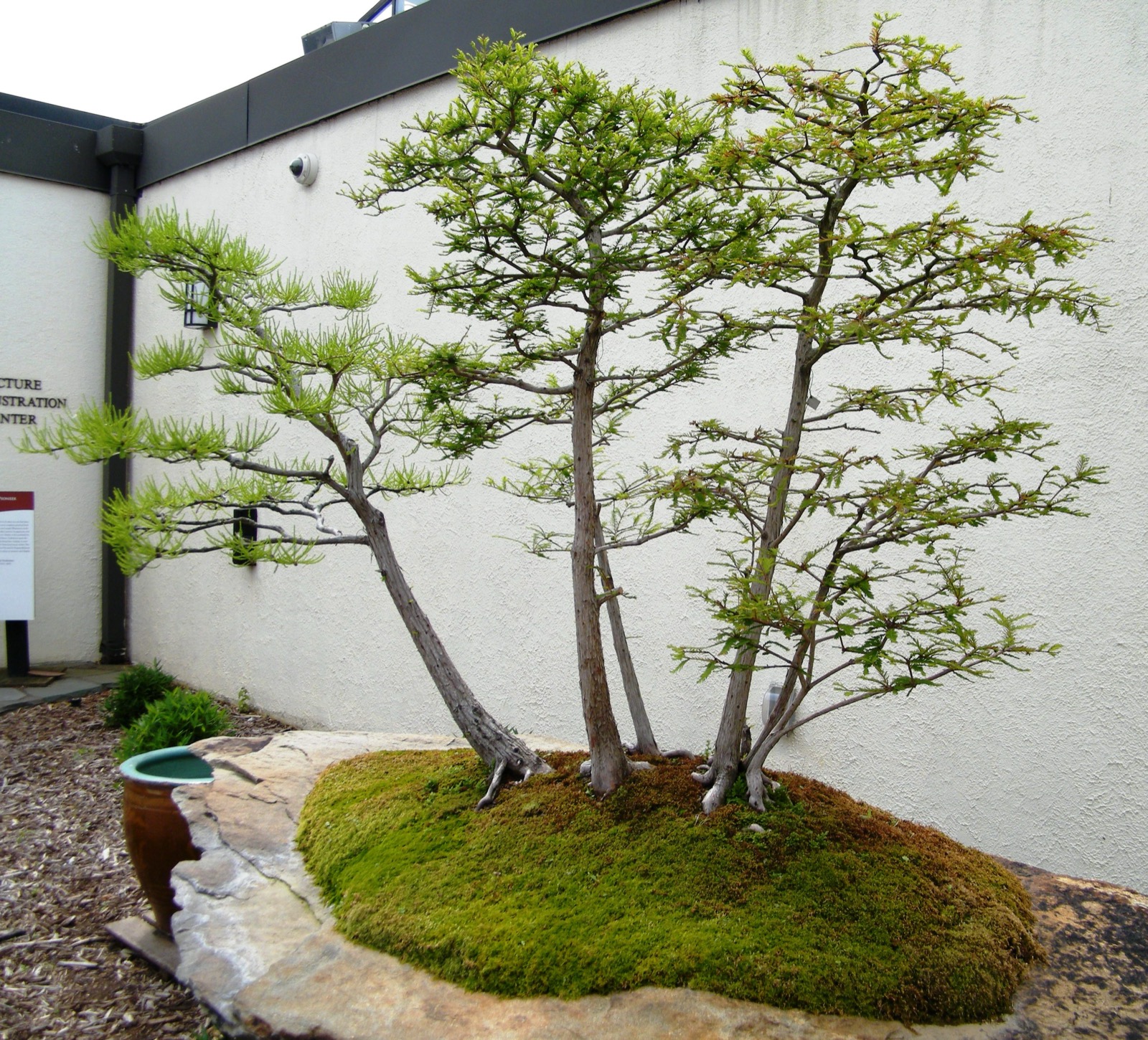
A bald cypress forest planting, in training since 1988, National Bonsai & Penjing Museum, U.S. National Arboretum. Photo: Sarah Stierch / Wikimedia Commons, CC BY 4.0.
Ask someone who has never trained a tree to picture a bonsai, and they will likely picture a pine, or a maple turning red in a shallow dish. Neither is wrong — both are central to the Japanese tradition. But neither is required. Around the world, a growing number of practitioners are shaping bonsai not from imported Japanese species but from whatever tree already grows outside their own door: olive in Spain, bald cypress in Louisiana, mesquite in Arizona, eucalypt in New South Wales.
Bonsai is a technique for reading and reducing a tree — not a fixed list of eligible species.
Why Pine and Maple Became the Default
It is worth remembering why pine and maple sit at the center of the Japanese tradition in the first place. Not because bonsai theory demands them, but because goyomatsu (五葉松, Japanese white pine), kuromatsu (黒松, black pine), and momiji (紅葉, maple) were the trees already standing in Japan's mountains and gardens when the practice matured over centuries. Artists worked with what they could collect, propagate, and observe close to home. The species came first; the reputation for suitability came after, earned tree by tree.
The same logic, applied anywhere else, points to different trees. A technique built to miniaturize a mountain pine does not stop working when the mountain in question is in California, Andalusia, or Queensland. What changes is only the material at hand.
A Collection Built the Same Way, an Ocean Away
The clearest institutional statement of this idea sits inside the National Bonsai & Penjing Museum at the U.S. National Arboretum in Washington, D.C. Alongside its Japanese and Chinese collections, the museum maintains a North American Collection of 63 trees, displayed in the John Y. Naka North American Pavilion — every one of them the work of an artist living in North America, and many of them native species: California juniper, bald cypress and pond cypress, coast live oak, coastal redwood, cedar elm.
The bald cypress pictured above belongs to that same regional tradition, on display at the museum's North American Pavilion and shown in training since the late 1980s. Taxodium distichum grows wild in the swamps and river bottoms of the American South, where repeated flooding and root exposure produce the fluted, buttressed trunk bases that bonsai artists elsewhere spend decades trying to simulate on other species. In its native habitat, the tree has already done half the design work.
From Olive Groves to Desert Washes
Beyond North America, the same shift is visible wherever bonsai has taken hold outside Japan.
In Spain and across the Mediterranean, growers reach for the olive, Olea europaea, a tree with its own multi-millennia cultivation history quite apart from bonsai. Spain alone cultivates more than two hundred olive varieties, and the small-leaved wild form, Olea europaea sylvestris, is prized by bonsai artists for its tiny foliage, short internodes, and naturally gnarled, weathered bark — qualities that in Japanese pine take generations to develop, and in old wild olive are often already present. The tree's association with the Mediterranean landscape and its climate suitability for growers there make it as native a bonsai subject as pine is to Japan.
Further inland, in the arid Southwest of the United States, bonsai clubs work mesquite, desert willow, palo verde, and other plants adapted to drought and heat rather than importing junipers unsuited to the climate. The Phoenix Bonsai Society, for instance, recommends established native material precisely because it tolerates the region's extremes — full sun, long dry spells, minimal care during travel — in ways that non-native stock cannot. In Florida, artists have turned toward buttonwood, slash pine, and strangler fig, species that already carry bonsai-appropriate architecture from growing wild in coastal winds and swamp margins; one regional study of the movement describes it as a shift "from traditional styles to designs from the American landscape."
In Australia, the same instinct produced a body of work built from eucalypts, melaleuca, and banksia — trees with no equivalent in the Japanese canon at all. A 2006 exhibition at the Australian National Botanic Gardens gathered dozens of such specimens, including windswept eucalypt plantings that one grower described as capturing the look of a tree "you'd see if you took a drive down the Murray or Murrumbidgee" — an Australian landscape, reduced to a container, using an Australian tree.
The Idea Travels; the Species Doesn't Have To
None of this is a departure from bonsai. It is closer to a return to its founding logic. As we have written elsewhere, almost any woody tree can, in principle, be trained as bonsai — the deciding factors are structure, leaf reduction, and the artist's patience, not nationality. And practitioners working outside Japan's climate zones face their own version of a much older problem, one we cover in more detail in Bonsai in Other Climates: the textbook written for Japan's four seasons does not always transfer, and local knowledge has to fill the gap.
There are practical reasons native species keep winning out, beyond sentiment. A tree already adapted to the local climate needs less coddling, survives winters and summers the artist cannot fully control, and is often available to collect or propagate nearby rather than imported at cost and risk. As Bonsai in America shows, American practitioners have built an entire regional tradition — collected junipers from the Rocky Mountains, bald cypress from southern wetlands — around exactly this principle: species chosen for what grows well close to home, not for a fixed catalogue of accepted forms.
Closing
Strip away the species name and the underlying discipline barely changes: read the trunk's line, choose a front, decide which branch stays and which is cut, restrain growth into something smaller than the tree's instinct. That discipline was worked out in Japan on pine and maple because that is what stood nearby. It travels intact to an olive grove, a Louisiana swamp, or a stand of eucalypt beside an Australian river, because it was never really about the species. It was about the way of looking.
At Azukari, the trees under long-term care happen to be the Japanese species — pine, juniper, maple — that this tradition standardized around after centuries of practice in Japan's own climate and mountains. That is simply where those particular techniques reached their deepest expression, and where the artists who still practice them at that level are based. The same logic that lets a Floridian train buttonwood or a Spaniard train olive is the reason a tree grown from Japanese pine, under a Japanese artist's care, still has something worth staying connected to from anywhere else in the world.
References
- National Bonsai Foundation — Collections — the North American Collection's 63 trees, the John Y. Naka Pavilion, and the native species represented, including bald cypress, California juniper, and coast live oak.
- Bonsai Empire — Olive (Olea europaea) species guide — the olive's Mediterranean native range, its long cultivation history, and the small-leaved wild variety prized for bonsai.
- Phoenix Bonsai Society — Desert Bonsai FAQ — the society's use of desert-native species such as mesquite and desert willow, and their climate hardiness.
- Bonsai Mirai — "Florida, a Regional Study" — on Florida's native tree diversity and the shift toward native species such as buttonwood and slash pine in regional bonsai practice.
- Australian National Botanic Gardens — Australian Native Plants as Bonsai (2006) — an exhibition catalogue of native Australian bonsai, including eucalypt and melaleuca specimens.
- Wikimedia Commons — Bald Cypress, National Bonsai & Penjing Museum — photograph of the bald cypress forest planting, in training since 1988, donated by Jim Fritchey and Dick Wild.
