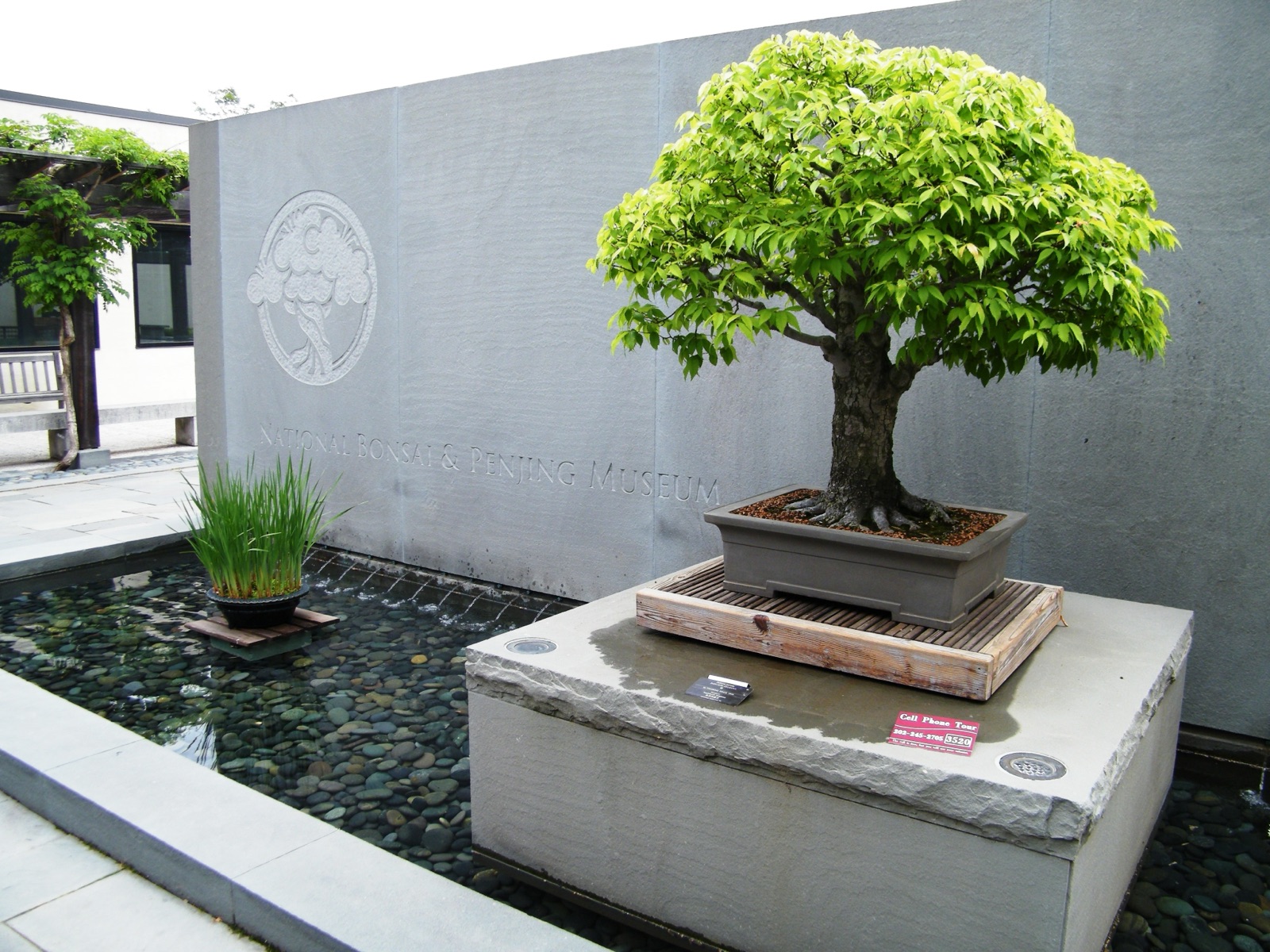
Photo by Sarah Stierch, CC BY 4.0, via Wikimedia Commons — Source

Bonsai (盆栽, "the art of cultivating miniature potted trees") reached the United States long before most Americans could name it. It arrived with Japanese immigrants in the early twentieth century, spread through returning servicemen after the Pacific War, and eventually settled into something the country built its own institutions around: a national museum on federal land, a pine that carries one of the twentieth century's darker histories, and a nationwide lattice of volunteer clubs that has kept the practice alive for more than sixty years. None of it is a copy of the Japanese original. It is a parallel tradition that grew its own roots.
A national collection in the capital
A short drive from downtown Washington, DC, the National Bonsai & Penjing Museum sits inside the grounds of the US National Arboretum, a federal research and display garden run by the Department of Agriculture. Its origin is a piece of diplomatic history as much as a horticultural one: in 1976, the Nippon Bonsai Association presented 53 trees and seven viewing stones to the American people to mark the country's bicentennial, a gift described at the time as a "Green Mission for Peace." A handful of trees in the museum's adjoining Chinese collection reach back further still, descended from penjing (盆景, the related Chinese tradition of miniature landscape planting) given to President Nixon after his 1972 visit to China. The collection has grown since with donations from North American artists, and more than 300 specimens now rotate through three pavilions and a special exhibits gallery. Admission is free, which is unusual among the world's dedicated bonsai institutions and has made the museum a genuine point of entry for visitors who arrive with no prior interest in the art. We covered it, alongside other major collections outside Japan, in our guide to bonsai museums around the world.
The pine that survived Hiroshima
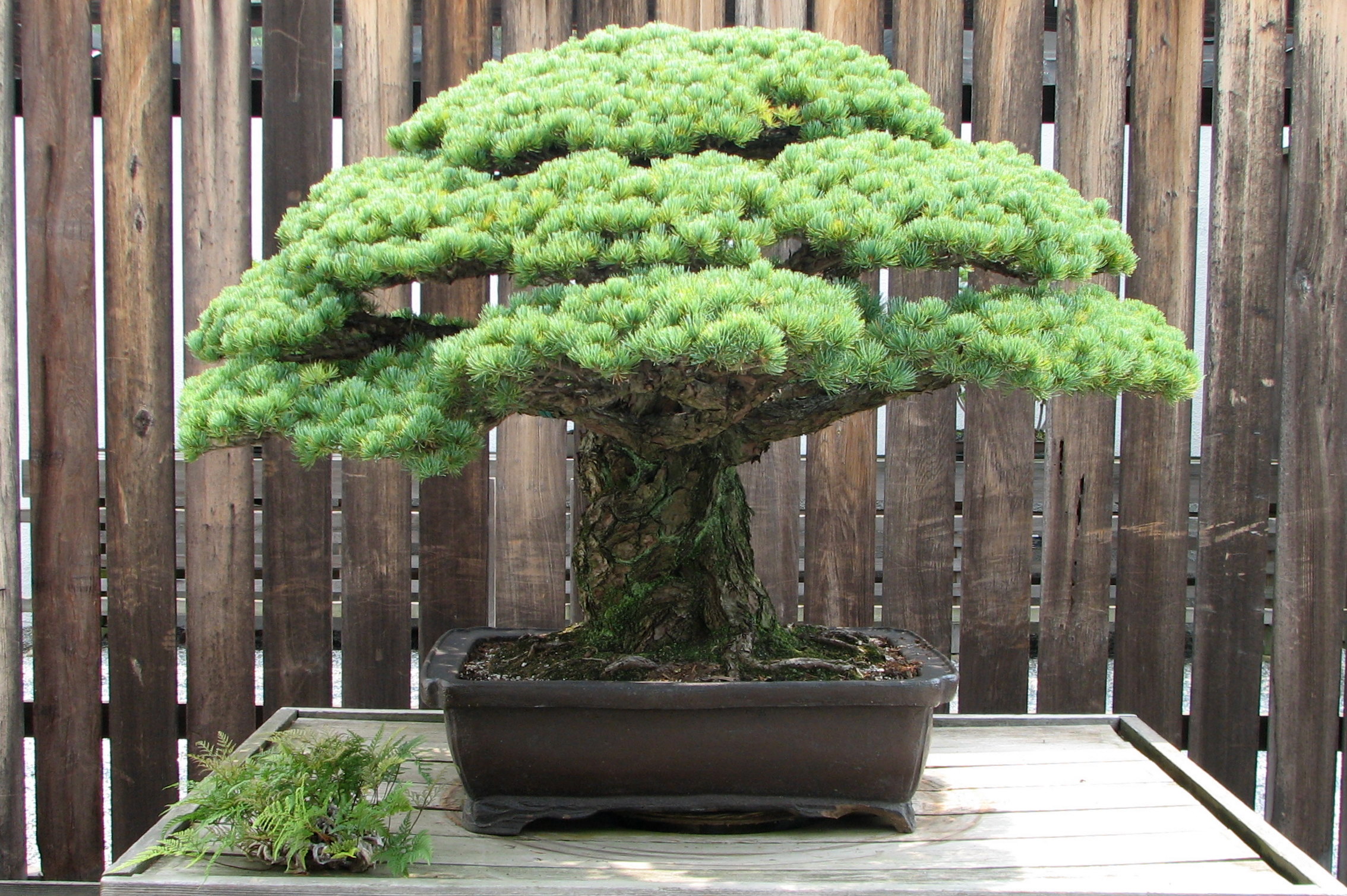
Photo by Ragesoss, CC BY-SA 3.0, via Wikimedia Commons — Source

Among the 1976 bicentennial gift is a Japanese white pine that has been in training since 1625 — nearly four centuries under cultivation by the time it reached American soil. For five generations, the tree was raised by the Yamaki family of Hiroshima. It was standing behind a garden wall on the family's property in 1945, and the wall is credited with shielding it when the city was bombed. Masaru Yamaki donated the tree in 1976 without disclosing that history, and it was not until 2001, when two of his grandsons visited the museum and recognized the tree, that its full story became known there. It now stands as one of the museum's most visited specimens, and one of the clearest illustrations of how far a single tree's documented history can reach. We wrote more about what a tree's long custody actually represents in our piece on why some bonsai live for centuries; the same tree's arrival in the United States, and what it took to bring a living plant across a border at all, is the subject of our article on plant quarantine.
A culture built on clubs
Japan's bonsai world is organized largely around nurseries — a small number of professional gardens, each training its own apprentices across years of live-in study. America built something structurally different: a network of volunteer societies. The American Bonsai Society, founded in 1967, describes its own purpose as developing styling techniques suited to North American species and serving as a source of information and mentorship for individual enthusiasts across the United States, Canada, and Mexico. Bonsai Clubs International, founded in 1960 and based in Illinois, has pursued a similar mission on a wider stage, connecting members across dozens of countries through a magazine, conventions, and an affiliated-club directory. Beneath both sit dozens of local clubs, in cities with no particular bonsai history at all, where members meet in library basements and botanical garden classrooms to trade cuttings, critique each other's trees, and pass on technique the way a hobbyist community does — through repetition and shared enthusiasm rather than formal lineage.
A different way of growing
That club structure has shaped what American bonsai actually looks like. Without a small number of nurseries setting the standard, style has diversified faster and along different lines than in Japan. American practitioners work pine and juniper as their Japanese counterparts do, but also collected junipers from the Rocky Mountains, bald cypress from southern wetlands, and other native trees that have no equivalent tradition in Japan at all — species chosen for what grows well regionally rather than for a fixed catalogue of accepted forms. Entry into the art runs through a weekend workshop or a club meeting rather than a multi-year apprenticeship, which has made it accessible to people who would never have had the chance to train under a Japanese master, at the cost of a hierarchy of some of that master's discipline. Neither approach is more legitimate than the other. They answer to different histories and different available time.
Closing
A tree in a Washington museum, a tree that outlived a bombing, and a hobbyist club meeting in a library on a Tuesday evening are not obviously the same tradition. But each rests on the same basic fact: someone kept returning to water, wire, and watch a particular pot, year after year, long enough for the tree to become something more than a plant. That discipline does not require a Japanese address to practice, and it never has.
Azukari works from the other direction — the tree itself stays in Japan, under a Japanese artist's daily care, while its owner joins that care from wherever they live through seasonal records. For an American enthusiast already tending trees of their own, it is one more way to stay connected to where the art form's oldest trees, and its oldest techniques, are still being kept.
References
- National Bonsai & Penjing Museum — US National Arboretum — official page on the museum's collection, history, and hours.
- National Bonsai Foundation — The Museum — history of the 1976 bicentennial gift and the museum's growth since.
- National Bonsai Foundation — Yamaki Pine — the Yamaki family's cultivation of the pine, its survival of the 1945 bombing, and its 1976 donation.
- Smithsonian Magazine — "The Bonsai Tree That Survived the Bombing of Hiroshima" — reporting on the tree's history and its 2001 identification by Yamaki's grandsons.
- American Bonsai Society — About Us — the society's 1967 founding and its stated mission.
- Bonsai Clubs International — the organization's 1960 founding, international membership, and club directory.