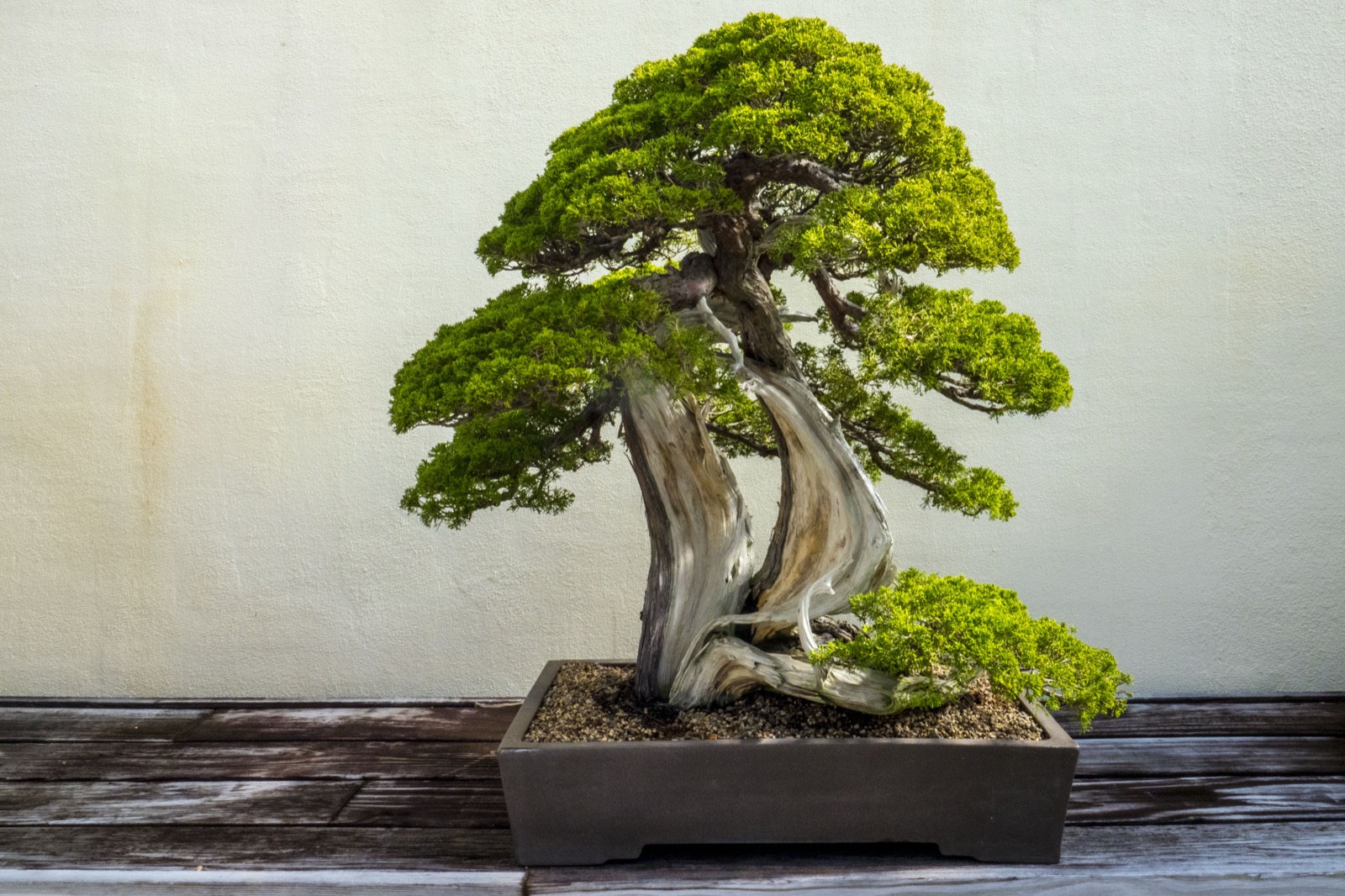
U.S. Department of Agriculture photo, 2018 Agricultural Outlook Forum tour of the U.S. National Arboretum — public domain (U.S. government work).
Most of what is written about bonsai care assumes a particular place: Japan, with its four distinct seasons, its defined winter cold, and its moderate, if humid, summer. A grower in the Arizona desert or the Florida subtropics can follow that advice to the letter and still watch a tree decline, because the advice was never written with their climate in mind. Bonsai as a discipline traveled out of Japan generations ago. The instructions did too, but they did not always survive the trip intact.
The techniques bonsai was built on assume Japan's climate — growers elsewhere have had to adapt species, watering, and even the calendar itself to their own conditions.
Where the Japanese textbook stops applying
Most of the trees at the center of Japanese bonsai — pine, maple, juniper, elm — are temperate species with a genuine dormancy requirement. According to bonsai grower Harry Harrington's widely cited winter-care guide, hardy species need continuous temperatures below 10°C for somewhere between 260 and 1,000 hours, depending on the species, before they can resume normal growth in spring. Skip that cold period, and a tree does not simply keep growing happily; deprived of dormancy, it may push growth out of season for a year or two and then decline into a genuinely sick tree. That single biological fact is the quiet assumption behind almost every seasonal instruction in a standard bonsai guide — repot before the buds swell, bring the tree outdoors for winter, never keep it on a windowsill indoors. All of it presumes a winter cold enough, and long enough, to trigger dormancy in the first place. Take the tree somewhere that winter barely exists, or somewhere it exists in a form Japan's mild, humid pattern never produces, and the calendar built around it stops giving useful answers.
Where dry heat rewrites the rules
Few regions illustrate the gap better than the American Southwest. The Phoenix Bonsai Society's own guidance for members opens by calling Arizona "probably the most challenging location in which any of us will attempt to raise bonsai," citing summer highs near 115°F alongside winter nights that can drop to 20°F. Classic Japanese material struggles there: junipers, a foundation species of the art in Japan, are reported to fail locally with some regularity even under attentive care, undone by the intensity of the desert sun and the speed at which a small pot dries out. Growers in the region have responded less by fighting the climate and more by working with what already thrives in it — mesquite, desert willow, sweet acacia, and Bursera species pulled from the same landscape the trees already grow wild in, alongside afternoon shade cloth for anything not fully adapted to unfiltered desert sun. On watering, the Society's advice drops the idea of a schedule entirely: water "whenever each tree needs to be watered, no sooner and no later," since a fixed interval that works in a humid climate can either drown or starve a tree in a dry one.
Where humidity replaces winter
Florida runs the opposite problem. Winters there rarely deliver the sustained cold that pine, maple, or juniper require, so growers who insist on those species are fighting a losing, permanent battle against a dormancy that will never fully arrive. A regional study by the training program Bonsai Mirai notes that Florida also happens to hold an unusual concentration of native tree diversity — more than half of all native tree species found in the United States grow somewhere within the state — which has pushed local practice toward material suited to a climate with no true winter: ficus, buttonwood, bougainvillea, and jaboticaba among them, species that grow in cycles rather than a single seasonal push and pause. Bonsai Empire's climate guide makes the general case plainly: tropical and subtropical species can tolerate an indoor life in a way temperate ones cannot, but they demand humidity that most homes and even most greenhouses in temperate countries don't supply. The variable that decides success in Florida is not cold tolerance but moisture — bright, filtered light and consistently damp air rather than seasonal dormancy at all.
Knowledge that had to be built locally
None of this adaptation came from a manual. It came from decades of individual growers losing trees, comparing notes, and slowly building a body of regional knowledge that Japan's own literature never had reason to cover. Desert societies in the American Southwest and tropical clubs in Florida each arrived, independently, at their own working answers to problems Japanese growers never had to solve, because Japanese growers never needed to. That knowledge now lives in club newsletters, regional workshops, and forum threads rather than in any single authoritative text — a second, distributed body of bonsai expertise sitting alongside the original one, built for climates the original was never asked to cover.
The part that still travels
What does carry across every climate is the underlying logic, even when the specific answers change. Watch the individual tree rather than a fixed calendar — a principle we cover in more depth in how often a bonsai actually needs watering. Get the placement right before worrying about technique, since where a tree sits decides more about its health than any amount of pruning or wiring — the subject of our piece on placement. And choose a species suited to where the tree will actually live, an idea we explore further in our article on bonsai grown from native trees. Japan's bonsai tradition produced the discipline. It did not have to produce every answer for every place that discipline eventually reached.
Closing
Japan's climate and its bonsai technique were never separate things — one grew out of the other, over centuries, in the same place. That is part of what a tree still being trained in Japan continues to offer: a fit between species, season, and method that took that long to settle into place, and that a desert or a subtropical garden has to work much harder, and much more recently, to approximate.
Azukari keeps a tree inside that original fit — cared for in Japan, by a Japanese artist, in the climate its technique was actually built for — while its owner follows along from wherever they live through seasonal records. For a grower already adapting bonsai to a harder climate at home, it is a way to also keep one tree in the conditions the art form assumes.
References
- Bonsai Empire — "Bonsai for Specific Climates" — overview of how care requirements differ across temperate, Mediterranean, tropical/subtropical, and arid climates.
- Bonsai4Me — "Winter Care For Bonsai" — Harry Harrington's guide to dormancy requirements, chilling-hour ranges, and the risks of year-round indoor growth for temperate species.
- Phoenix Bonsai Society — "Desert Bonsai FAQ" — member guidance on growing bonsai in the Arizona desert, including temperature extremes, species selection, and watering practice.
- Bonsai Mirai — "Florida, a Regional Study" — a regional study of Florida's native tree diversity and its influence on local bonsai species selection and design.