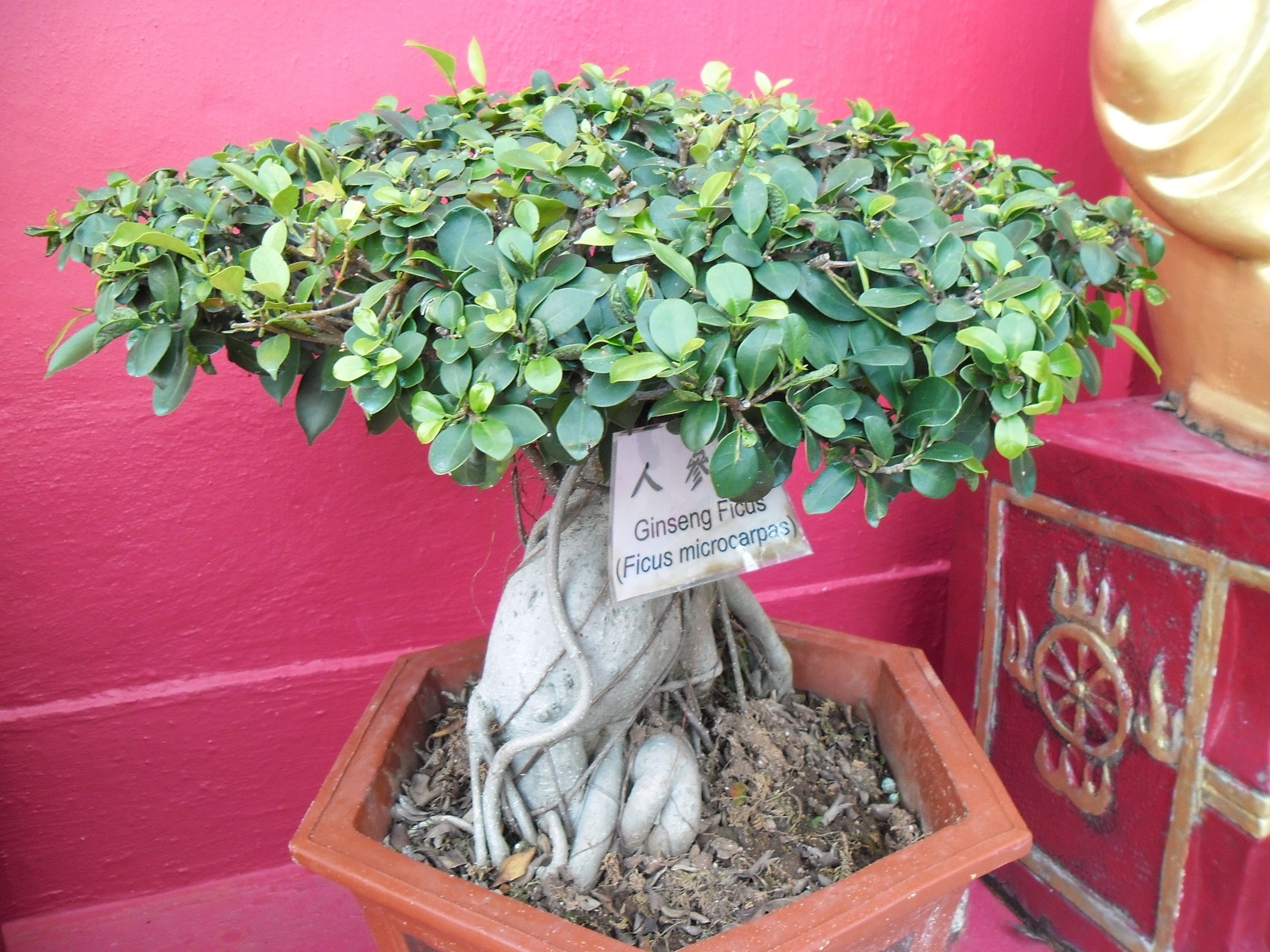
A Ficus microcarpa 'Ginseng' bonsai, its swollen aerial roots rising above the soil — a species with no place in the historical Japanese canon, and a fully legitimate bonsai all the same. Photo by Earth100, CC BY-SA 3.0, via Wikimedia Commons — Source

In principle, yes. Almost any perennial tree or shrub with a woody stem and true branches can be trained as bonsai. What actually separates an easy first tree from a difficult one is not the species' name but three underlying traits: a permanent woody structure that pot confinement and root pruning won't kill, a habit of pushing new buds after a hard cut, and foliage that shrinks under restraint instead of simply refusing to.
The requirement is structural, not ceremonial
Bonsai has no approved species list. As the general definition puts it, bonsai can be made from nearly any perennial, woody-stemmed tree or shrub species that produces true branches and can be kept small through pot confinement, crown pruning, and root pruning. Pine and maple are not requirements written into the technique; they are simply the trees that happened to grow in the mountains and gardens where the technique was refined over centuries, a point covered in more depth in Bonsai from Native Trees. Judged purely on structural terms, a quince, an oak, an olive, and a fig all qualify on the same footing a pine does.
Back-budding decides how forgiving a species is
The trait that most changes how a tree can be worked is back-budding — whether a species pushes fresh growth from bare, older wood after being cut back hard, or only extends from buds already near the branch tips. Elms, maples, ficus, cotoneaster, privet, and many junipers back-bud freely, which means a grower can cut a branch back into old wood and reasonably expect a new shoot to appear where none was visible before — a safety net that makes early mistakes recoverable. Pines are the well-known exception: most pines do not back-bud reliably, so a branch cut back too far can leave a permanent gap rather than a new shoot. Japanese black pine is worked around this through decandling — removing the new spring shoots so a second, shorter flush regrows in their place — a targeted technique rather than the tree's own habit.
Leaves are reduced, not naturally tiny
Foliage size is treated the same way. Most deciduous species can be defoliated — stripped of their leaves at the right point in the growing season — which pushes the tree to regrow a second set of smaller leaves and finer branching in their place, a routine technique for maple and elm through early summer. Conifers use a parallel trick: the decandling that manages a pine's back-budding also shortens its needles, and a species like Zuisho, a dwarf white pine cultivar, shows how far leaf size can already run within a single species before any technique is applied at all — a variation we look at closely in Hasei: Reading Leaf Quality. None of this means every tree arrives small. It means smallness is mostly manufactured, one growing season at a time, on a structure built to allow it.
Where the line actually falls
The exceptions are narrower than most people expect, and they are structural rather than aesthetic. True palms — coconut, date, areca, and their relatives — are monocots with a single growth point at the crown and no secondary wood-forming layer, so they cannot branch, cannot be shaped by pruning, and generally die outright if that one growing tip is damaged. Their thick root mass also resists the confinement bonsai depends on. Growers who want the look substitute ponytail palm or sago palm, neither a true palm botanically, both genuinely trainable as bonsai. Annuals fail for a simpler reason: bonsai measures its results in years and decades, and a plant with no perennial structure to return to each spring has nothing for the technique to work on.
The rest is patience, not eligibility
Outside that narrow structural boundary, "will this work as bonsai" is mostly a question of how long a grower is willing to wait and how forgiving the species is while they learn. A tree that back-buds freely and reduces its leaves easily rewards early mistakes; one that doesn't demands a plan made years in advance and rarely offers a second chance on a badly placed cut. This is exactly why so many practitioners outside Japan build a first tree, and often a lifelong collection, from whatever grows well close to home — a shift covered at length in Bonsai from Native Trees.
At Azukari, the trees under long-term care happen to be pine, juniper, and maple — not because the technique requires them, but because those are the species several centuries of Japanese practice worked hardest to refine, and where an artist's hand still shows most clearly today.
References
- Wikipedia — "Bonsai" — on the general definition of eligible bonsai material as nearly any perennial, woody-stemmed tree or shrub species that produces true branches and can be kept small through pot confinement, crown, and root pruning.
- San Diego Bonsai Club — "Back-Budding" — on which species back-bud freely (elm, maple, juniper, ficus, cotoneaster, privet) versus poorly (pine), and on decandling as the technique used to induce back-budding on Japanese black pine.
- Bonsai Empire — "Bonsai Defoliation" — on defoliation as a technique to reduce leaf size and increase ramification, most commonly used on deciduous species in early summer.
- Bonsai Resource Center — "Bonsai Palm Tree Grower's Guide" — on why true palms lack the branching and root tolerance bonsai requires, and on ponytail palm and sago palm as workable substitutes.
- All Things Bonsai — "Can Any Tree Be a Bonsai Tree?" — on small leaf size and back-budding as the traits that make a species easier or harder to train, without ruling any species out entirely.