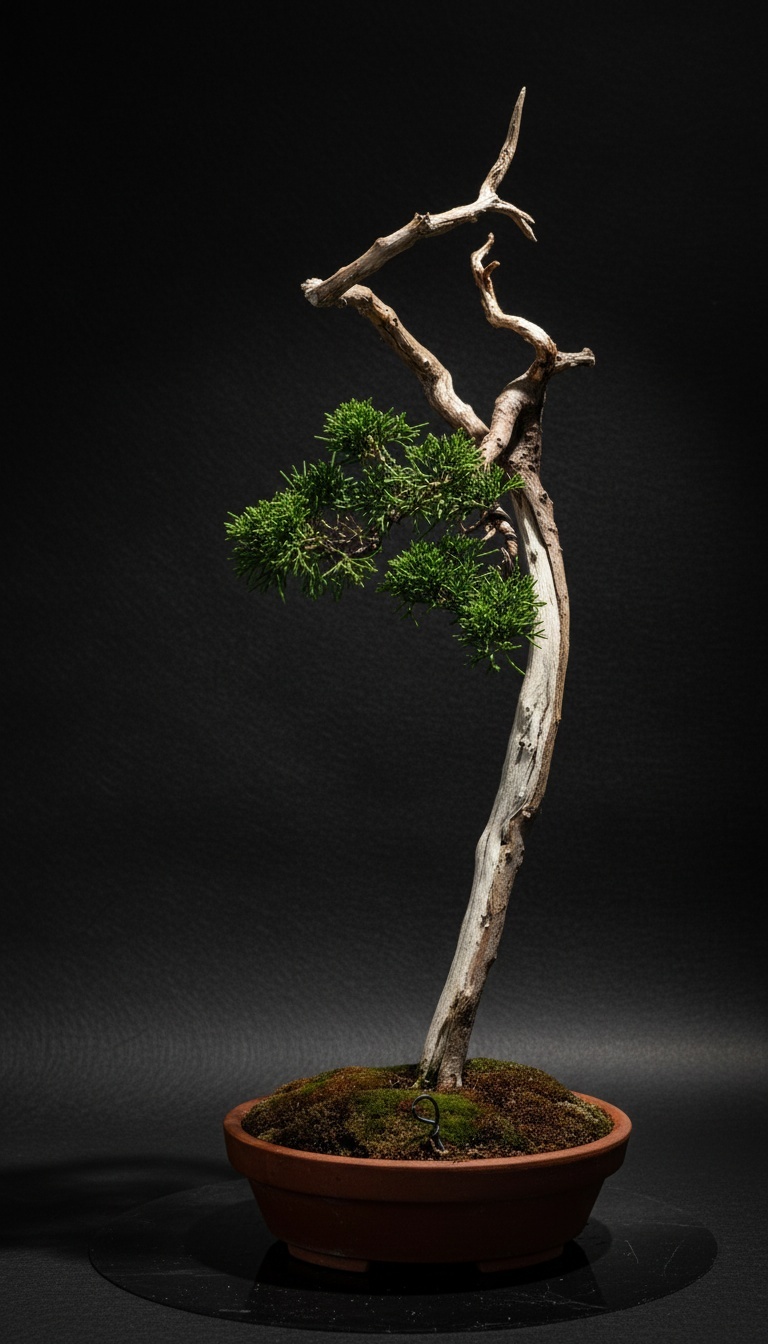
Shimpaku juniper. Conifers like this one are notorious for showing almost nothing on the surface once the roots beneath them have already failed.
Scratch a strip of bark off a low branch, and a bonsai will tell you in seconds whether it is still alive: moist green tissue underneath means yes, dry brown tissue means no. Growers are taught to trust this test over the needles above it, because a shimpaku juniper or black pine can hold its color for weeks after the roots beneath it have already rotted away. Most people who take up bonsai learn to do this the hard way — reaching for a fingernail only after an earlier tree has already been lost, its leaves still green days after its roots gave out.
Almost everyone who takes up bonsai kills a tree within the first few years, and the tree that is lost usually teaches more than any of the trees that live.
Ask a grower who has kept trees for a decade how they started, and this loss tends to come up on its own, told less like a confession than a rite of passage. The instructional books rarely mention it, since they are written to explain what should happen rather than what usually does.
Three in four new bonsai die within their first month
Bonsai Empire, one of the most widely used English-language bonsai resources, estimates that more than three in four newly bought bonsai die within their first month in a new home. The site is careful to call this an estimate drawn from years of reader questions rather than a formal count, but the pattern behind it shows up across bonsai forums and care guides regardless of the exact figure: a new owner treats a bonsai the way they would treat an ordinary houseplant, and loses it within weeks. The mistake is almost never dramatic. It is nearly always watering, done slightly wrong, for long enough that the tree cannot recover.
Root rot and dehydration start the same way and end differently
There is an old saying among bonsai growers in Japan, mizuyari sannen (水やり三年, "three years for watering"): that mastering the simple act of watering takes roughly three years of daily practice. We have written elsewhere about what that mastery actually involves — reading soil, leaves, and season together rather than following a fixed schedule. What gets said less often is how most growers arrive at year one of those three: by getting it wrong first.
Japanese bonsai vocabulary keeps separate words for the two ways watering usually fails. Mizugire (水切れ, "running out of water") is a tree that has simply dried out, its finest roots dying of thirst. Negusare (根腐れ, "root rot") is the opposite failure, and often begins the same way: soil kept wet for too long drives air out from around the roots, and the fine roots die and begin to rot from below, well before anything above the soil shows it. Broadleaf trees tend to announce even a mild case of mizugire quickly, their leaf tips wilting or browning within a day or two. Pines and junipers offer no such warning, which is exactly why the scratch test above exists: a grower who has never lost a tree to this kind of quiet failure tends to trust the foliage anyway, simply because nothing has yet taught them not to. A grower who has lost one checks the bark.
Only a lost tree makes the rule stick
Books and care guides can describe all of this in the abstract: the schedule, the scratch test, the difference between a tree resting and a tree gone. What they cannot supply is the specific memory of having gotten it wrong — the particular shade a given species turns just before it is too late, roughly how many days a certain pot size can go before the soil truly dries out, the give of a small root that should have bent instead of the snap of one that broke. Growers who have lost a tree tend to describe watching their surviving ones differently afterward: pressing a finger into the soil rather than trusting its surface color, catching a slight change in leaf sheen a week earlier than they once would have. Learning to read a tree well seems to depend less on knowing the rules than on having once broken one badly enough to remember it. Daily pest and disease checks work on the same logic: a grower who has already lost one tree to something they missed tends to look a little closer at every tree afterward, not only the one that was lost.
The mistake itself is completely ordinary
This is also where bonsai parts ways with most other quiet, patient crafts. A woodworker who ruins a joint can recut it. A potter who misjudges a glaze can fire the piece again. A bonsai grower who misjudges a watering schedule can lose, within a matter of weeks, a tree that had spent decades, sometimes longer than a human lifetime, becoming what it was before it ever reached them. That kind of small, ordinary mistake could happen to anyone. Living material simply does not forgive it the way wood or clay does.
The apprentice starts on cuttings so the mistake costs a season, not a lifetime
None of this makes bonsai unusual among Japanese crafts that ask for years of unglamorous repetition before real skill arrives. What is unusual is that bonsai's material can simply die while the student is still learning, taking irreplaceable years of another season's growth down with it. That fact has long shaped who is trusted with the oldest, most established trees. An apprentice does not begin on a fifty-year-old shimpaku. They begin on cuttings and ordinary nursery stock, precisely so the tree lost to an early mistake costs a season rather than a lifetime, and the artist eventually trusted with an old tree is one who has already made, and survived, those early mistakes on lesser ones.
Azukari places the daily watering with someone who has already lost a tree
Azukari rests on the same logic, extended outward. A tree's daily watering, in Japan, stays with an artist who has already been through mizuyari sannen and the losses that came with it, so an owner living at a distance is not the one deciding, each morning, whether the soil looks dry enough to worry about. The owner still carries the part of this that cannot be handed to anyone else — the simple fact of a tree mattering to them. What moves to someone else's hands is the daily, technical judgment behind watering itself: the scratch test, the read of a leaf, the years it took to trust either one. It is placed with someone whose judgment has already been tested, once, against trees they could still afford to lose.
References
- Bonsai Empire — "Help! My Bonsai is dying!" — the estimate that more than three-quarters of newly bought bonsai die within their first month, and the distinction between overwatering and underwatering as causes.
- Bonsai Empire — "7 Bonsai mistakes to avoid" — on watering as the most common cause of a beginner's bonsai dying, among other frequent mistakes.
- Miyagi Bonsai — "Is my Bonsai Dead or Dormant? Signs, Tests & What to Do Next" — the scratch test for checking whether the cambium beneath the bark is still alive.
- Kotobank — 「水切れ」 — dictionary definition of mizugire (from the Bonsai Glossary, Kindai Shuppan), including the note that broadleaf species show wilting quickly while pines and conifers are harder to judge.
- Bonsai Myo — 「根腐れ」 — glossary entry on negusare (root rot), its typical causes, and the damage it does to a tree's vigor.
- The Shikoku Shimbun — "Mizuyari" (BONSAI glossary) — on the saying that mastering bonsai watering takes roughly three years.